Old Fiji
p. 53 · Read in the full issue
Turtle Fishing in Old Fiji
By Lex Holliday
SOME time ago when I accompanied some Fijians on a reef-fishing expe dition, one of the party deftly speared a turtle that crossed his path, swam to the surface, casually tossed it onto its back in the bow of the boat, and dived back to the reefs in search of further sport.
I was, therefore, more than interested recently to come across an old docu ment purporting to be a translation from a statement made by an aged Fijian, concerning the lengthy ritual ac companying turtle fishing many, many years ago. The ceremonies described by him were practised by fishermen in the province of Bua.
Evidently, in the days before the white man came to Fiji, turtle fishing cere monial was a highly skilled and compli cated affair with a host of associated feasts and tabus.
Firstly, the conference: The decision to fish for Turtle could be reached only in conference especially called for the occasion. Once decided upon a date was fixed for the initial function of making the nets.
At the appointed hour, green coconuts would be collected, their fibres stripped and roasted and, after three days’ air ing, beaten to sufficient softness to en able plaiting and weaving to commence.
It was believed that disagreements or quarrels between tribes during initial dis cussions would hamper the success of the expedition and chiefs therefore exhorted their subjects to refrain from argument or unpleasantness of any description.
When the nets were completed, a special day would be chosen for immer sion—a signal for further feasting—fol lowed by the more practical task of visi ting relatives’ graves en masse, weeding them and laying clean drapes of tapa cloth over the earth in order to solicit friendly co-operation from departed spirits. The success of the new nets would thus be assured.
Lots had to be drawn to decide which team would have the honour of catching the first turtle, and so a further feast was held after which fishing commenced.
The moment a catch was made, the rep tiles would be brought ashore for the concluding feast of this initial stage of the performance, called “feast for the first fruits of the net.” After which the nelj would be taken ashore, carefully dried, wrapped in coconut leaves and stored in safe keeping awaiting the vil
lage chief’s order to go turtle fishing in a big way.
BY now, no doubt feeling it incumbent upon him to exert authority, the chief of the entire tribe would order the real business to begin. His command took the tangible form of several whales’ teeth sent by messenger as a gift to the village chief concerned. This gentle man would then perform several rites and exhortations finally issuing a war-like command to his men to “Go! Catch Turtle!” But before carrying out these terse instructions time was somehow found for one more ceremonial feast . . . a kind of last minute insurance that success would be the lot of the expedi tion.
Before any other members of the tribe could commence fishing the chief fisher man, or Tunidau, had to catch one turtle single-handed: no one helped him handle the net, polling the canoe being the only assistance given.
This catch made, a flag would be hoisted, the crew returning to shore where Tunidau was painted red from head to foot and left to sleep all night in the open air alongside the Turtle.
Following the presentation of several whale’s teeth to the Tunidau and his crew, the way would then be clear for the remaining fishermen, selected for the task, to participate in the catch.
Once each canoe had caught nine turtles, the chief would order the crews to sea again, on a favourable day, to catch the tenth. Woe betide the crew which returned without its tenth turtle for one of its members would be killed as a substitute. Needless to say, fish ing was very keen on this particular day.
Feasting would now begin in earnest, and during it fishermen from the coastal villages would decide on a day for the presentation of turtles to their tribal chief.
As the time for this big event drew near, crews would approach the main village from the sea, canoes laden with turtles clubbed to unconsciousness. When near the shore they would be besieged by crowds of laughing and singing women who proceeded to hurl stones and spears at fishermen, and sink their canoes—a playful sport often re sulted in serious injury to the men who, however, took it all in good part.
Final feast was the “Na Seredalidali”
which involved releasing the ropes hold ing the turtles’ fore-flippers. This over, the natives returned to their own vil lages laden with many gifts of whale’s teeth, tapa coth and food and proceeded to hold feasts of their own amongst small family groups.
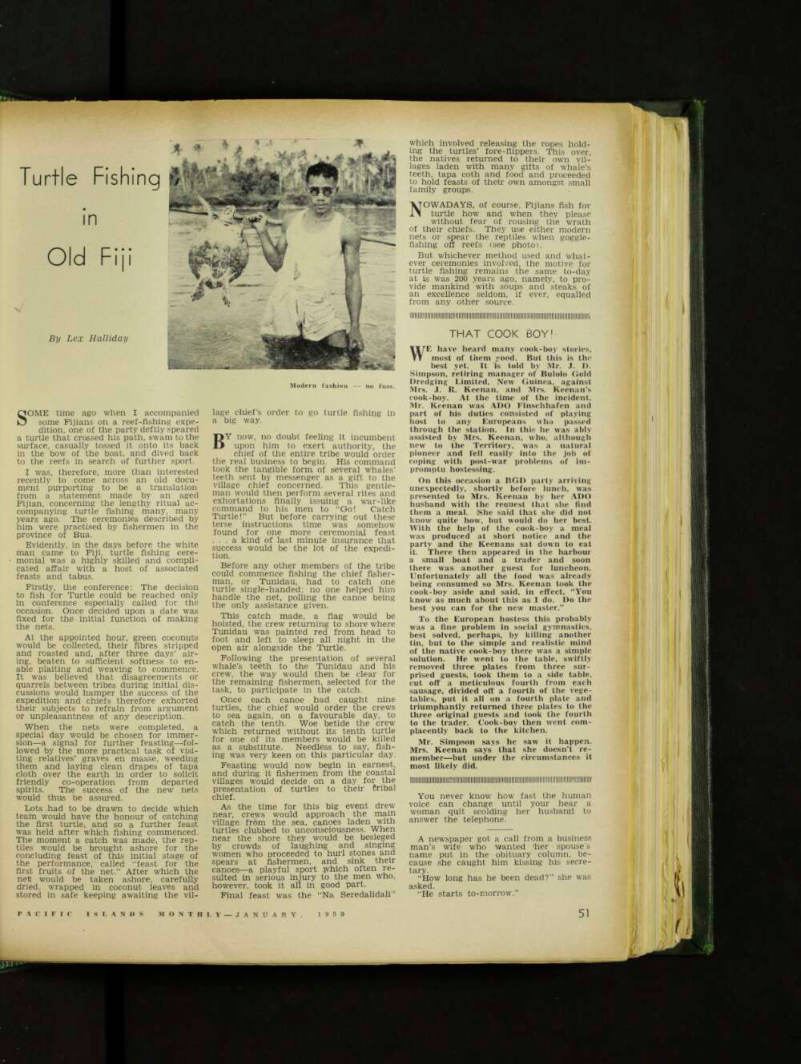
NOWADAYS, of course, Fijians fish for turtle how and when they please without fear of rousing the wrath of their chiefs. They use either modern nets or spear the reptiles when goggle fishing off reefs (see photo).
But whichever method used and what ever ceremonies involved, the motive for turtle fishing remains the same to-day at is was 200 years ago, namely, to pro vide mankind with soups and steaks of an excellence seldom, if ever, equalled from any other source.
You never know how fast the human voice can change until your hear a woman quit scolding her husband to answer the telephone.
A newspaper got a call from a business man’s wife who wanted 'her spouses name put in the obituary column, be cause she caught him kissing his secre tary.
“How long has he been dead?” she was as ked “He starts to-morrow.”
Modern fashion no fuss.