Magazine Section
pp. 51-52 · Read in the full issue
Territoriesp Talk-Talk
By "Tolala"
THERE was often a play of words made on Eddie Ward’s name when he was Minister for the Territories. No doubt there will be not a few made on the name of the new Minister. As Old Bill remarked the other day: ‘‘Ward was cer tainly New Guinea’s best spender; but now New Guinea is Spender’s best ward.”
And talking about changes, there will probably be a few both in policy and personnel—insofar as Papua-New Guinea is concerned—and there is not a little speculation in some quarters as to whether some of the officials, who were often over-enthusiastic in putting the Minister’s Socialistic theories into practice, may not now regret their Edwardian ardour.
Once primitive races have enjoyed ex travaErant nrivilesres it is a difficult task I ripfv hfm nTpvfn Lriifv thl Tt Is ea!v y enourti’ to eive anothS matte? is easy enougn to give, out anotner matter welfare policy an 6
than revolutionary oSe y
man a revolutionary one.
A N ? S< h denomi “ A tered the NG mission field—the Aus trahan Baptists. I have the greatest respect for mission work, save when de nominational dogmas tend to confound the native mind on the broad precepts
of Christianity, and where sec tarian enthusiasm creates such keen competitiveness for souls that Christian principles are too often sacrificed in the fight for adherents. It is to be hoped the Baptists are opening up new country and there will be no overlapping with or by other de nominations.
It is a great pity it has not been possible to maintain the old zoning system originally in troduced into Papua years ago, but long since abandoned.
Native religious zealots can be far more dangerous to the ad vance of civilisation—and the maintenance of good order — than hordes of primitive warriors. There should be some sort of control on mission ex pansion in the Territories. The difficulty, of course, is the
much-vaunted “freedom of religion”
Clause, which works overtime. * A ND talking of missions reminds me 0 f the news item last month from Rabaul (PIM, Dec., p. 22) where the Rabaul DO received ’complaints from Duke of York natives regarding insuffident land. It would not surprise me If the investigations showed that of the alienated land, in this group of small islands, the majority was held by mission societies. Such ownership is, to a great extent, justified; for it was here that Dr.
George Brown, who pioneered the missionary movement in New Britain, had his headquarters and did a great job of work. On Mioko, Queen Emma first started trading, and the first German government station was established on Karawara island, in the same group. It is the oldest white settlement in TNG.
T . , ~. , , Incidentally, before the war. mission interests held about one-fifth of all alienated land in TNG. The Sacred mission headed the list with some 34 ’ 000 acres ’ * T N t “ y °P“°tvpfcanv tropical SSSttta A the most tropical m the Ten tory .withi its; palm-fringed islands, wnite, sanay beacnes, blue lagoons and submarine coral gardens.
The ideal tourist spot is to be found here,
and one of these days somebody with imagination and initiative will be cater ing for wear y Sydney businessmen over L he week-end * n a modern hotel. And he ’ n P robabl y be a Yank, for they seem 136 tbe most successful tourist-caterers. * • • rrunr cinnth Pa.ifir K -
Tl. piJ?, ,° ' bemg
A f l . ln * IJI * n A P nl next - ma Y con
r?cn?ePts Yi? en
i helr
iPfp ances ~J ia ve ICal s l chools hniri^b^rpin?* nf 6 ffnSprn?^ entS n ° longer *. ,• „ i iv? 11 01 iu n j s - lla f,P d i Z^ a nged since an ds policies_ a o re f being , SSISIL, m ? c r l « m lPr ar a I Dutch New Guinea is concerned, and not so obedient to the dictator ial edicts from UN Committees as she was a couple of vears aeo So the non-native representatives to the Conference may find their governments’ attitudes have undergone a change to
“to SMtSS?. J?uS^W5
th wal f lt shou]d be verv interesting, b t possibly sllghtly confusing to the nativ r rpnrpspntativps Ilciuve lepresemawves.
(Continued next page)
Plenty Kai-Kai 'E
Come Up!
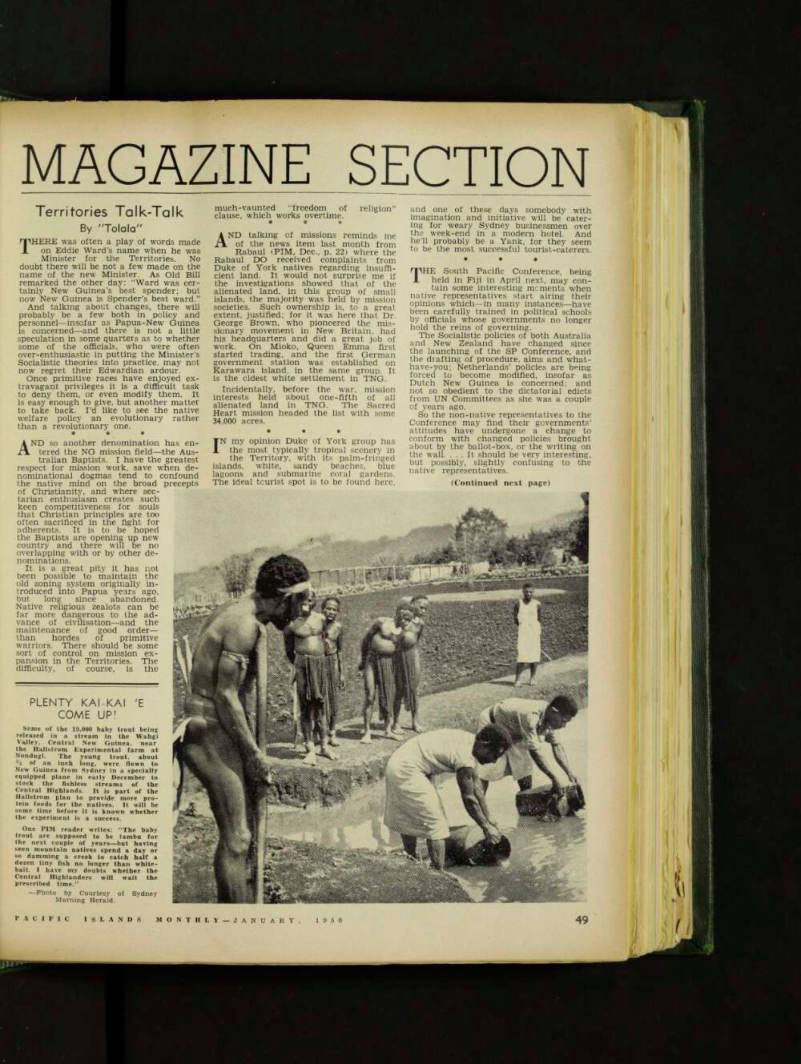
Some of the 19,000 baby trout being released in a stream in the Wahgi Valley, Central New Guinea, near the Hallstrom Experimental farm at Nondugl. The young trout, about ¾ of an inch long, were flown to New Guinea from Sydney in a specially equipped plane in early December to stock the fishless streams of the Central Highlands. It is part of the Hallstrom plan to provide more pro tein foods for the natives. It will be some time before it is known whether the experiment is a success.
One PIM reader writes: “The baby trout are supposed to be tambu for the next couple of years—but having seen mountain natives spend a day or so damming a creek to catch half a dozen tiny fish no longer than white bait, I have my doubts whether the Central Highlanders will wait the prescribed time.” —Photo by Courtesy of Sydney Morning Herald.
ALL this talk of Dutch New Guinea brings to mind the touchy situation likely to develop if the newly created United States of Indonesia ac quires Dutch NG. for then there is a great possibility of Japanese migrants settling there. The Javanese were openly sympathetic towards the Japs during the War, and those migrants would speedily develop the country which has for so long remained a terra incognita, despite the research and investigations carried out by the Dutch New Guinea Committee and Dr. Klein in 1935. The Dutch certainly have a problem on their hands, to develop this rugged country.
Displaced persons from Europe might be a solution. It requires careful handling lest it become the cock-pit of the Pacific. ♦ ♦ * MORE window-dressing for UNO came to light in Sydney papers in a mes sage from Canberra dated December 10 (Election Day) when reference was made to an Ordinance issued by Exter nal Territories providing “the framework for establishing native village councils, ’ as though it were something new. As pre-war residents know, it was being in troduced by slow degrees in certain areas —mostly around Rabaul —in 1938 and 1939, and members of the Trusteeship Committee probably know that, too. It received enough press publicity at the time, anyway. ♦ * * rpHE time might be propitious now for JL Territorians to revive the agitation for the establishment of a Parlia mentary Representative for TNG, on the same basis as that allowed the Northern Territory, at least. It would be so much easier to have a Member looking after the interests of Territorians in the House than for private Members—usually from the Opposition—airing grievances, often merely for party purposes. A Member for Pacific Territories should be a fair proposition, one who would look after the interests of residents in Papua- New Guinea, Nauru and Norfolk Island.
Natives are well cared for by a paternal government, and Chinese have their Consul; it is only the European resident who is fatherless and consul-less and is forced to go seeking someone to fire the bullets which unhappy circumstances force him to make.
Did somebody say; "No representation without taxation?" Or was it “No taxa tion without representation?" No one can say there’s no taxation in the Terri tory, though it may be indirect. Which reminds me of the time in TNG —it was about 1923, I think—when a Business Tax was introduced among white residents. It lasted a year. The cost of collecting the tax was more than the amount of the tax collected! ♦ ♦ * BITS AND PIECES: Margaret Cilento, who spent some years of her child hood in Rabaul when her Dad was PMO in TNG, and Margaret Olley (made famous by artist Bill Dobell) have been hitch-hiking in Europe, from Marseilles to Florence and back. Margaret is already making a name for herself in the art world.
In Melbourne, on December 20, Miss Marjorie Stewart was married to Mr. J.
R. Landman, who is a member of the staff of the New Guinea Administration.
The future home of the couple will be in Bougainville.
Dr. and Mrs. Carl Gunther, of Bulolo, New Guinea, left Sydney by the Strathe den, in early January. They will spend some months in Europe.