High Cost Of
p. 25 · Read in the full issue
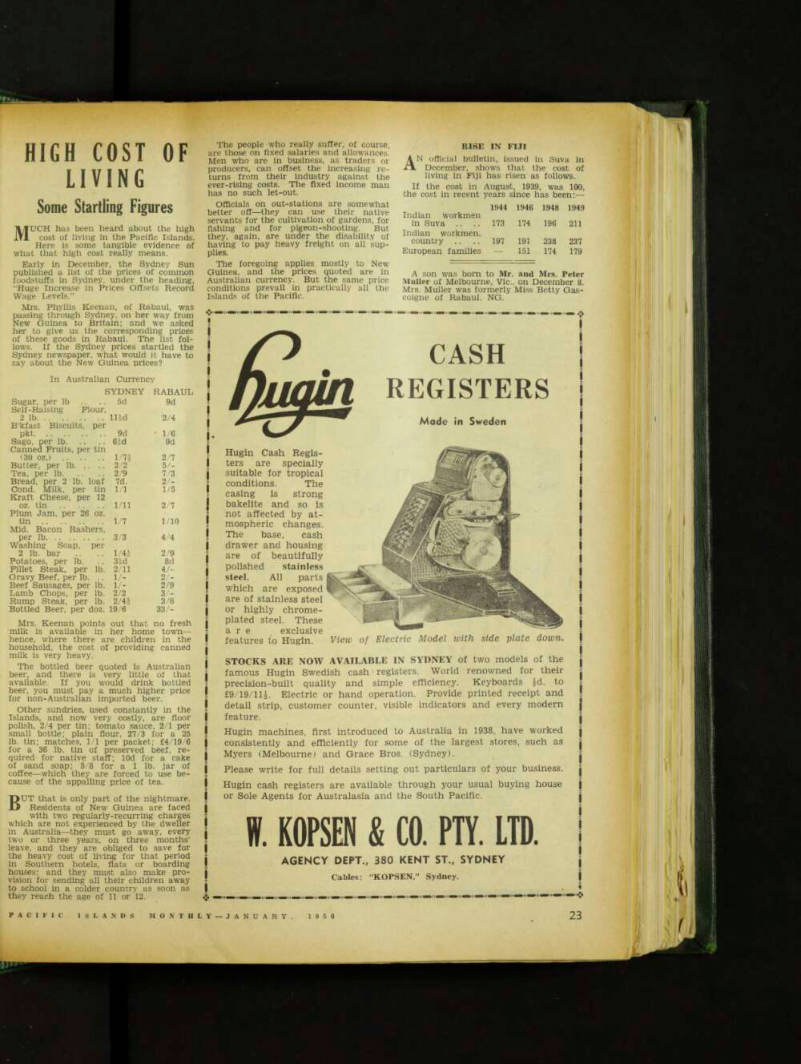
Living
Some Startling Figures
MUCH has been heard about the high cost of living in the Pacific Islands.
Here is some tangible evidence of what that high cost really means.
Early in December, the Sydney Sun published a list of the prices of common foodstuffs in Sydney, under the heading, “Huge Increase in Prices Offsets Record Wage Levels.”
Mrs. Phyllis Keenan, of Rabaul, was passing through Sydney, on her way from New Guinea to Britain; and we asked her to give us the corresponding prices of these goods in Rabaul. The list fol lows. If the Sydney prices startled the Sydney newspaper, what would it have to say about the New Guinea prices?
In Australian Currency
Mrs. Keenan points out that no fresh milk is available in her home town — hence, where there are children in the household, the cost of providing canned milk is very heavy.
The bottled beer quoted is Australian beer, and there is very little of that available. If you would drink bottled beer, you must pay a much higher price for non-Australian imported beer.
Other sundries, used constantly in the Islands, and now very costly, are floor polish, 2/4 per tin; tomato sauce, 2/1 per small bottle; plain flour, 27/3 for a 25 lb. tin; matches, 1/1 per packet; £4/19/6 for a 36 lb. tin of preserved beef, re quired for native staff; lOd for a cake of sand soap; 5/8 for a 1 lb. jar of coffee —which they are forced to use be cause of the appalling price of tea.
BUT that is only part of the nightmare.
Residents of New Guinea are faced with two regularly-recurring charges which are not experienced by the dweller in Australia—they must go away, every two or three years, on three months’ leave, and they are obliged to save for the heavy cost of living for that period in Southern hotels, flats or boarding houses; and they must also make pro vision for sending all their children away to school in a colder country as soon as they reach the age of 11 or 12.
The people who really suffer, of course, are those on fixed salaries and allowances.
Men who are in business, as traders or producers, can offset the increasing re turns from their industry against the ever-rising costs. The fixed income man has no such let-out.
Officials on out-stations are somewhat better off —they can use their native servants for the cultivation of gardens, for fishing and for pigeon-shooting. But they, again, are under the disability of having to pay heavy freight on all sup plies.
The foregoing applies mostly to New Guinea, and the prices quoted are in Australian currency. But the same price conditions prevail in practically all the Islands of the Pacific.
Sydney
Rabaui.
Sugar, per lb .. 5d 9d Self-Raising Flour, 2 lb ll£d 2/4 B’kfast Biscuits, per pkt 9d * 1/6 Sago, per lb 6id 9d Canned Fruits, per tin (30 oz.) 1/7* 2/7 Butter, per lb 2/2 5/- Tea, per lb 2/9 7/3 Bread, per 2 lb. loaf 7d. 2/- Cond. Milk, per tin 1/1 1/5 Kraft Cheese, per 12 oz. tin 1/11 2/7 Plum Jam, per 26 oz. tin 1/7 1/10 Mid. Bacon Rashers, per lb 3/3 4/4 Washing Soap, per 2 lb. bar 1/41 2/9 Potatoes, per lb. 3?.d 8d Fillet Steak, per lb. 2/11 4/- Gravy Beef, per lb. .. 1/- 2/- Beef Sausages, per lb. 1/- 2/9 Lamb Chops, per lb. 2/2 3/- Rump Steak, per lb. 2/4i 3/8 Bottled Beer, per doz. 19/6 33/-