Papua-Ng Sea Transport On Point Of Collapse
pp. 10-102 · Read in the full issue
Socialist Defeat Came Just in Time
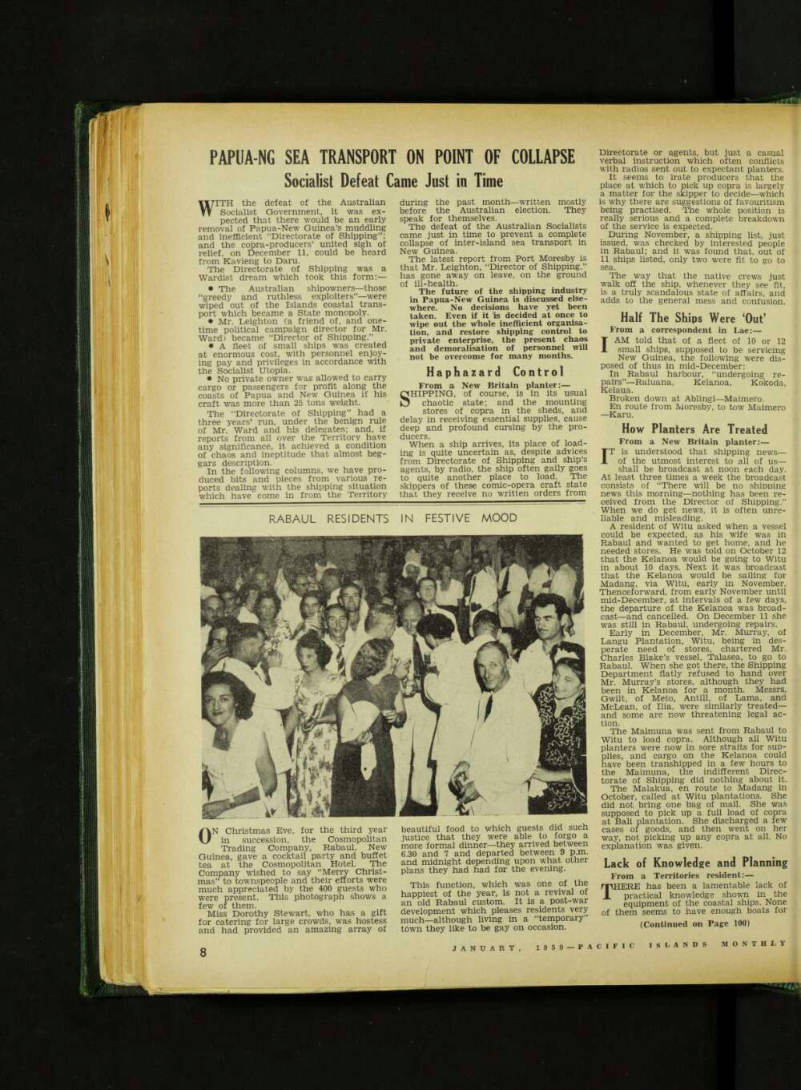
WITH the defeat of the Australian Socialist Government, it was expected that there would be an early removal of Papua-New Guinea’s muddling and inefficient “Directorate of Shipping”; and the copra-producers’ united sigh of relief, on December 11, could be heard from Kavieng to Daru The Directorate of Shipping was a Wardist dream which took this form;— • The Australian shipowners—those “greedy and ruthless exploiters —were wiped out of the Islands coastal transport which became a State monopoly. • Mr. Leighton (a friend of, and onetime political campaign director for Mr.
Ward) became “Director of Shippmg. • A fleet of small ships was created at enormous cost, with personnel enjoying pay and privileges in accordance with the Socialist utopia. • No private owner was allowed to carry cargo or passengers for profit along the coasts of Papua and New Guinea if his craft was more than 25 tons weight.
The “Directorate of Shipping” had a three years’ run, under the benign rule of Mr. Ward and his delegates; and, if reports from all over the Territory have any significance, it achieved a condition of chaos and ineptitude that almost begsj&rs description.
In the following columns, we have produced bits and pieces from various reports dealing with the shipping situation which have come in from the Territory
during the past month—written mostly before the Australian election. They speak for themselves, The defeat of the Australian Socialists came just in time to prevent a complete collapse of inter-island sea transport in New Guinea. . The latest report from Port Moresby is that Mr. Leighton, “Director of Shipping,” has gone away on leave, on the ground The f u t ure G f the shipping industry j n p a pua-New Guinea is discussed else where. No decisions have yet been taken. Even if it is decided at once to out the inefficient organisa tion an d restore shipping control to private enterprise, the present chaos and demoralisation of personnel will not be overcome for many months,
Haphazard Control
From a New Britain planter:— CIHIPPING, of course, is in its usual O chaotic state; and the mounting stores of copra in the sheds, and delay in receiving essential supplies, cause deep and profound cursing by the pro ducers. . s . . . . - When a ship arrives, its place of load ing is quite uncertain as, despite advices from Directorate of Shipping cind ship s agents, by radio, the ship often gaily goes to quite another place to load. The skippers of these comic-opera craft state that they receive no written orders from
Directorate or agents, but just a casual verbal instruction which often conflicts with radios sent out to expectant planters.
It seems to irate producers that the place at which to pick up copra is largely a matter for the skipper to decide —which is why there are suggestions of favouritism being practised. The whole position is really serious and a complete breakdown of the service is expected.
During November, a shipping list, just issued, was checked by interested people in Rabaul; and it was found that, out of 11 ships listed, only two were fit to go to sea.
The way that the native crews just walk off the ship, whenever they see fit, is a truly scandalous state of affairs, and adds to the general mess and confusion.
Half The Ships Were ‘Out’
From a correspondent in Lae:— lAM told that of a fleet of 10 or 12 small ships, supposed to be servicing New Guinea, the following were dis posed of thus in mid-December: In Rabaul harbour, “undergoing re pairs”—Raluana, Kelanoa, Kokoda, Kelaua.
Broken down at Ablingi—Maimero.
En route from Moresby, to tow Maimero —Karu.
How Planters Are Treated
From a New Britain planter:— IT is understood that shipping news— of the utmost interest to all of us— shall be broadcast at noon each day.
At least three times a week the broadcast consists of “There will be no shipping news this morning—nothing has been re ceived from the Director of Shipping.”
When we do get news, it is often unre liable and misleading.
A resident of Witu asked when a vessel could be expected, as his wife was in Rabaul and wanted to get home, and he needed stores. He was told on October 12 that the Kelanoa would be going to Witu in about 10 days. Next it was broadcast that the Kelanoa would be sailing for Madang, via Witu, early in November.
Thenceforward, from early November until mid-December, at intervals of a few days, the departure of the Kelanoa was broad cast—and cancelled. On December 11 she was still in Rabaul, undergoing repairs.
Early in December, Mr. Murray, of Langu Plantation, Witu, being in des perate need of stores, chartered Mr.
Charles Blake’s vessel, Talasea, to go to Rabaul. When she got there, the Shipping Department flatly refused to hand over Mr. Murray’s stores, although they had been in Kelanoa for a month. Messrs.
Gwilt, of Meto, Antill, of Lama, and McLean, of Ilia, were similarly treated— and some are now threatening legal ac tion.
The Maimuna was sent from Rabaul to Witu to load copra. Although all Witu planters were now in sore straits for sup plies, and cargo on the Kelanoa could have been transhipped in a few hours to the Maimuna, the indifferent Direc torate of Shipping did nothing about it.
The Malakua, en route to Madang in October, called at Witu plantations. She did not bring one bag of mail. She was supposed to pick up a full load of copra at Bali plantation. She discharged a few cases of goods, and then went on her way, not picking up any copra at all. No explanation was given.
Lack of Knowledge and Planning
From a Territories resident: — THERE has been a lamentable lack of practical knowledge shown in the equipment of the coastal ships. None of them seems to have enough boats for
(Continued on Page 100)
the efficient loading of copra. A sufficient number of properly designed boats, with some power unit to help them along, would greatly reduce loading time. But the whole system is haphazard and in efficient.
Another source of complaint is the high handed, arbitrary way in which the Direc torate and/or its agents deal with radio’d requests for goods. The planters listen for the broadcast news that ships will go to their districts. Thereupon, they radio for stores. More often than not. some of them say, they get the uncompromising answer that Bills of Lading have closed.
This may be three or four days before the little ships sail.
Copra Accumulating
From a Rabaul correspondent:— AT the end of the year, there were com plaints from various parts of the Territory of Papua-New Guinea that copra was piling up, owing to lack of coastal ships, and in some cases was de teriorating.
For example, in the Witu district, on December 12, there was an accumulation of 6,000 bags, produce of six plantations.
Burns Philp, controlling four plantations, and having plenty of finance, was not worrying; but the 3,000 bags piled up on Langu and Bali represented an increasing headache to two private planters, whose financial resources presumably are not endless. The “Director of Shipping” ad vised in December that the Maimuna would go and load copra in Witu. She can lift 660 bags!
Conditions in Buka and
Bougainville
From Our Correspondent
Sohano, Dec. 15.
DURING the visit of the Administrator (Colonel J. K. Murray) to Eastern New Guinea on December 6, the president of the Bougainville Association (Mr. F. P. Archer), and the hon, secretary (Mr. Max Babbage), had a discussion with His Honor on matters relating to District affairs and welfare. The Acting District Officer, Mr. R. Cole, was present. The following were under review:—
Shipping
The deputation pointed to lack of ships, general inefficiency in methods of handling ships; lack of co-ordination be tween Shipping Directorate, ships’ agents and ships’ officers; no written and definite instructions to master, on vessel leaving