Where Dead Ships Lie
p. 58 · Read in the full issue
By Geoffrey Shepherd
SHOWN on Pacific maps, between New Caledonia and Queensland’s Great Barrier, there are two insignificant looking specks, lying close together. These are Elizabeth and Middleton Reefs, at first glance just two of the Pacific’s many reefs —but what a history they have!
Like coral necklaces rising from the sea, they break from the Pacific in a welter of foam. With a reputation of being marine graveyards, veritable Goodwins of the Pacific, they are avoided like plague spots by all shipping to-day, for theirs is a grim history.
Since 1800 they have taken toll of at least 20 vessels which were driven by ill winds and currents onto their coral ram parts. These fangs of the sea had no verdure-covered shores peopled with friendly natives waiting to succour casta ways.
I have seen Middleton Reef and some of the wrecks which, even in death, still cling to it. It was only a fleeting glimpse that I had, from a liner which was taking an observation, but as a picture of utter desolation and starkness, its chill memory remains with me yet.
ELIZABETH REEF was named after the first victim it snared, in 1831. It has a somewhat less villainous record than Middleton. It is about four miles in diameter and was visited, in 1936, by a small scientific party in the yacht, Wan derer. Middleton Reef was also visited on that occasion—one of the rare times when humans have voluntarily landed on these coral necklaces of death.
Middleton is 30 miles to the north of Elizabeth and is the slightly larger. Its first recorded victim was snared in 1806, although there is evidence that many un identified vessels finished their careers there at an even earlier period.
Middleton has 12 recorded wrecks: Eli zabeth eight; but loss of life has been far more severe on Middleton, a heavy toll being taken of the crews of the barques, Ramsay (1852), Mary Lawson (1866) and Errol (1909). With others Fate was less relentless—some crews were picked up by passing vessels as the reefs lie in the zone of early China-bound clippers and some reached the shores of Lord Howe Island, 120 miles south from Middleton. In this latter category were the crews from the Naiad (1855) which piled up on Elizabeth, and the Annasona and Maelgwyn, both wrecked in 1907.
Earlier this year, when on Lord Howe Island, I heard from a resident the strange story of the series of queer co incidences that dogged the sister ships, Annasona and Maelgwyn. Both sailed from the Mersey, Liverpool, during the same month in 1906. They were bound for different destinations but both en countered the same Pacific storm and both became wrecks—the Annasona piling up on Middleton Reef and the Maelgwyn being abandoned as a derelict off Lord Howe Island.
Crews of both vessels took to the boats and safely reached Lord Howe’s shores within a week of each other. It seemed, somehow, that the mystical hand of Fate had intervened, for the strangest feature in these links was that the derelict Maelgwyn, after being abandoned, was caught by currents and driven up onto Middleton Reef where she became re united, in death, with her sister ship.
Middleton reef’s worst disaster was the loss of the Errol, a Nor wegian barque bound for Newcastle from Peru. She carried 22 people, includ
ing Mrs. Andreason, the wife of the skipper, and their four young children.
The vessel struck the northern fringes of the reef in bad weather, at midnight on June 18, 1909. Heavy seas soon breached her and in the confusion of the disaster the first mate and three sailors were washed overboard and drowned.
Daylight revealed a cheerless scene. The Errol was a hopeless wreck. Only her fore and aft sections remained awash and on these the 18 survivors clung.
There was tinned food in the galley— but the galley lay shattered at the bottom of the lagoon which was alive with sharks.
There was no rush of volunteers to dive for it. Then a young Australian seaman named Lawrence, with reckless disregard of the perils lurking below, went down and managed to secure a meagre supply of tinned food.
Days of despair slowly passed. On the fourth day Captain Andreason and his second mate were caught in under currents and drowned when trying to make a raft from floating timber in the lagoon. His wife was not spared the hor ror of later seeing his body devoured by sharks.
With the captain dead, discipline slackened among the remnants of the thirst and hunger-crazed crew. Ominous glances were cast at the children, but the faithful Lawrence appears to have taken the family as his charge and warded off attempts of violence by the more des perate.
Men weakened and slipped off the wreck into the seas below. The few sur vivors were now desperate. At last five of them completed a raft and put off for the Annasona, leaving Lawrence behind on the shattered Errol with his charges.
The Annasona had been wrecked two years previously, but had been flung high upon the reef, about four miles away, and appeared to be in a well-preserved con dition. The raft reached the wreck but
hot before it had capsized, drowning one of the five. The Annasona proved to be a bare hulk, securer than the Errol cer tainly, but without supplies.
A week after the disaster a steamer bound for the islands from Sydney passed close in by the reef but failed to observe the addition of the new wreck, or the frantic efforts the castaways were making to attract attention. The steamer un heeding continued on, finally disappearing over the horizon.
Meanwhile, back on the Errol, tragedy had again struck. One morning Law rence awoke to find the bodies of the woman and her children floating on the lagoon. The demented heart-broken woman had at last carried out her promise to rejoin her husband. On that battered hulk of tragedy Lawrence was left to himself and his bitter thoughts.
On the twenty-sixth day of their ordeal —ten days without water—another steamer approached the reef, sighted the wreck and this time deliverance was at hand. Those who survived were picked up in the last stages of exhaustion. They were only five, but it is satisfying to know that the devoted Lawrence was among them. The curtain was at last rung down on the drama of the Errol.
To-day on Elizabeth Reef there are no visible remains of its wrecks. Time, tides and tempests have dislodged them from this reef’s grip and the dead ships lie in waters fathoms deep.
But on Middleton a few ribs from the shattered Errol protrude. And despite the bombing by the RAAF, which used it for war-time target practice, the old Anna sona still clings there, her bow pointing defiantly upwards as if challenging the heavens to dislodge her.
With the passing of the era of sail and the fact that the reefs are chartered and given a wide berth, it is many years since the seas brought them their grim tribute. The last victim Eliza beth claimed was the barque, Askoy in 1911, but Middleton Reef, almost as if aghast at the catastrophe it brought to the ill-fated Errol, has made no more claims on shipping.
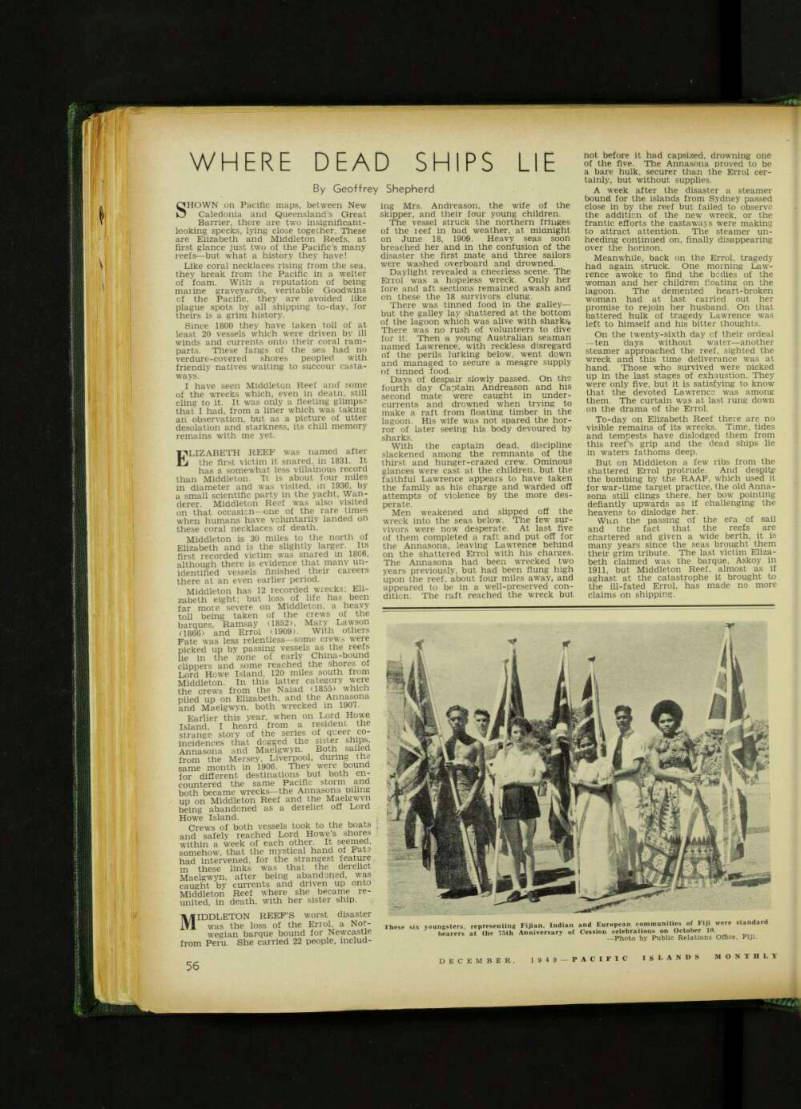
These six youngsters, representing Fijian, Indian and European communities of Fiji were standard bearers at the 75th Anniversary of Cession celebrations on October 10.
Photo by Public Relations Office, Fiji.