All Quiet on Fiji’s Industrial Front
p. 35 · Read in the full issue
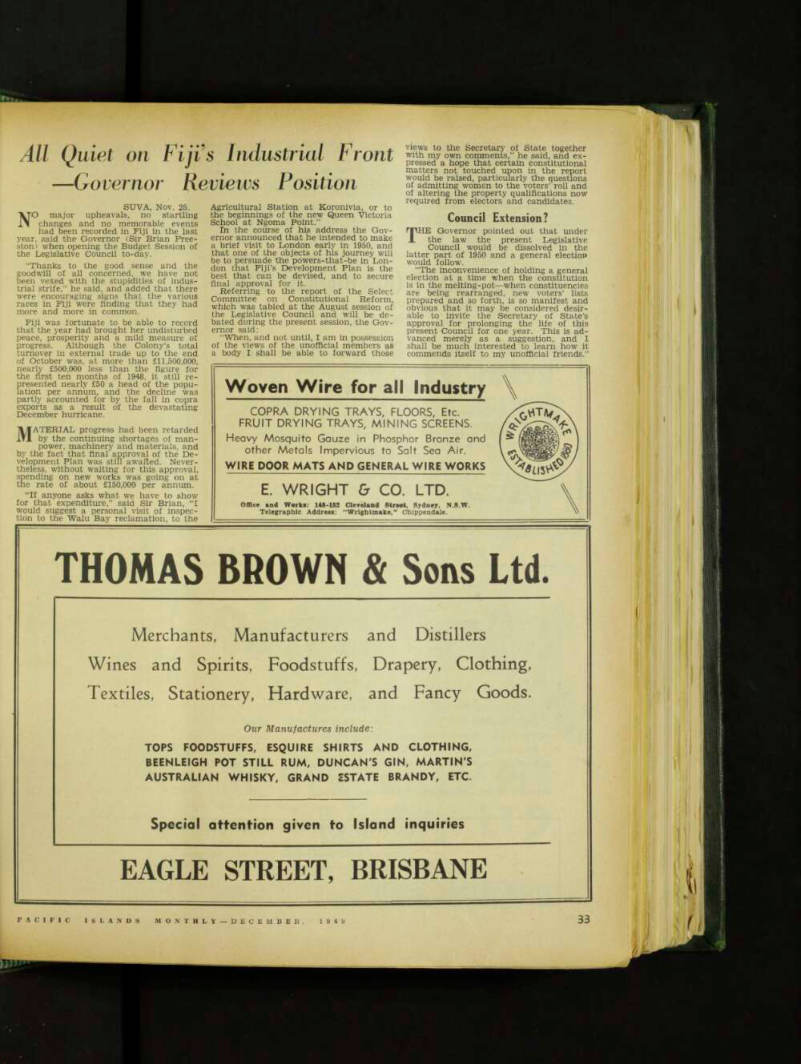
Governor Reviews Position
Suva, Nov. 25.
NO major upheavals, no startling changes and no memorable events had been recorded in Fiji in the last year, said the Governor (Sir Brian Free ston) when opening the Budget Session of the Legislative Council to-day.
“Thanks to the good sense and the goodwill of all concerned, we have not been vexed with the stupidities of indus trial strife,” he said, and added that there were encouraging signs that the various races in Fiji were finding that they had more and more in common.
Fiji was fortunate to be able to record that the year had brought her undisturbed peace, prosperity and a mild measure of progress. Although the Colony’s total turnover in external trade up to the end of October was, at more than £11,500,000, nearly £500,000 less than the figure for the first ten months of 1948, it still re presented nearly £5O a head of the popu lation per annum, and the decline was partly accounted for by the fall in copra exports as a result of the devastating December hurricane.
MATERIAL progress had been retarded by the continuing shortages of man power, machinery and materials, and by the fact that final approval of the De velopment Plan was still awaited. Never theless, without waiting for this approval, spending on new works was going on at the rate of about £150,000 per annum.
“If anyone asks what we have to show for that expenditure,” said Sir Brian, “I would suggest a personal visit of inspec tion to the Walu Bay reclamation, to the
Agricultural Station at Koronivia, or to the beginnings of the new Queen Victoria School at Ngoma Point.”
In the course of his address the Gov ernor announced that he intended to make a brief visit to London early in 1950, and that one of the objects of his journey will be to persuade the powers-that-be in Lon don that Fiji’s Development Plan is the best that can be devised, and to secure final approval for it.
Referring to the report of the Select Committee on Constitutional Reform, which was tabled at the August session of the Legislative Council and will be de bated during the present session, the Gov ernor said; “When, and not until, I am in possession of the views of the unofficial members as a body I shall be able to forward those
views to the Secretary of State together with my own comments,” he said, and ex pressed a hope that certain constitutional matters not touched upon in the report would be raised, particularly the questions of admitting women to the voters’ roll and of altering the property qualifications now required from electors and candidates.
Council Extension?
THE Governor pointed out that under the law the present Legislative Council would be dissolved in the latter part of 1950 and a general election would follow.
“The inconvenience of holding a general election at a time when the constitution is in the melting-pot—when constituencies are being rearranged, new voters’ lists prepared and so forth, is so manifest and obvious that it may be considered desir able to invite the Secretary of State’s approval for prolonging the life of this present Council for one year. This is ad vanced merely as a suggestion, and I shall be much interested to learn how it commends itself to my unofficial friends.”