Nauru’S Sulky
p. 25 · Read in the full issue
Communities
Time Has Come for a New Outlook
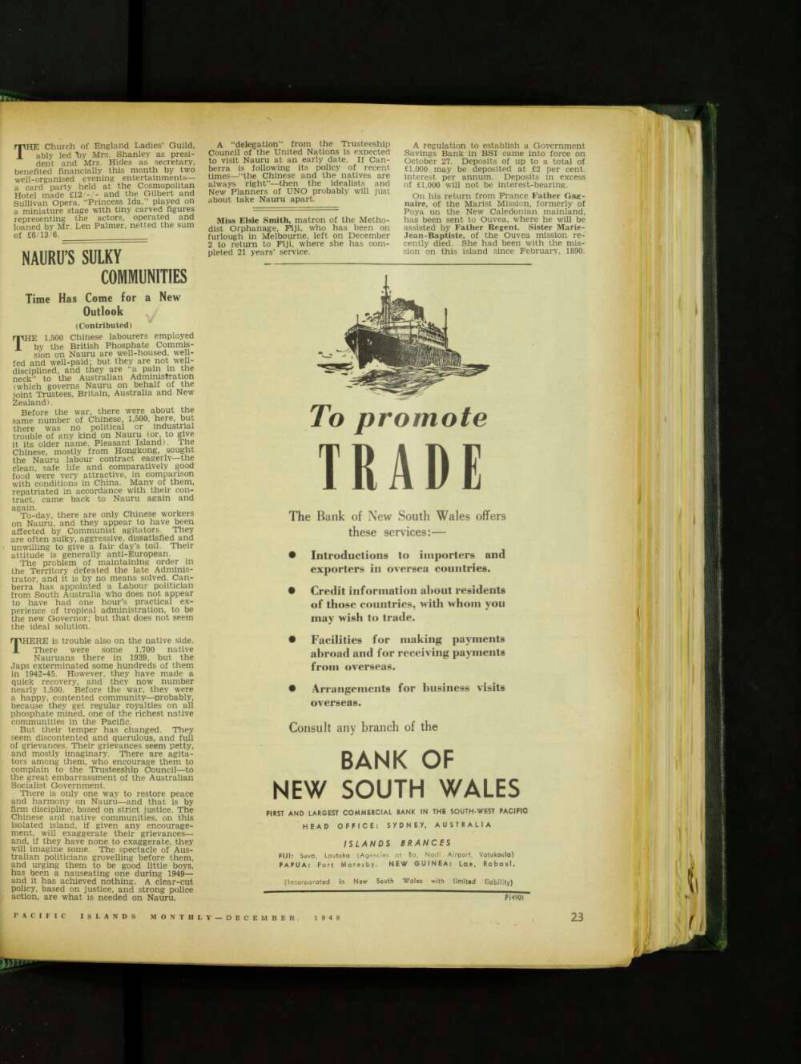
(Contributed) THE 1,500 Chinese labourers employed by the British Phosphate Commis sion on Nauru are well-housed, well fed and well-paid; but they are not well disciplined, and they are “a pain in the neck” to the Australian Administration (which governs Nauru on behalf of the joint Trustees, Britain, Australia and New Zealand).
Before the war, there were about the same number of Chinese, 1,500, here but there was no political or industrial trouble of any kind on Nauru (or, to give it its older name, Pleasant Island). The Chinese, mostly from Hongkong, sought the Nauru labour contract eagerly—the clean, safe life and comparatively good food were very attractive, in comparison with conditions in China. Many of them, repatriated in accordance with their con tract, came back to Nauru again and again.
To-day, there are only Chinese workers on Nauru, and they appear to have been affected by Communist agitators. They are often sulky, aggressive, dissatisfied and unwilling to give a fair day’s toil. Their attitude is generally anti-European.
The problem of maintaining order in the Territory defeated the late Adminis trator, and it is by no means solved. Can berra has appointed a Labour politician from South Australia who does not appear to have had one hour’s practical ex perience of tropical administration, to be the new Governor; but that does not seem the ideal solution.
THERE is trouble also on the native side.
There were some 1,700 native Nauruans there in 1939, but the Japs exterminated some hundreds of them in 1942-45. However, they have made a quick recovery, and they now number nearly 1,500. Before the war, they were a happy, contented community—probably, because they get regular royalties on all phosphate mined, one of the richest native communities in the Pacific.
But their temper has changed. They seem discontented and querulous, and full of grievances. Their grievances seem petty, and mostly imaginary. There are agita tors among them, who encourage them to complain to the Trusteeship Council —to the great embarrassment of the Australian Socialist Government.
There is only one way to restore peace and harmony on Nauru—and that is by firm discipline, based on strict justice. The Chinese and native communities, on this isolated island, if given any encourage ment, will exaggerate their grievances— and, if they have none to exaggerate, they will imagine some. The spectacle of Aus tralian politicians grovelling before them, and urging them to be good little boys, has been a nauseating one during 1949 — and it has achieved nothing. A clear-cut policy, based on justice, and strong police action, are what is needed on Nauru.
A “delegation” from the Trusteeship Council of the United Nations is expected to visit Nauru at an early date. If Can berra is following its policy of recent times —“the Chinese and the natives are always right”—then the idealists and New Planners of UNO probably will just about take Nauru apart.
Miss Elsie Smith, matron of the Metho dist Orphanage, Fiji, who has been on furlough in Melbourne, left on December 2 to return to Fiji, where she has com pleted 21 years’ service.
A regulation to establish a Government Savings Bank in BSI came into force on October 27. Deposits of up to a total of £l,OOO may be deposited at £2 per cent, interest per annum. Deposits in excess of £l,OOO will not be interest-bearing.
On his return from France Father Gag naire, of the Marist Mission, formerly of Poya on the New Caledonian mainland, has been sent to Ouvea, where he will be assisted by Father Regent. Sister Marie- Jean-Baptiste, of the Ouvea mission re cently died. She had been with the mis sion on this island since February, 1890.