and Gardens
pp. 54-55 · Read in the full issue
Nauru Builds Empire Farms and Gardens
By courtesy of Qantas Empire Airways, who make acknowledgments to Norman F. Way and AM Magazine.
A STONE’S throw from the equator, but more than two thou- A sand miles from their homeland, a handful of Australians, with a sprinkling of Britishers, control Nauru, Australia’s blood bank of soil fertiliser. They get good wages, beer for 1/4 a bottle, tins of 50 English cigarettes for 2/6, and pay no taxes. And all for digging up a million-years-old deposit of phosphate.
Phosphate, 25 to 30 feet deep, covers four-fifths of Nauru’s 5,300 acres. How did it get there? Well, there are two theories to account for it. A million years or so ago, the advocates of the bird theory say, the island of Nauru, built by coral insects, rose above the ocean level and became a breeding ground for sea birds, such as the tern and frigate bird. Millions of tons of their droppings accumulated. Nauru has disappeared under the sea at least twice since then, and the sea water washed out all the impurities, leaving pure phosphate of lime.
The other theory claims that the phosphate deposits, all marine sediment, came up from the bottom of the sea with the underlying limestone. Marine fossils have been found in the phosphate, so there may be something in their argument.
To-day the phosphate looks like light brown sand, and doesn’t smell. It provides us with all our superphosphate.
Rising almost a sheer 1,200 feet from the floor of the Pacific, Nauru is as beautiful as any other coral island, but consists of only three things—vegetation, coral limestone, and phosphate. A strip of dazzling white sand skirts the edge of the reef, but that is all. There is no clay, no loam, no sub-soil. The lush tropical growth springs from scant inches of decayed vegetable matter.
Drive in a spade where you will and you have phosphate, which isn’t fertile until it has been processed.
In 1919, when England, New Zealand, and Australia jointly took over the old phosphate-producing company for three and a half million pounds, a representative of each was appointed to form the British Phosphate Commission. It wasn’t just an other board, but an active business concern, with a general manager, and offices located in Collins Street Melbourne, where the B.P.C. flag flies over Phosphate House.
Things were going well when war flared in the Pacific. The industry was on a sound footing, exporting about a million and a quarter tons of phosphate yearly. Exported at that rate, the deposits should last 70 years. Treated with sulphuric acid, a
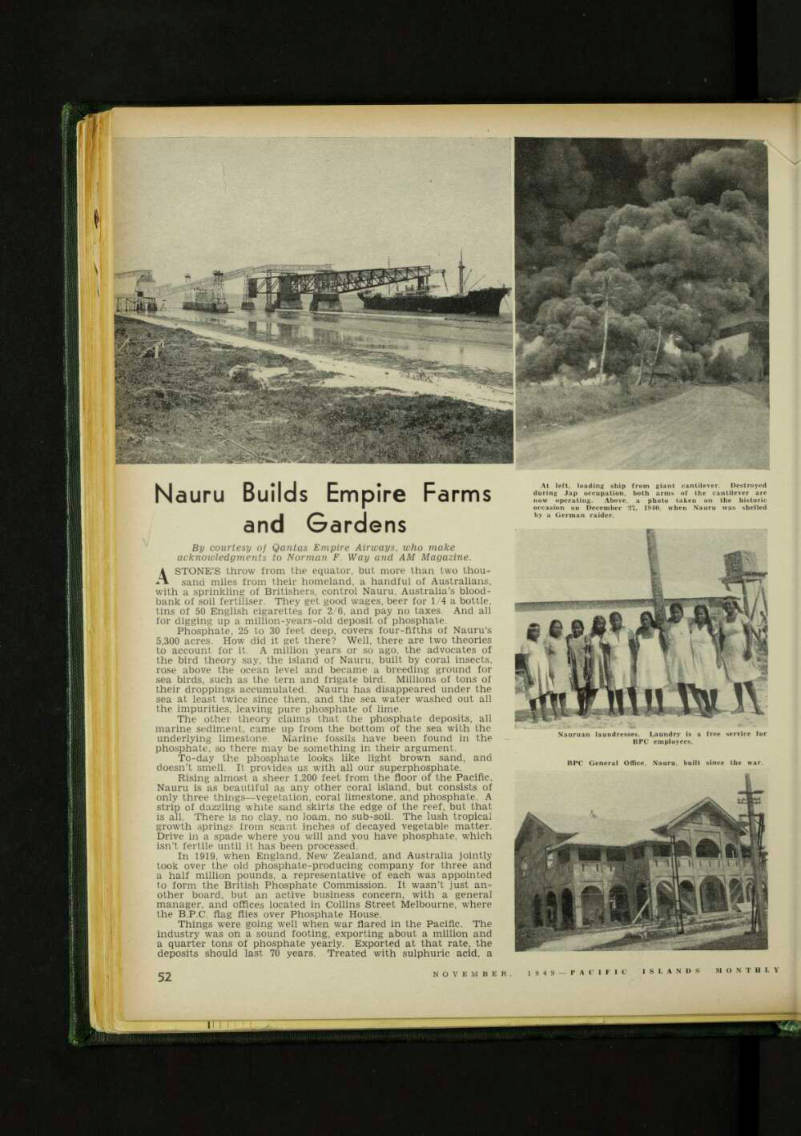
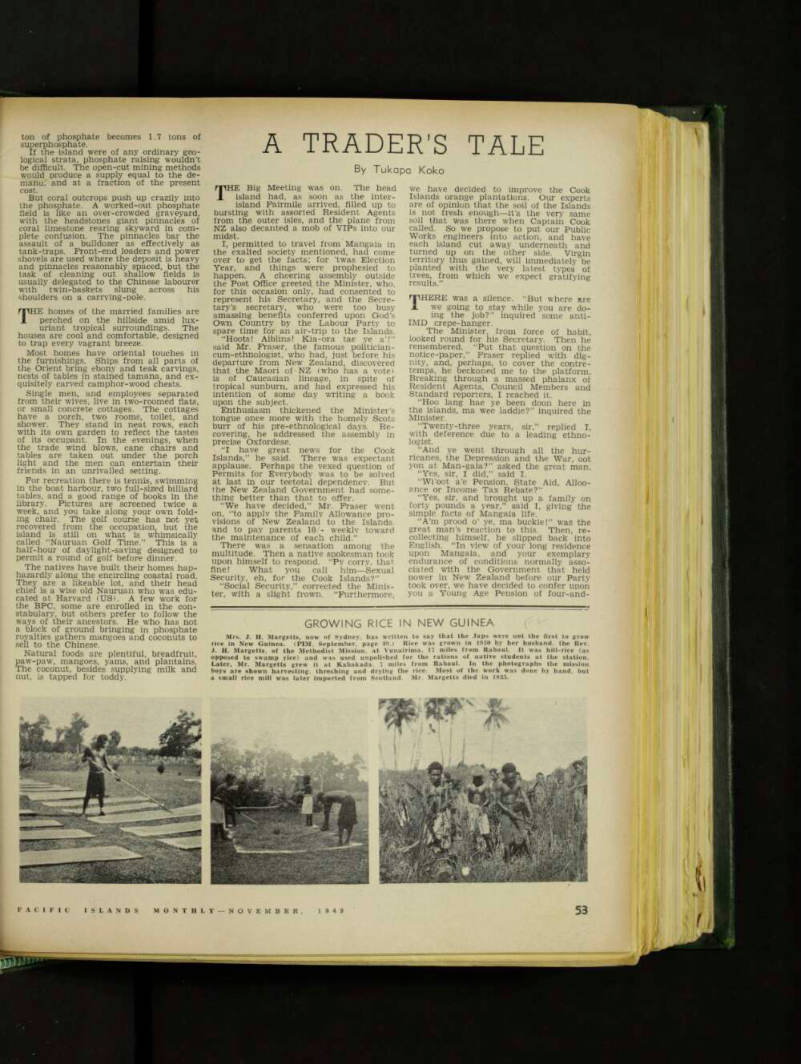
At left, loading ship from giant cantilever. Destroyed during Jap occupation, both arms of the cantilever are now operating. Above, a photo taken on the historic occasion on December 27, 1940, when Nauru was shelled by a German raider.
Nauruan laundresses. Laundry is a free service for BPC employees.
BPC General Office, Nauru, built since the war.
ton of phosphate becomes 1.7 tons of superphosphate.
If the Island were of any ordinary geo logical strata, phosphate raising wouldn’t be difficult. The open-cut mining methods would produce a supply equal to the de manu, and at a fraction of the present cost.
But coral outcrops push up crazily into the phosphate. A worked-out phosphate field is like an over-crowded graveyard, with the headstones giant pinnacles of coral limestone rearing skyward in com plete confusion. The pinnacles bar the assault of a bulldozer as effectively as tank-traps. Front-end loaders and power shovels are used where the deposit is heavy and pinnacles reasonably spaced, but the task of cleaning out shallow fields is usually delegated to the Chinese labourer with twin-baskets slung across his shoulders on a carrying-pole.
THE homes of the married families are perched on the hillside amid lux uriant tropical surroundings. The houses are cool and comfortable, designed to trap every vagrant breeze.
Most homes have oriental touches in the furnishings. Ships from all parts of the Orient bring ebony and teak carvings, nests of tables in stained tamana, and ex quisitely carved camphor-wood chests.
Single men, and employees separated from their wives, live in two-roomed flats, or small concrete cottages. The cottages have a porch, two rooms, toilet, and shower. They stand in neat rows, each with its own garden to reflect the tastes of its occupant. In the evenings, when the trade wind blows, cane chairs and tables are taken out under the porch light and the men can entertain their friends in an unrivalled setting.
For recreation there is tennis, swimming in the boat harbour, two full-sized billiard tables, and a good range of books in the library. Pictures are screened twice a week, and you take along your own fold ing chair. The golf course has not yet recovered from the occupation, but the island is still on what is whimsically called “Nauruan Golf Time.” This is a half-hour of daylight-saving designed to permit a round of golf before dinner.
The natives have built their homes hap hazardly along the encircling coastal road.
They are a likeable lot, and their head chief is a wise old Nauruan who was edu cated at Harvard (US). A few work for the BPC, some are enrolled in the con stabulary, but others prefer to follow the ways of their ancestors. He who has not a block of ground bringing in phosphate royalties gathers mangoes and coconuts to sell to the Chinese.
Natural foods are plentiful, breadfruit, paw-paw, mangoes, yams, and plantains.
The coconut, besides supplying milk and nut, is tapped for toddy.