Operation Drum follows Operation Cow
p. 53 · Read in the full issue
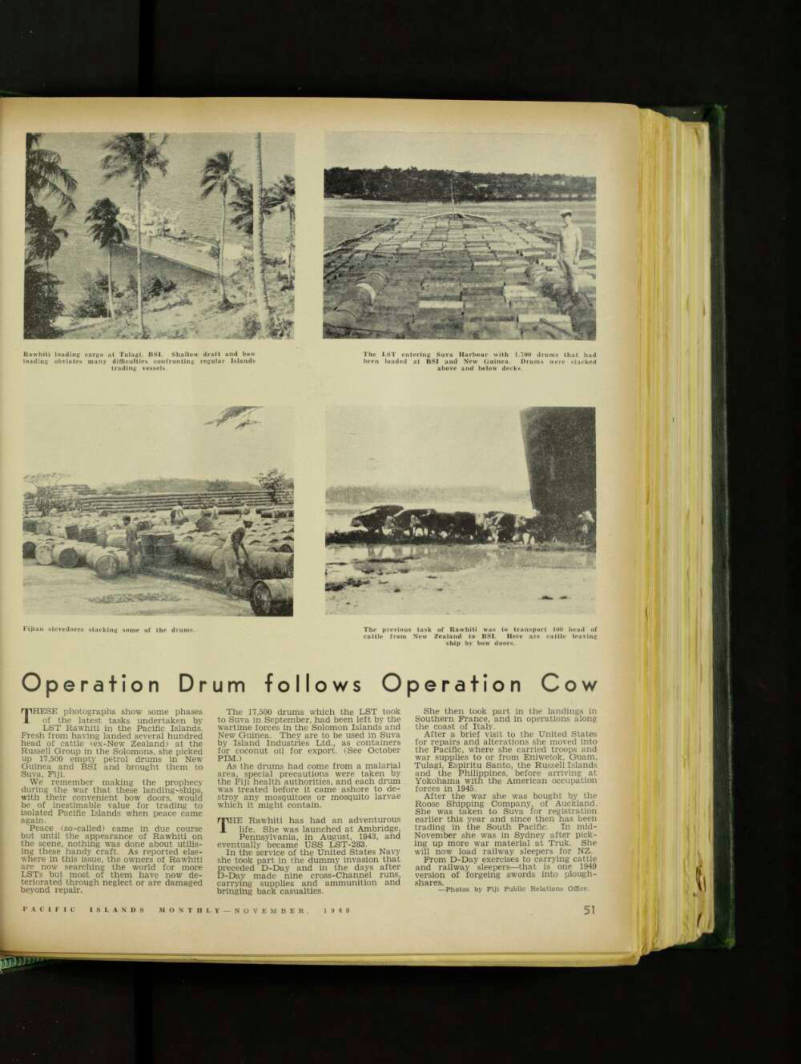
THESE photographs show some phases of the latest tasks undertaken by LST Rawhiti in the Pacific Islands.
Fresh from having landed several hundred head of cattle (ex-New Zealand) at the Russell Group in the Solomons, she picked up 17,500 empty petrol drums in New Guinea and BSI and brought them to Suva, Fiji.
We remember making the prophecy during the war that these landing-ships, with their convenient bow doors, would be of inestimable value for trading to isolated Pacific Islands when peace came again.
Peace (so-called) came in due course but until the appearance of Rawhiti on the scene, nothing was done about utilis ing these handy craft. As reported else where in this issue, the owners of Rawhiti are now searching the world for more LSTs but most of them have now de teriorated through neglect or are damaged beyond repair.
The 17,500 drums which the LST took to Suva in September, had been left by the wartime forces in the Solomon Islands and New Guinea. They are to be used in Suva by Island Industries Ltd., as containers for coconut oil for export. (See October
Pim.)
As the drums had come from a malarial area, special precautions were taken by the Fiji health authorities, and each drum was treated before it came ashore to de stroy any mosquitoes or mosquito larvae which it might contain.
THE Rawhiti has had an adventurous life. She was launched at Ambridge, Pennsylvania, in August, 1943, and eventually became USS LST-283.
In the service of the United States Navy she took part in the dummy invasion that preceded D-Day and in the days after D-Day made nine cross-Channel runs, carrying supplies and ammunition and bringing back casualties.
She then took part in the landings in Southern France, and in operations along the coast of Italy.
After a brief visit to the United States for repairs and alterations she moved into the Pacific, where she carried troops and war supplies to or from Eniwetok, Guam, Tulagi, Espiritu Santo, the Russell Islands and the Philippines, before arriving at Yokohama with the American occupation forces in 1945.
After the war she was bought by the Roose Shipping Company, of Auckland.
She was taken to Suva for registration earlier this year and since then has been trading in the South Pacific. In mid- November she was in Sydney after pick ing up more war material at Truk. She will now load railway sleepers for NZ.
From D-Day exercises to carrying cattle and railway sleepers—that is one 1949 version of forgeing swords into plough shares —Photos by Fiji Public Relations Office.
Rawhiti loading cargo at Tulagi, BSI. Shallow draft and bow loading obviates many difficulties confronting regular Islands trading vessels.
The LST entering Suva Harbour with 1,700 drums that had been loaded at BSI and New Guinea. Drums were stacked above and below decks.
Fijian stevedores stacking some of the drums
The previous task of Rawhiti was to transport 400 head of cattle from New Zealand to BSI. Here are cattle leaving ship by bow doors.