Fiji Has C[?] Long Way
pp. 54-56 · Read in the full issue
S[?]74
OCTOBER lO this year was the Cession which made Fiji a ] be said that Fiji has come a long annexed by one or another of t floundering along in the backwas!
Not so Fiji. To-day the mosl its outlook is modern, and it is reached its present age, howeve The greatest of its problems to-< which now far outstrips the nat on sugar, and it was the early si first Indians, as a reliable source the job of solving the “Indian pi of the Europeans of Fiji. That i all its ramifications, is now very < Indians make more clamorous de taining a stubborn allegiance to Britain, who at the time of Fijians, and who apparently hoj the last 30 years, would solve itse the status quo in her South Seas Meanwhile, in spite of her h land, wherein life appear irritating aspects of existence foi When, on October 10, 1874, ceded their lands to the British little better than cannibals or h state.
The first missionaries had g< pression upon these ferocious pe( was converted to Christianity, Is with Maafu of Tonga, later chie became Christian he ardently d' The edict went forth that they ] Most of them became Christian virtually all had been converted.
To-day, the Fijians are 100 their religion. Much of their i frame-work, but education and opportunity to serve their peopl in trade. Although traditionally the Fijian has also contributed patriotic, Fijian forces served in in World War 11. As a jung acclaim. (Co:
Under the portraits of the British R< and elected members repres<
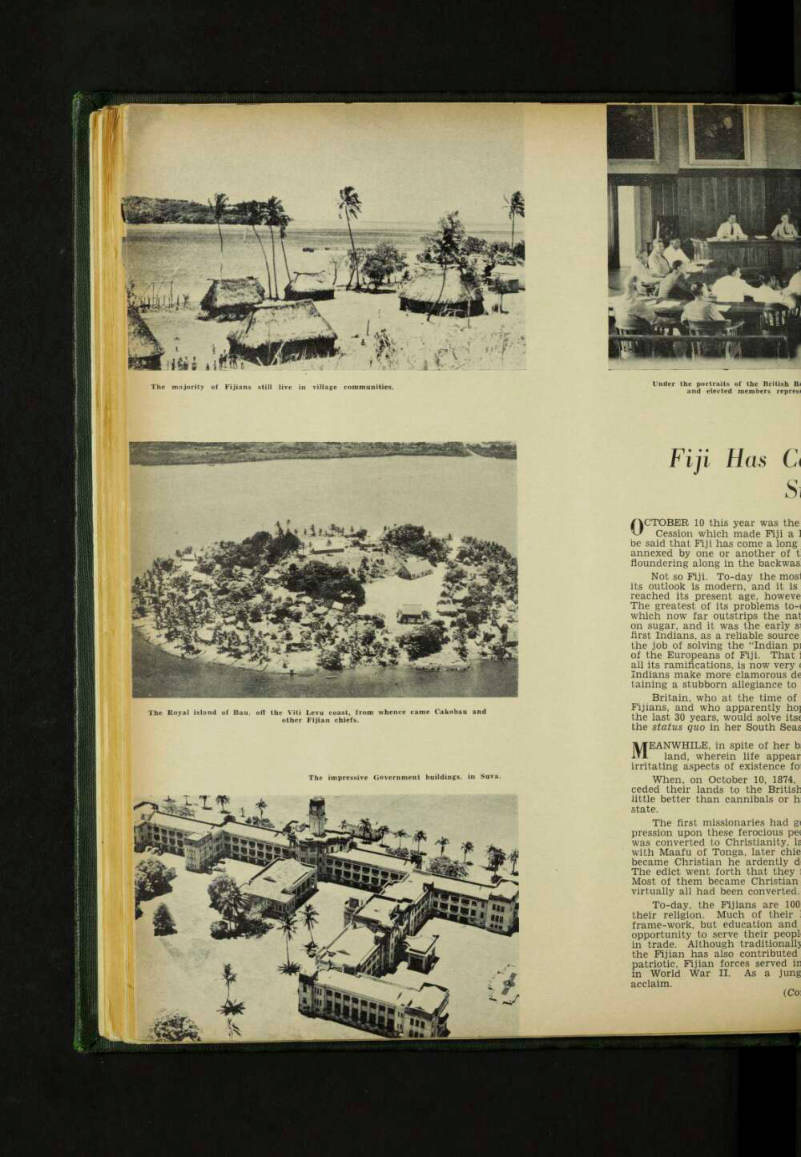
The majority of Fijians still live in village communities.
The Royal island of Bau, off the Viti Levu coast, from whence came Cakobau and other Fijian chiefs.
The impressive Government buildings, in Suva.
iry of the signing of the Deed of Colony. Without triteness it can . Many Pacific Islands territories, rs about the same time, are still i. md territory in the South Pacific, isiderable prosperity. It has not wing-pains or without problems, dly increasing Indian population ulation. Fiji’s economy is based i the Colony who brought in the is, in the opinion of some, throws s in 1949, right back into the lap cation —the Indian problem, with reatens to become more so as the iji, on the one hand, while main cn the other. sed to secure Fijian lands to the problem,” as it has developed in ace sterner measures to maintain )lem, Fiji is a green and pleasant itly along, without many of the or Australasia. of Fiji, and other Fijian chiefs of Victoria’s new subjects were ly emerged from that interesting ut 1835, but they made little im- Some time in the 50’s, Cakobau tter of expedience as an alliance is, hung upon it. Once Cakobau subjects also should become so. their heathen gods or be flogged.
I by the end of the 19th century ctising Christians and happy in ed within the traditional Fijian mtlook has given many of them of teaching, medicine, and even m European commerce, as such, whole Fiji community. Ardently ’ and, to a much greater extent, : Fijian has gained world-wide 'age)
Fiji Legislative Council meets. Official [?]an and Indian communities.
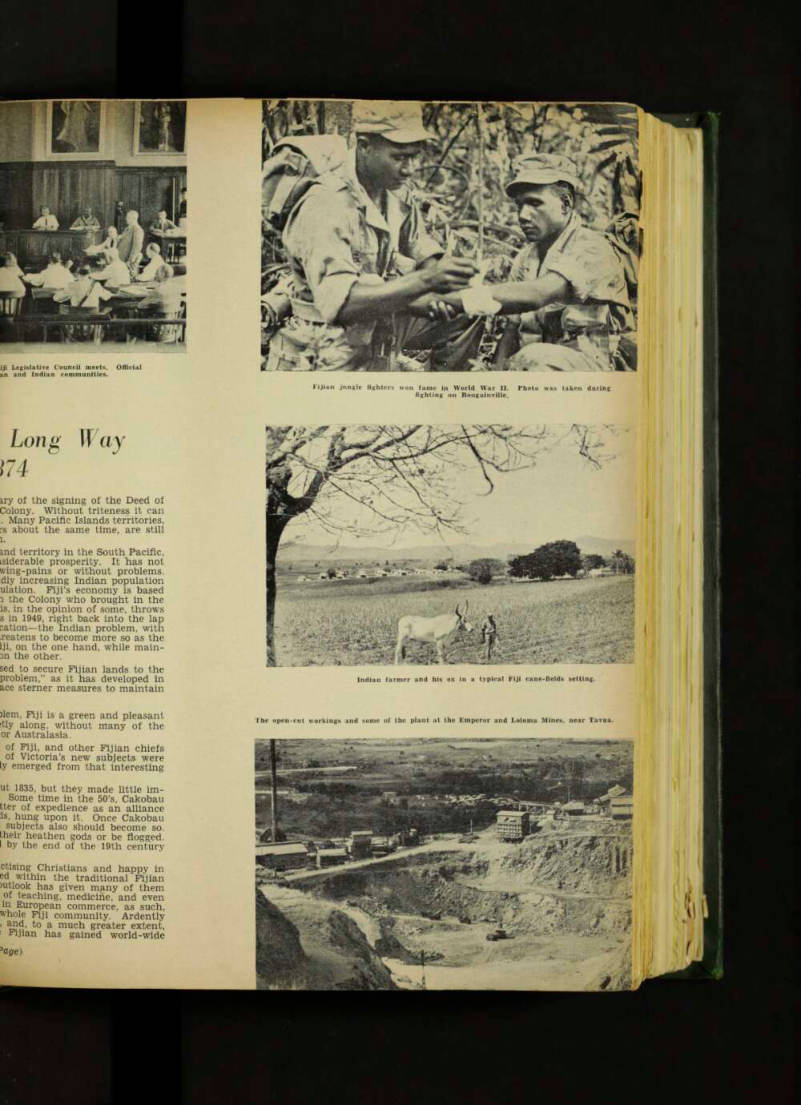
Fijian jungle lighters won fame in World War II. Photo was taken during fighting on Bougainville.
Indian farmer and his ox in a typical Fiji cane-fields setting.
The open-cut workings and some of the plant at the Emperor and Loloma Mines, near Tavua.
The Indian, although he is a problem, has contributed a great deal to the wealth and prosperity of the Colony. The majority are still peasant farmers, but many have be come the small shopkeepers and tailors of the towns; they have entered the professions; and the transport industry is completely in their hands.
SHORTLY after the capital was moved from Levuka, on Ovalau, to Suva, which has developed into a fine town of impressive build ings, fine homes and public institu tions. Around the sugar centres, in other parts of the Group, other large towns have grown. The whole Colony is well-roaded, and Nadi, on north west Viti Levu, the present inter national airport, has become a Pacific aerial cross-roads. In 1950 or 1951 it is expected that the inter national airport will be moved to a new site near Suva.
There are deep-water harbours for ships of all tonnages at Suva and Levuka, from whence go the copra, coconut oil, canned pineapples, sugar and bananas to help feed a hungry world. From the huge Emperor Gold mines at Tavua, go the gold ingots that help to provide the British Commonwealth with elusive Yankee dollars.