for Weaklings
pp. 53-58 · Read in the full issue
Norfolk Island Whaling is Not for Weaklings
By Vernon Wheatley
EVERY year whales from the Arctic wastes south of New Zealand pass Norfolk Island on their annual trip to warmer latitudes where they breed.
During this period—from July to Novem ber or December—it is not uncommon to see the mammals close inshore, and, on calm evenings, one can clearly hear the detonation as they slap the surface of the water with their flukes, in play.
The blue or hump-back whale is the most common in Norfolk waters, but in January an occasional sperm whale puts in an appearance. The blue whale is com paratively less risky to kill than a sperm.
It seems that the sperm whale has twenty-feet jaws and can easily crush a small boat and its crew.
Although the present company operat ing at Norfolk Island—The South Seas Whaling and Sharking Company—have only recently begun operations, the whale ing industry was formerly carried on for very many years by the Islanders them selves, operating from the same site located at Ball Bay.
The Islanders’ whale-boats, mere 30-foot wooden craft, were rowed or sailed, and each crew operated in conjunction with another. Also, between all crew members
there was complete under standing. This was essential, for the mistake of one could lead to the death of all.
Usually two craft put out and one would never make an independent kill —one craft would always stand by ready to lend a hand, if necessary.
When you are within almost touching-distance of a whale, 60 or 70 feet long, it is wise to be prepared for any emergency. A whale’s weight is calculated at the rate of one ton to each foot of length.
THE Island whalers had to be tough to tackle a whale in an open boat.
Their harpoons and lances were hand-thrown and the boat had to be carefully placed alongside so that the harpoon could be thrust home through the thick skin and the mass of blubber.
Iron nerve was essential.
No panic was permitted in a tight situation. As an example they quote the oc casion when one boat was searching off Garnet Reef and a whale surfaced —beneath the boat! The crew sat like images. The whale carried the boat on its back across the entrance of Ball Bay (about a mile) before it submerged off Flat Rock.
During their unenviable ex perience not one member of the crew spoke or showed signs of strain.
New recruits to the crews had only one chance to prove themselves. If they showed signs of panic or spoke during the critical moments before the kill, they were not after
wards selected as crew members. Dis obedience of the skipper’s orders meant automatic disqualification. Usually, new crew members who looked likely to panic were hit over the head and temporarily knocked out. This seemingly harsh measure was necessary for the safety of tne rest 01 tne , cvew - Once the whale was killed, its mouth was literally sewn up before it was towed to shore. Sewing the mouth was essen tial, as the lower jaw dropped, thus in creasing resistance to towing. Similarly, towing tail-first causes the flukes to ex tend from the carcase at an angle of 90 deg., thus causing an even greater resis tance. The Company, by the way, plan to tow tail-first, after cutting the fluke muscles and sinews thus allowing the flukes to fold back from their closed position as soon as towing movement is started, The Islanders cut and boiled the blubber on shore under somewhat primitive conditions, but the oil was generally of a high grade. War-time restrictions brought a halt to their whaling and re cently the Company acquired their assets, hoping to streamline the industry as there are Plenty of whales for the taking,
(Continued on page 58)
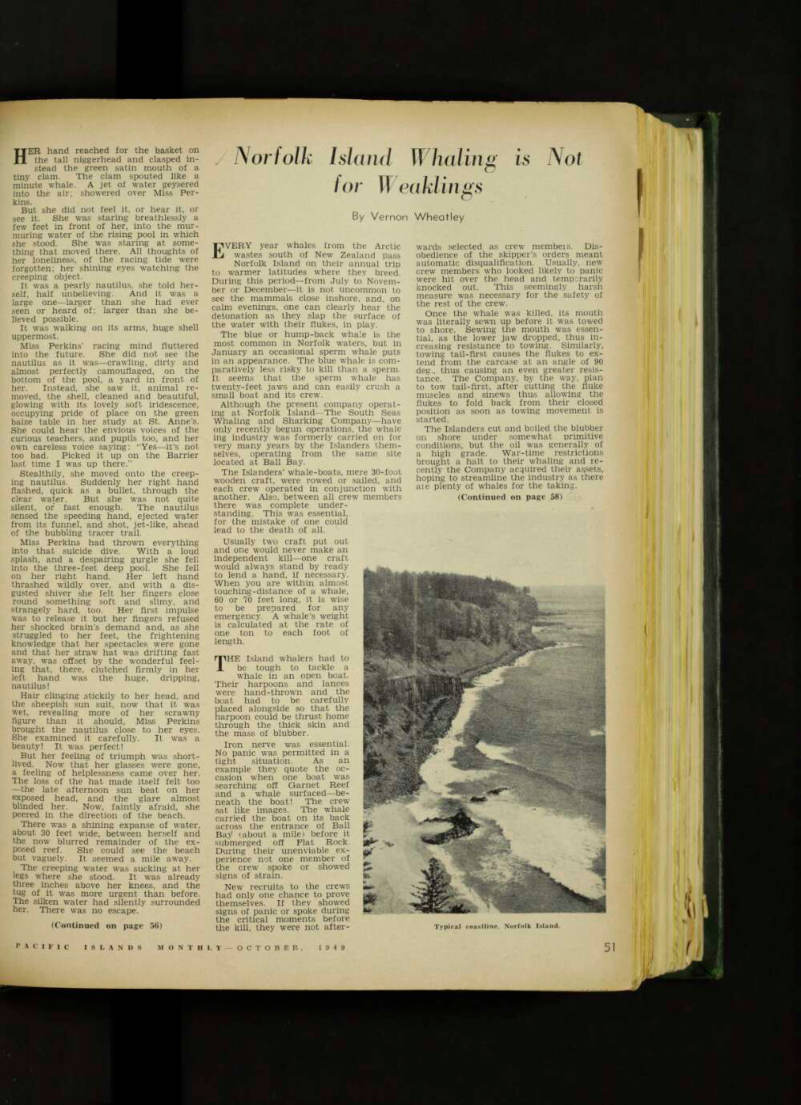
Typical coastline, Norfolk Island.
THE Company was started by Mr. and Mrs. Max Picard of Hamilton (NZO, and Captain K. Hansen, who has been responsible for the erection of most of the buildings and the plant, including winches, petrol engines, choppers and cutters and also the re-installation of the boiling pots. In this work he has been ably assisted by Messrs. Stan and Bill Buffet, Johnny Young, R. Quintal, of the Island, and Les D’Arcy of New Zealand.
Nestling at the foot of the steep hills which slope down to Ball Bay, the build ings do not offend the eye. The scenery and general surroundings are beautiful, and one would expect a whaling factory to be out of place in such a spot. Strangely, it is not. The buildings are unobstrusive and face a concrete apron running into the sea. On the apron the whales will be flensed and the strips of blubber will be hauled up a slide. The product will be pumped out at the other side of the building as oil, awaiting shipments over seas.
Last year the Company, with an un usual run of bad luck, tried to operate against many difficulties. A launch was acquired but it was not suited for the job.
It lacked that extra touch of speed and the weighty harpoon gun held its bow down. The Company have now acquired a chaser from Cook Strait (NZ) with a speed of 30 knots and more, plus a record of over 100 whales killed.
The original launch broke down after the beginning of the previous season and precious time was lost in making only temporary repairs. When all seemed set fair, the Island ran out of petrol. So the Company ceased operations for the season. However, this may have been to the ultimate good, for extra time was thus available for improvements, modifications and additions to the existing plant.
The Company deserves full credit for its virile approach to seemingly insur mountable difficulties, particularly m re gard to the lack of facilities and supplies.
A big problem lies ahead as there is in adequate road access to the Bay, while the anchorage also is not of the best like all Bays on the Island, it is suitable only when the wind is fair.
If the Company meets with the success it deserves, it will automatically have a bearing on the future economy of the Island.