Fiji Does Not Want A Change
p. 78 · Read in the full issue
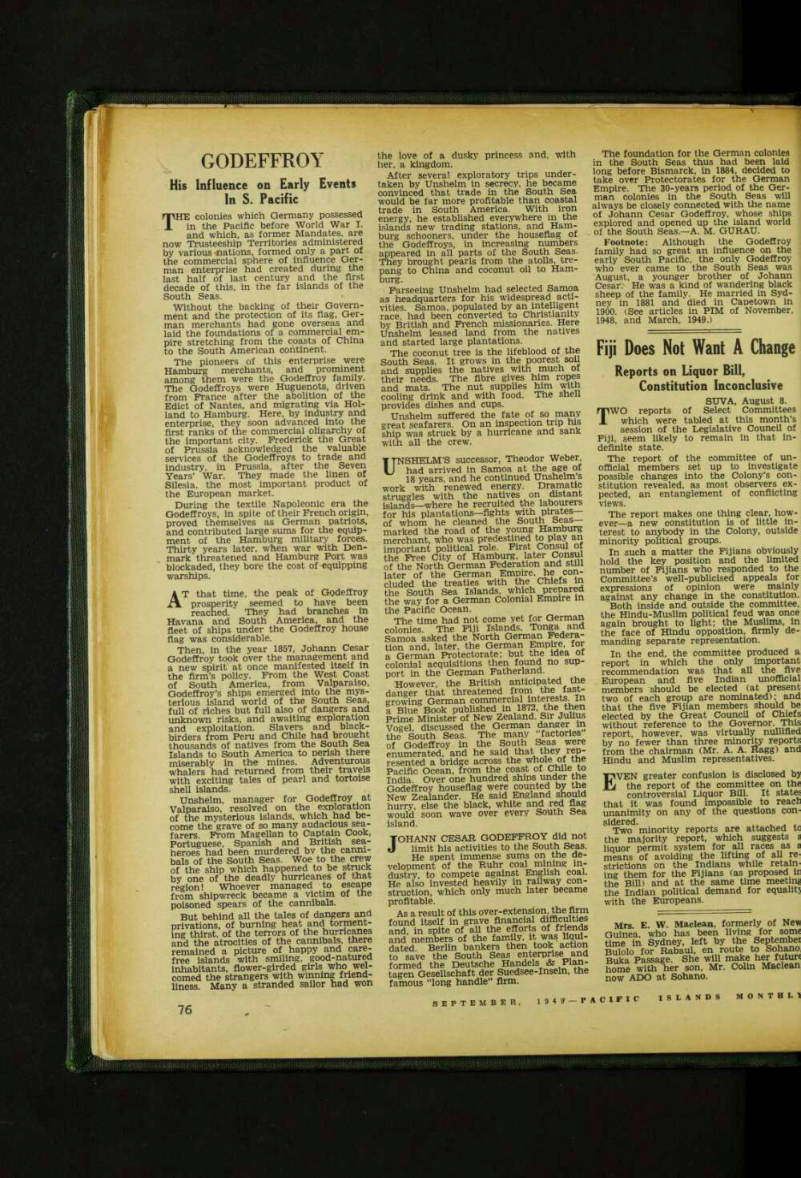
Reports on Liquor Bill, Constitution Inconclusive
SUVA, August 8.
TWO reports of Select Committees which were tabled at this month’s session of the Legislative Council of Fiji, seem likely to remain in that in definite state.
The report of the committee of un official members set up to investigate possible changes into the Colony’s con stitution revealed, as most observers ex pected, an entanglement of conflicting views.
The report makes one thing clear, how ever—a new constitution is of little in terest to anybody in the Colony, outside minority political groups.
In such a matter the Fijians obviously hold the key position and the limited number of Fijians who responded to the Committee’s well-publicised appeals for expressions of opinion were mainly against any change in the constitution.
Both inside and outside the committee, the Hindu-Muslim political feud was once again brought to light; the Muslims, in the face of Hindu opposition, firmly de manding separate representation.
In the end, the committee produced a report in which the only important recommendation was that all the five European and five Indian unofficial members should be elected (at present two of each group are nominated); and that the five Fijian members should be elected by the Great Council of Chiefs without reference to the Governor This report, however, was virtually nullified by no fewer than three minority reports from the chairman (Mr. A. A. Hagg) and Hindu and Muslim representatives.
EVEN greater confusion is disclosed by the report of the committee on the controversial Liquor Bill. It states that it was found impossible to reach unanimity on any of the questions con sidered. , . , .
Two minority reports are attached to the majority report, which suggests a liquor permit system for all races as a means of avoiding the lifting of all re strictions on the Indians while retain ing them for the Fijians (as proposed in the Bill) and at the same time meeting the Indian political demand for equalitj with the Europeans.
Mrs. E. W. Maclean, formerly of New Guinea, who has been living for some time in Sydney, left by the Bulolo for Rabaul, en route to Sohano, Buka Passage. She will make her future home with her son, Mr. Colin Maclean now ADO at Sohano.