Mixed Blood In Polynesia
pp. 72-76 · Read in the full issue
Examination of Some Unusual Social Problems
This article, by Ernest Beaglehole, of Victoria University College, was published in the last issue of “The Journal of the Polynesian Society,” of Wellington, NZ.
OVER the past century and a half race * mixture has been faMv continuous in the Polynesian islands of the Pacific From the time of their discovery
most islands have carried a numerically small alien population which has mixed with the island population.
A characteristic frontier society during this period, the alien elements were initially European men —runaway sailors, beachcombers, traders. Only the mission aries brought their wives. The other Europeans mated freely with the hospit able Polynesian islanders.
Later intrusive elements were Asiatics, Indians, a few Negroes and a few Japanese. With the exception of the Indians, these later-comers also mixed with the indigenous inhabitants.
The position to-day, therefore, is that the population of Polynesia consists of an unknown number of pure-blood Poly nesians and an equally unknown number of mixed-bloods. Keesing is of the opinion that at least one-ninth to one tenth of those who claim pure Polynesian ancestry to-day are of mixed heredity, and of those who claim to be non natives, a proportion certainly are of mixed blood.
The number of mixed-bloods in Poly nesia is difficult to calculate with any ac curacy, for two reasons. One is the fact that, over a century and a half of contact, distant intermarriages of several genera tions ago may well have been forgotten, or the intermixture of European blood may have come from passing liaisons which were forgotten as readily and as easily as they were formed. No shame has been involved, merely the forgetfulness of an easy-going people, with no handed
down European surname to keep memories alive.
The second reason is that Pacific census statistics more often than not classify according to legal and social concepts rather than follow biological classifica tions of the population. Hence the posi tion in Samoa, where many without European blood are legally classified as Europeans.
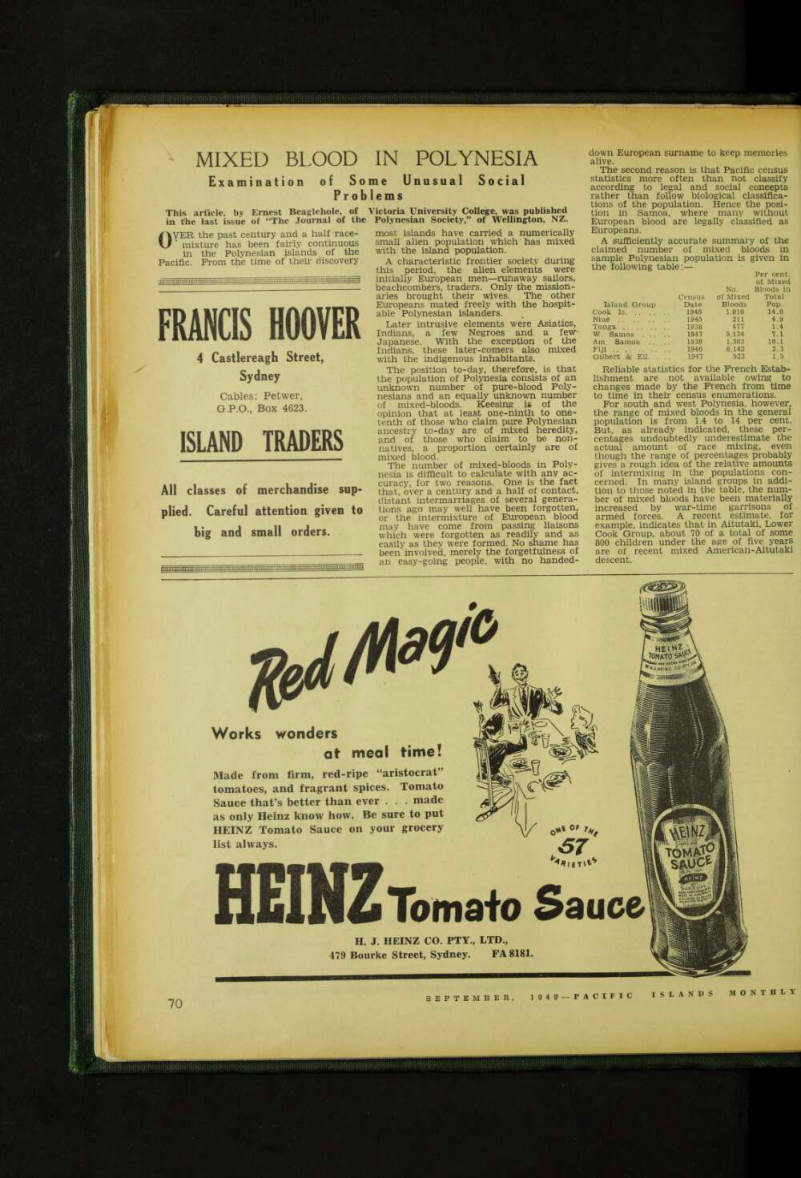
A sufficiently accurate summary of the claimed number of mixed bloods in sample Polynesian population is given in the following table: —
Reliable statistics for the French Estab lishment are not available owing to changes made by the French from time to time in their census enumerations.
For south and west Polynesia, however, the range of mixed bloods in the general population is from 1.4 to 14 per cent.
But, as already indicated, these per centages undoubtedly underestimate the actual amount of race mixing, even though the range of percentages probably gives a rough idea of the relative amounts of intermixing in the populations con cerned. In many island groups in addi tion to those noted in the table, the num ber of mixed bloods have been materially increased by war-time garrisons of armed forces. A recent estimate, for example, indicates that in Aitutaki, Lower Cook Group, about 70 of a total of some 800 children under the age of five years are of recent mixed American-Aitutaki descent.
Census No. of Mixed Per cent, of Mixed Bloods in Total Island Group Date Bloods Pop.
Cook Is 1945 1.910 14.0 Niue 1945 211 4.9 Tonga 1938 477 1.4 W. Samoa ... . 1947 . 5,134 7.1 Am. Samoa .. 1938 1,303 10.1 Fiji 1946 6,142 2.3 Gilbert & Ell. . . 1947 523 1.5
Apart from special war-time circum stances and with the exception of areas where separate mixed blood groups exist, there has always been a tendency for the mixed blood to marry back into the in digenous population. Thus there is a tendency in many islands for the mixed blood to be absorbed biologically and socially into the dominant native popu lation. leaving behind only Polynesian variants of European names as evidence of previous European contact.
By the time European mixture has been diluted to a thirty-second or a sixty fourth, as must be the case many times over in the Cook Islands, for instance, the influence of European heredity must be negligible biologically, and survive socially only in some vague family tradition or cherished inconsequential family heir loom.
THE biological position in Polynesia may now be summarised briefly. A large but unknown proportion of the oopulation of most Polynesian islands is of mixed European and/or Asiatic and Polynesian stocks. In many cases, the ilien blood has been absorbed comnletely oy the dominant Polynesian strains.
The Polynesian was a mixed-blood vhen he entered the Pacific: and the century or more that have passed since liscovery and contact with western Euro oean culture have merely continued a orocess of race mixing that has always nade Polynesia one of the oldest mixing jowls of the world.
If attention is now focussed on the social and economic status of the Poly nesian mixed-blood, there appears to ;xist two rather sharply differentiated ittitudes to this status, probably stem ning ultimately from historical influences mplicit in the type of European and the ype of settlements that were charac eristic of different island groups. In the last and south Pacific, French or British nave established a status of tolerance and icceptance for the mixed-blood.
In the west, notably in Samoa, German nfluence (and then a continuance of German tradition by New Zealand) set ip a marginal mixed-blood community übject to various social disadvantages, nd giving rise to-day to difficult prob ems of adjustment among the members )f this part-Samoa group. It may be rarth while analysing briefly the dif erences in this respect between east and zest Polynesia in order to set the social iroblem of the Polynesian mixed-blood a its proper perspective.
French Oceania ns an example of the widest tolerance being granted to offspring of inter-racial matings.
It has always been French colonial policy to avoid setting up a separate socially underprivileged class and to endeavour by every means to absorb mixed bloods into already existing social groups.
Thus the 1931 census of French Settle ments makes it possible to classify the population into four racial groups: whites (French and Europeans), Oceanians (French citizens and French subjects), Asiatics (Syrians, Chinese, Japanese), and Others (Foreign Oceanians and float ing native population). No mixed-bloods thus appear in the census classifications and to all intents and purposes there is social and economic equality for all the population groups under French oceanic jurisdiction.
In the Cook Islands there is similar social and economic equality. Although the 1945 Population Census continues the New Zealand practice of reporting the numbers of full-blood and native-Euro
peans under the three classifications of full-native, three-quarter native and half native, the figures must be accepted with such serious reservations that it is doubt ful whether they have even a rough ap proximate value.
In any case, there is no mixed-blood problem in the Cook Islands. The Cook Islanders are singularly unconscious of race distinction. All natives, whatever their ancestry, are immediately absorbed into native life and participate equally in the values of native society.
There is a small population of 180 Euro peans in all the Cook Islands—no more than one per cent, of the total population.
The Europeans comprise planters, traders, administrative officials and missionaries, their wives and children. Over 68 ner cent, were residents of more than five years’ standing, 50 per cent, of ten years or over, and 29 per cent, had exceeded twenty years of island residence. Thus, apart from a small minority who live for short periods in the Cook Islands the majority live there for substantial periods
and adapt themselves, as easily as the natives, to the prevailing tolerant social attitudes.
THE position in Western Samoa is very different from the tolerant eastern Pacific. Much of this difference must be due to the fact that German,
British and, under Mandate, New Zea land administration has, unlike the French, introduced into Samoa the racial consciousness and prejudice of Anglo- Saxon colonial society.
Successive censuses have set up statis tical and social distinctions which have
resulted, in Samoa, in the development of a segregated social group, known officially as Europeans of part-Samoan ancestry. Some 93 per cent, of this group consist of local-born part-Samoans, mixed-bloods who would have disap peared into the native societies of French Oceania or the Cook Islands, but who re main in Samoa an artificial group creat ing strain and tension in the whole of Samoan society.
Two points about this part-Samoan group are important to notice. First, the group is increasing very rapidly, and the majority being at the pre-productive age level, a further rapid increase can be confidently expected. The second point is that the definition of a part-Samoan has passed far beyond the simplicities of racial ancestry and is now purely a con cept with a complicated legal definition, which refers operationally to legal rights and limitations in regard to such matters as land-holding, schooling, court pro cedures.
The part-Samoan thus suffers from a number of serious disadvantages, and in return he is privileged to enjoy the doubt ful value of being a European, but a Euro pean with a big difference, a second-rate European in other words, who enjoys less favourable wages and other conditions of employment than personnel recruited from New Zealand.
That the distinctions which define this part-Samoan group are to-day purely arbitrary and technical is shown by the manner in which European status may be acquired. Europeans of part-Samoan ancestry are defined as (a) the legitimate descendants in the male line of Europeans; (b) persons with not more than 50 per cent. Samoan blood who peti tion the Court for European status; (c) persons not of Samoan status whose male ancestors have not more than 75 pr cent, of Polynesian blood.
Out of these technicalities, the situation arises where a person may be denied European status because his father was a full Samoan, but granted this status if his father were a full Chinese or Melanesian labourer.
It is estimated that about 15 per cent, of the “Europeans” in the territory pos sess not even the slightest trace of European or white ancestry in their racial make-up. Because of the sense of social superiority implicit in being a European many part-Samoans prefer European to Samoan status. Thus, up to March Sl. 1947 541 part-Samoans have petitioned for and been granted European status while only 27 with European status have petitioned to become Samoans, and of these three subsequently repetitioned to become Europeans.
These figures suggest that whatever the discrimination implicit J n traded as a European of part-Samoan ancestry many more mixed-bloods prefer Status than that 9 f being a Samoan.
Racial discrimination is, therefore a part of nresent-day Samoan society, with skin colom 5 influencing the kind and amount of schooling and hospital attention a person receives.
This discrimination, this “ranking source of deep-seated irritation, requires careful analysis with a. view to its. elim ination unless the strain and tension of a conflict of interests are going to con tinue to upset the harmony of Samoan social and political life.
TTnrrmeans of part-Samoan descent have contributed greatly in the past and continue to d 0 so to-day, to the economic and social leadership of the Territory^ b?o e odf h live h bar d ely m above a subsistence
standard of living as artisans, small traders, employees of business firms and of the administration.
To draw these part-Samoans into the great society that is modem Samoa, to utilise their skills and their capacities for leadership, and at the same time not an tagonise the pure Samoan population will require, during the next decades, states manship of high order. But the task is worth trying, if for no other reason than that at present Samoa stands out as an unfortunate exception to a more humane, wiser, general Polynesian pattern of be haviour towards the mixed-blood.
IT is curious that the one island group in Polynesia where the mixed-blood is a social problem and where person ality integration for the mixed-blood should be so difficult to achieve is Samoa.
Hawaii and New Zealand, the far north and far south of Polynesia, have pre sented few social problems for the mixed blood. East and south-east. French Oceania and the Cook Islands have ab sorbed those of mixed alien blood both biologically and socially.
The west alone stands out. Why, it is hard to say. Frontier life, large seaports are found elsewhere in Polynesia. Is the problem, therefore, a heritage from Ger man tradition and were consuls, German business men, administrators, and sons af missionaries so ashamed of association with Samoans that they unconsciously quietened their guilt by segregating the mixed blood? Some psychological ex planation is probably the correct one be cause neither purely social nor economic factors are sufficiently unique for Samoa o make socio-economic explanations com pletely plausible.
Some authorities are of the opinion that the basic prejudice against mixed-bloods in Samoa arises primarily from the So v* 16 ™ fri V 0 * true t ? at Ipl ?^ n ohnn l r nj>i§ a S. (^^r.c : Spe 'o! C <- R ' S t?°w , oL^ But * is ftj®9 highly probable, m Keesing notes, that mucil of thls discrimination is simply
a reflection on the part of the Samoan of attitudes and opinions about the mixed blood which the Samoan has acquired from the white officials, Before the German administration of Samoa, little, if any stigma was attached to the mixed-blood. His problems, there fore, are to-day typically those of a
marginal man caught in the pincers of a double prejudice. The problem of solving the status of the; mixed-blood m Samoa is thus made doubly difficult, but it still
noTTe 5
social skills of the new Samoa.