Societies Boom In
p. 50 · Read in the full issue
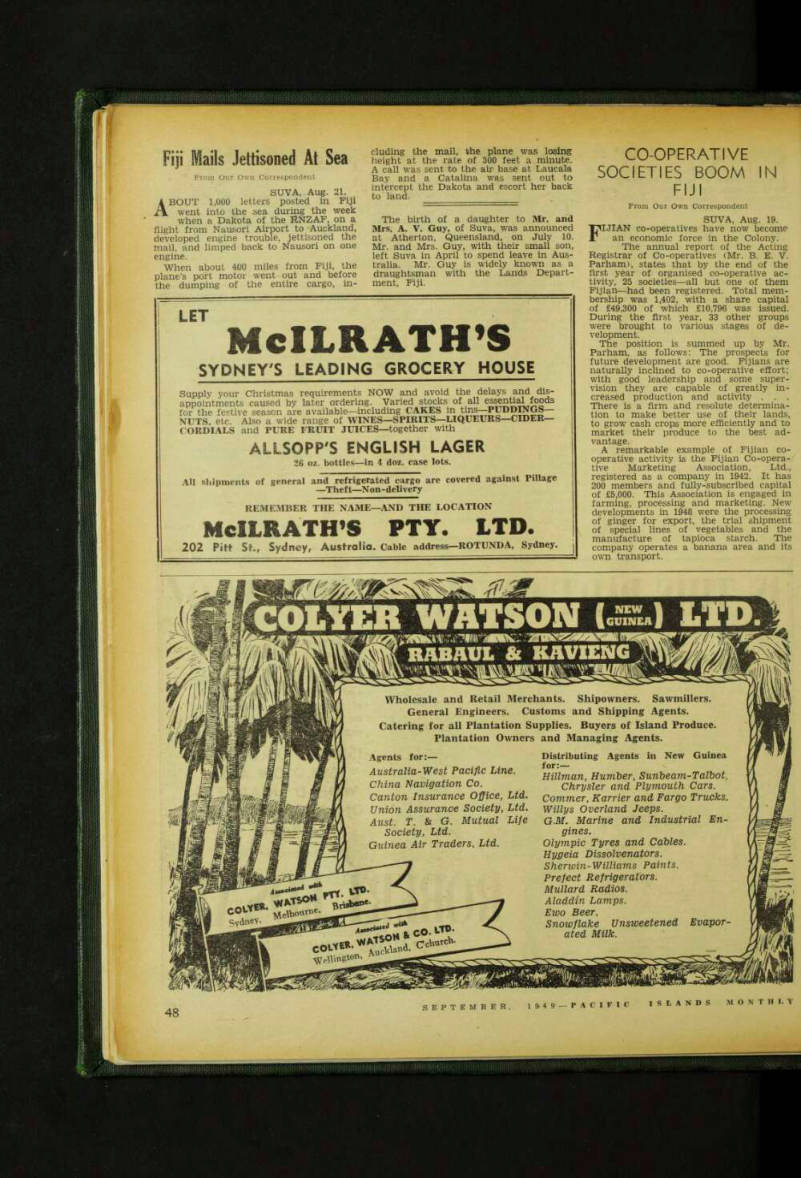
Co-Operative
Fiji
From Our Own Correspondent
Suva, Aug. 19.
FIJIAN co-operatives have now become an economic force in the Colony.
The annual report of the Acting Registrar of Co-operatives (Mr. B. E. V.
Parham), states that by the end of the first year of organised co-operative ac tivity, 25 societies —all but one of them Fijian—had been registered. Total mem bership was 1,402, with a share capital of £49,300 of which £10,796 was issued.
During the first year, 33 other groups were brought to various stages of de velopment.
The position is summed up by Mr.
Parham, as follows: The prospects for future development are good. Fijians are naturally inclined to co-operative effort; with good leadership and some super vision they are capable of greatly in creased production and activity . , .
There is a firm and resolute determina tion to make better use of their lands, to grow cash crops more efficiently and to market their produce to the best ad vantage.
A remarkable example of Fijian co operative activity is the Fijian Co-opera tive Marketing Association, Ltd., registered as a company in 1942. It has 200 members and fully-subscribed capital of £5,000. This Association is engaged in farming, processing and marketing. New developments in 1948 were the processing of ginger for export, the trial shipment of special lines of vegetables and the manufacture of tapioca starch. The company operates a banana area and its own transport.