Question of Sugar , Copra Export
p. 21 · Read in the full issue
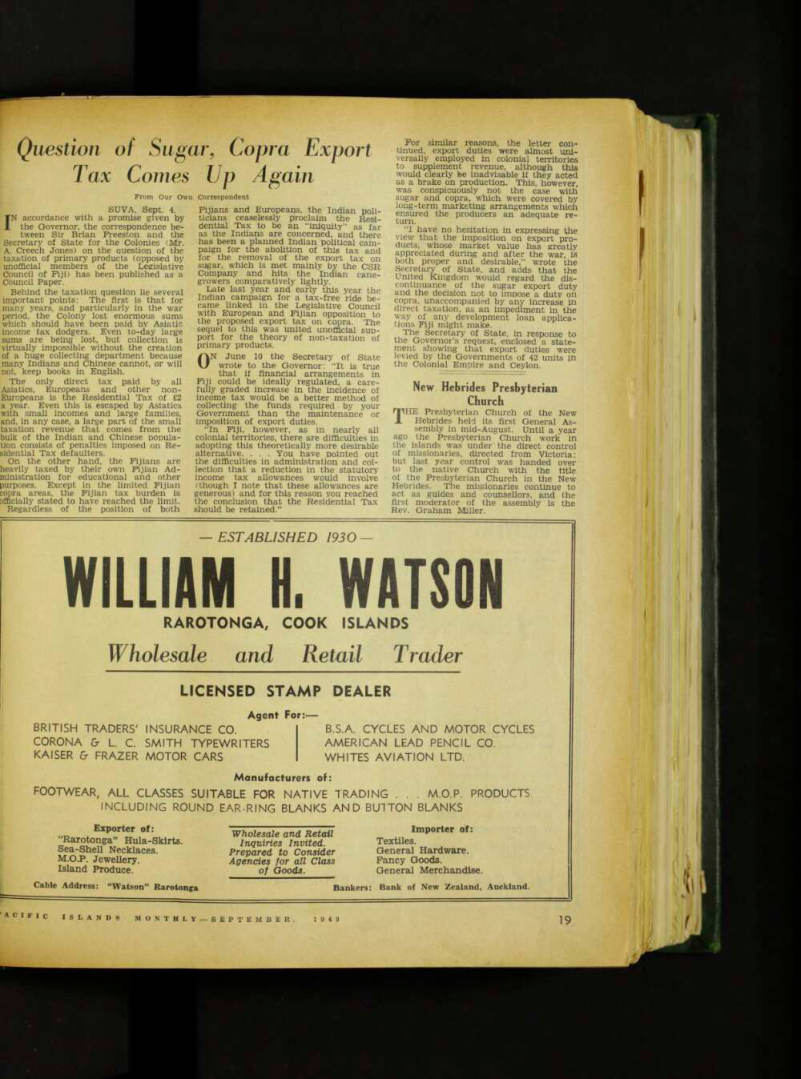
Tax Comes Up Again
From Our Own Correspondent
SUVA, Sept. 4.
IN accordance with a promise given by the Governor, the correspondence be tween Sir Brian Preeston and the Secretary of State for the Colonies (Mr.
A. Creech Jones) on the question of the taxation of primary products (opposed by unofficial members of the Legislative Council of Fiji) has been published as a Council Paper.
Behind the taxation question lie several important points: The first is that for many years, and particularly in the war period, the Colony lost enormous sums which should have been paid by Asiatic income tax dodgers. Even to-day large sums are being lost, but collection is virtually impossible without the creation of a huge collecting department because many Indians and Chinese cannot, or will not, keep books in English.
The only direct tax paid by all Asiatics, Europeans and other non- Europeans is the Residential Tax of £2 a year. Even this is escaped by Asiatics with small incomes and large families, and, in any case, a large part of the small taxation revenue that comes from the bulk of the Indian and Chinese popula tion consists of penalties imposed on Re sidential Tax defaulters.
On the other hand, the Fijians are heavily taxed by their own Fijian Ad ministration for educational and other purposes. Except in the limited Fijian copra areas, the Fijian tax burden is officially stated to have reached the limit.
Regardless of the position of both
Fijians and Europeans, the Indian poli ticians ceaselessly proclaim the Resi dential Tax to be an “iniquity” as far as the Indians are concerned, and there has been a planned Indian political cam paign for the abolition of this tax and for the removal of the export tax on sugar, which is met mainly by the CSR Company and hits the Indian cane growers comparatively lightly.
Late last year and early this year the Indian campaign for a tax-free ride be came linked in the Legislative Council with European and Fijian opposition to the proposed export tax on copra. The sequel to this was united unofficial sup port for the theory of non-taxation of primary products, ON June 10 the Secretary of State wrote to the Governor: “It is true that if financial arrangements in Fiji could be ideally regulated, a care fully graded increase in the incidence of income tax would be a better method of collecting the funds required by your Government than the maintenance or imposition of export duties.
“In Fiji, however, as in nearly all colonial territories, there are difficulties in adopting this theoretically more desirable alternative. . . . You have pointed out the difficulties in administration and col lection that a reduction in the statutory income tax allowances would involve (though I note that these allowances are generous) and for this reason you reached the conclusion that the Residential Tax should be retained.”
For similar reasons, the letter con tinued, export duties were almost uni versally employed in colonial territories to supplement revenue, although this would clearly be inadvisable if they acted as a brake on production. This, however, was conspicuously not the case with sugar and copra, which were covered by long-term marketing arrangements which ensured the producers an adequate re turn.
“I have no hesitation in expressing the view that the imposition on export pro ducts, whose market value has greatly appreciated during and after the war, is both proper and desirable,” wrote the Secretary of State, and adds that the United Kingdom would regard the dis continuance of the sugar export duty and the decision not to impose a duty on copra, unaccompanied by any increase in direct taxation, as an impediment in the way of any development loan applica tions Fiji might make.
The Secretary of State, in response to the Governor’s request, enclosed a state ment showing that export duties were levied by the Governments of 42 units in the Colonial Empire and Ceylon.