An ‘Annexation’ That Britain
p. 15 · Read in the full issue
Repudiated
Chester Incident in Port Moresby in 1883
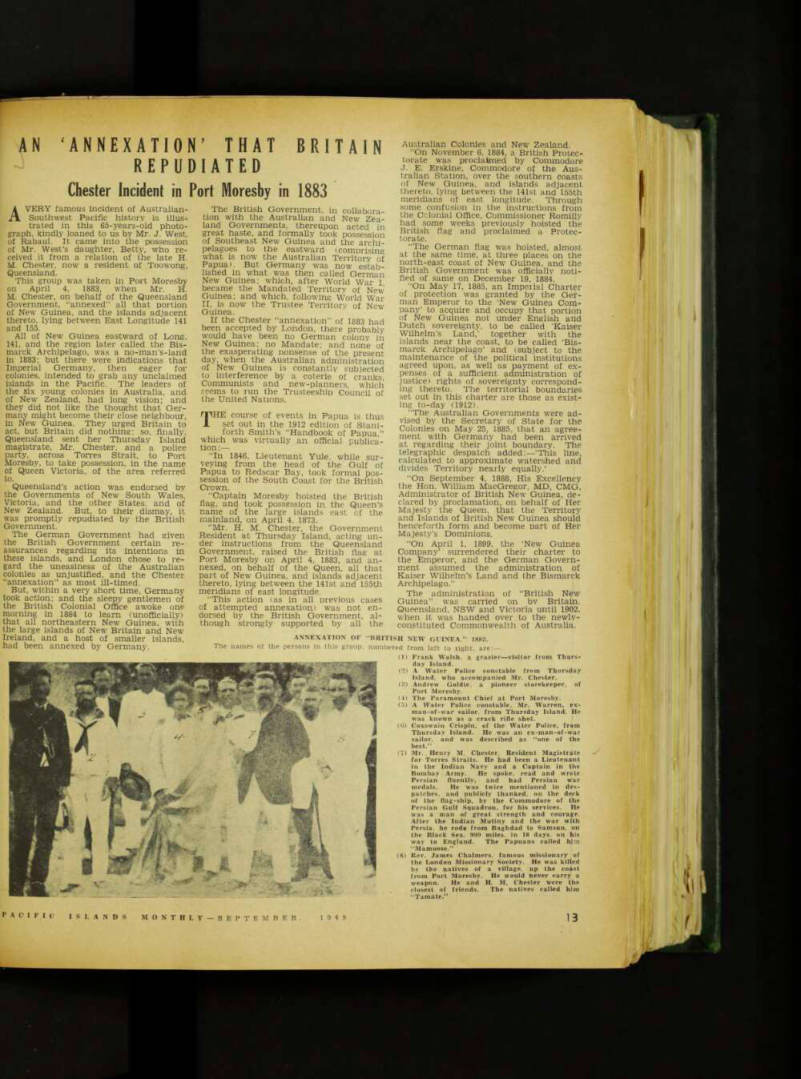
AVERY famous incident of Australian- Southwest Pacific history is illus trated in this 65-years-old photo graph, kindly loaned to us by Mr. J. West, of Rabaul. It came into the possession of Mr. West’s daughter, Betty, who re ceived it from a relation of the late H.
M. Chester, now a resident of Toowong, Queensland.
This group was taken in Port Moresby on April 4, 1883, when Mr. H.
M. Chester, on behalf of the Queensland Government, “annexed” all that portion of New Guinea, and the islands adjacent thereto, lying between East Longitude 141 and 155.
All of New Guinea eastward of Long. 141, and the region later called the Bis marck Archipelago, was a no-man’s-land in 1883; but there were indications that Imperial Germany, then eager for colonies, intended to grab any unclaimed islands in the Pacific. The leaders of the six young colonies in Australia, and of New Zealand, had long vision; and they did not like the thought that Ger many might become their close neighbour, in New Guinea. They urged Britain to act, but Britain did nothing: so, finally, Queensland sent her Thursday Island magistrate, Mr. Chester, and a police party, across Torres Strait, to Port Moresby, to take possession, in the name of Queen Victoria, of the area referred to.
Queensland’s action was endorsed by the Governments of New South Wales, Victoria, and the other States, and of New Zealand. But, to their dismay, it was promptly repudiated by the British Government.
The German Government had given the British Government certain re assurances regarding its intentions in these islands, and London chose to re gard the uneasiness of the Australian colonies as unjustified, and the Chester “annexation” as most ill-timed.
But, within a very short time, Germany took action; and the sleepy gentlemen of the British Colonial Office awoke one morning in 1884 to learn (unofficially) that all northeastern New Guinea, with the large islands of New Britain and New Ireland, and a host of smaller islands, had been annexed by Germany.
The British Government, in collabora tion with the Australian and New Zea land Governments, thereupon acted in great haste, and formally took possession of Southeast New Guinea and the archi pelagoes to the eastward (comprising what is now the Australian Territory of Papua). But Germany was now estab lished in what was then called German New Guinea: which, after World War I became the Mandated Territory of New Guinea; and which, following World War 11, is now the Trustee Territory of New Guinea.
If the Chester “annexation” of 1883 had been accepted by London, there probably would have been no German colony in New Guinea; no Mandate: and none of the exasperating nonsense of the present day, when the Australian administration of New Guinea is constantly subjected to interference by a coterie of cranks Communists and new-planners, which seems to run the Trusteeship Council of the United Nations.
THE course of events in Papua is thus set out in the 1912 edition of Stani forth Smith’s “Handbook of Papua,” which was virtually an official publica tion:— “In 1846, Lieutenant Yule, while sur veying from the head of the Gulf of Papua to Redscar Bay, took formal pos session of the South Coast for the British Crown.
“Captain Moresby hoisted the British flag, and took possession in the Queen’s name of the large islands east of the mainland, on April 4, 1873.
“Mr. H. M. Chester, the Government Resident at Thursday Island, acting un der instructions from the Queensland Government, raised the British flag at Port Moresby on April 4, 1883, and an nexed, on behalf of the Queen, all that part of New Guinea, and islands adjacent thereto, lying between the 141st and 155th meridians of east longitude.
“This action (as in all previous cases of attempted annexation) was not en dorsed by the British Government, al though strongly supported by all the
Australian Colonies and New Zealand.
"On November 6, 1884, a British Protec torate was proclaimed by Commodore J. E. Erskine, Commodore of the Aus tralian Station, over the southern coasts of New Guinea, and islands adjacent thereto, lying between the 141st and 155th meridians of east longitude. Through some confusion in the instructions from the Colonial Office, Commissioner Romilly had some weeks previously hoisted the British flag and proclaimed a Protec torate.
“The German flag was hoisted, almost at the same time, at three places on the north-east coast of New Guinea, and the British Government was officially noti fied of same on December 19, 1884.
“On May 17, 1885, an Imperial Charter of protection was granted by the Ger man Emperor to the ‘New Guinea Com pany’ to acquire and occupy that portion of New Guinea not under English and Dutch sovereignty, to be called ‘Kaiser Wilhelm’s Land,’ together with the islands near the coast, to be called ‘Bis marck Archipelago’ and (subject to the maintenance of the political institutions agreed upon, as well as payment of ex penses of a sufficient administration of justice) rights of sovereignty correspond ing thereto. The territorial boundaries set out in this charter are those as exist ing to-day (1912).
“The Australian Governments were ad vised by the Secretary of State for the Colonies on May 25, 1885, that an agree ment with Germany had been arrived at regarding their joint boundary. The telegraphic despatch added:—‘This line, calculated to approximate watershed and divides Territory nearly equally.’
“On September 4, 1888, His Excellency the Hon. William MacGregor, MD, CMG, Administrator of British New Guinea, de clared by proclamation, on behalf of Her Majesty the Queen, that the Territory and Islands of British New Guinea should henceforth form and become part of Her Majesty’s Dominions.
“On April 1, 1899, the ‘New Guinea Company’ surrendered their charter to the Emperor, and the German Govern ment assumed the administration of Kaiser Wilhelm’s Land and the Bismarck Archipelago.”
The administration of “British New Guinea” was carried on bv Britain, Queensland. NSW and Victoria until 1902. when it was handed over to the newlv constituted Commonwealth of Australia.
Annexation Of “British New Guinea,” 1883.
The names of the persons in this group, numbered from left to right, are:—
(1) Frank Walsh, a grazier—visitor from Thurs day Island. (2) A Water Police constable from Thursday Island, who accompanied Mr. Chester. (3) Andrew Goldie, a pioneer storekeeper, of Port Moresby. (4) The Paramount Chief at Port Moresby. (5) A Water Police constable, Mr. Warren, ex man-of-war sailor, from Thursday Island. He was known as a crack rifle shot. (6) Coxswain Crispin, of the Water Police, from Thursday Island. He was an ex-man-of-war sailor, and was described as “one of the best.” (7) Mr. Henry M. Chester. Resident Magistrate for Torres Straits. He had been a Lieutenant in the Indian Navy and a Captain in the Bombay Army. He spoke, read and wrote Persian fluently, and had Persian war medals. He was twice mentioned in des patches. and publicly thanked, on the deck of the flag-ship, by the Commodore of the Persian Gulf Squadron, for his services. He was a man of great strength and courage.
After the Indian Mutiny and the war with Persia, he rode from Baghdad to Samsun, on the Black Sea, 999 miles, in 18 days, on his way to England. The Papuans called him “Mamoose.” (8) Rev. James Chalmers, famous missionary of the London Missionary Society. He was killed by the natives of a village, up the coist from Port Moresby. He would never carry a weapon. He and H. M. Chester were the closest of friends. The natives called him “Tamate.”