Echo of “Deep Water and Shoal ”
p. 55 · Read in the full issue
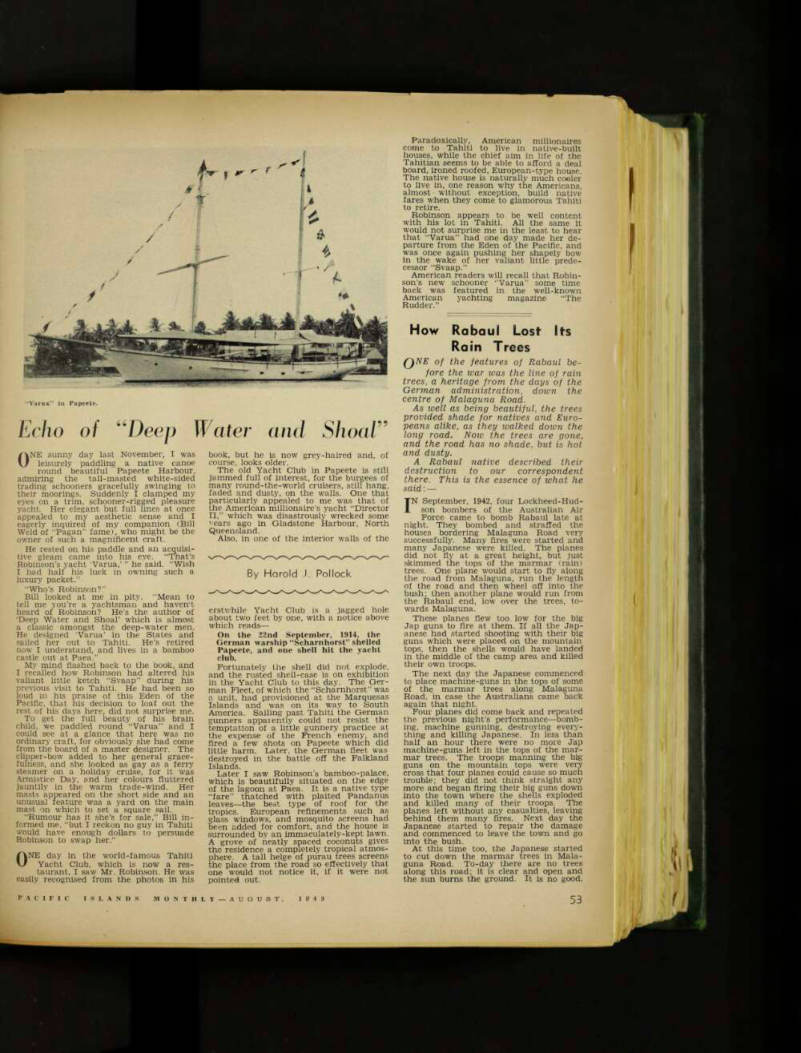
ONE sunny day last November, I was leisurely paddling a native canoe round beautiful Papeete Harbour, admiring the tall-masted white-sided trading schooners gracefully swinging to their moorings. Suddenly I clamped my eyes on a trim, schooner-rigged pleasure yacht. Her elegant but full lines at once appealed to my aesthetic sense and I eagerly inquired of my companion (Bill Weld of “Pagan” fame), who might be the owner of such a magnificent craft.
He rested on his paddle and an acquisi tive gleam came into his eye. “That’s Robinson’s yacht ‘Varua,’ ” he said. “Wish I had half his luck in owning such a luxury packet.”
“Who’s Robinson?”
Bill looked at me in pity. “Mean to tell me you’re a yachtsman and haven‘t heard of Robinson? He’s the author of ‘Deep Water and Shoal’ which is almost a classic amongst the deep-water men.
He designed ‘Varua’ in the States and sailed her out to Tahiti. He’s retired now I understand, and lives in a bamboo castle out at Paea.”
My mind flashed back to the book, and I recalled how Robinson had altered his valiant little ketch “Svaap” during his previous visit to Tahiti. He had been so loud in his praise of this Eden of the Pacific, that his decision to loaf out the rest of his days here, did not surprise me.
To get the full beauty of his brain child, we paddled round “Varua” and I could see at a glance that here was no ordinary craft, for obviously she had come from the board of a master designer. The clipper-bow added to her general grace fulness, and she looked as gay as a ferry steamer on a holiday cruise, for it was Armistice Day, and her colours fluttered jauntily in the warm trade-wind. Her masts appeared on the short side and an unusual feature was a yard on the main mast on which to set a square sail.
“Rumour has it she’s for sale,” Bill in formed me, “but I reckon no guy in Tahiti would have enough dollars to persuade Robinson to swap her.”
ONE day in the world-famous Tahiti Yacht Club, which is now a res taurant, I saw Mr. Robinson. He was easily recognised from the photos in his
book, but he is now grey-haired and, of course, looks older.
The old Yacht Club in Papeete is still jammed full of interest, for the burgees of many round-the-world cruisers, still hang, faded and dusty, on the walls. One that particularly appealed to me was that of the American millionaire’s yacht “Director II,” which was disastrously wrecked some years ago in Gladstone Harbour, North Queensland.
Also, in one of the interior walls of the
By Harold J. Pollock
erstwhile Yacht Club is a jagged hole about two feet by one, with a notice above which reads — On the 22nd September, 1914, the German warship “Scharnhorst” shelled Papeete, and one shell hit the yacht club.
Fortunately the shell did not explode, and the rusted shell-case is on exhibition in the Yacht Club to this day. The Ger man Fleet, of which the “Scharnhorst” was a unit, had provisioned at the Marquesas Islands and was on its way to South America. Sailing past Tahiti the German gunners apparently could not resist the temptation of a little gunnery practice at the expense of the French enemy, and fired a few shots on Papeete which did little harm. Later, the German fleet was destroyed in the battle off the Falkland Islands.
Later I saw Robinson’s bamboo-palace, which is beautifully situated on the edge of the lagoon at Paea. It is a native type “fare” thatched with plaited Pandanus leaves —the best type of roof for the tropics. European refinements such as glass windows, and mosquito screens had been added for comfort, and the house is surrounded by an immaculately-kept lawn.
A grove of neatly spaced coconuts gives the residence a completely tropical atmos phere. A tall hedge of purau trees screens the place from the road so effectively that one would not notice it, if it were not pointed out.
Paradoxically, American millionaires come to Tahiti to live in native-built houses, while the chief aim in life of the Tahitian seems to be able to afford a deal board, ironed roofed, European-type house.
The native house is naturally much cooler to live in, one reason why the Americans, almost without exception, build native fares when they come to glamorous Tahiti to retire.
Robinson appears to be well content with his lot in Tahiti. All the same it would not surprise me in the least to hear that “Varua” had one day made her de parture from the Eden of the Pacific, and was once again pushing her shapely bow in the wake of her valiant little prede cessor “Svaap.”
American readers will recall that Robin son’s new schooner “Varua” some time back was featured in the well-known American yachting magazine “The Rudder.”
“Varua” in Papeete.