Shock To New Hebrides
p. 35 · Read in the full issue
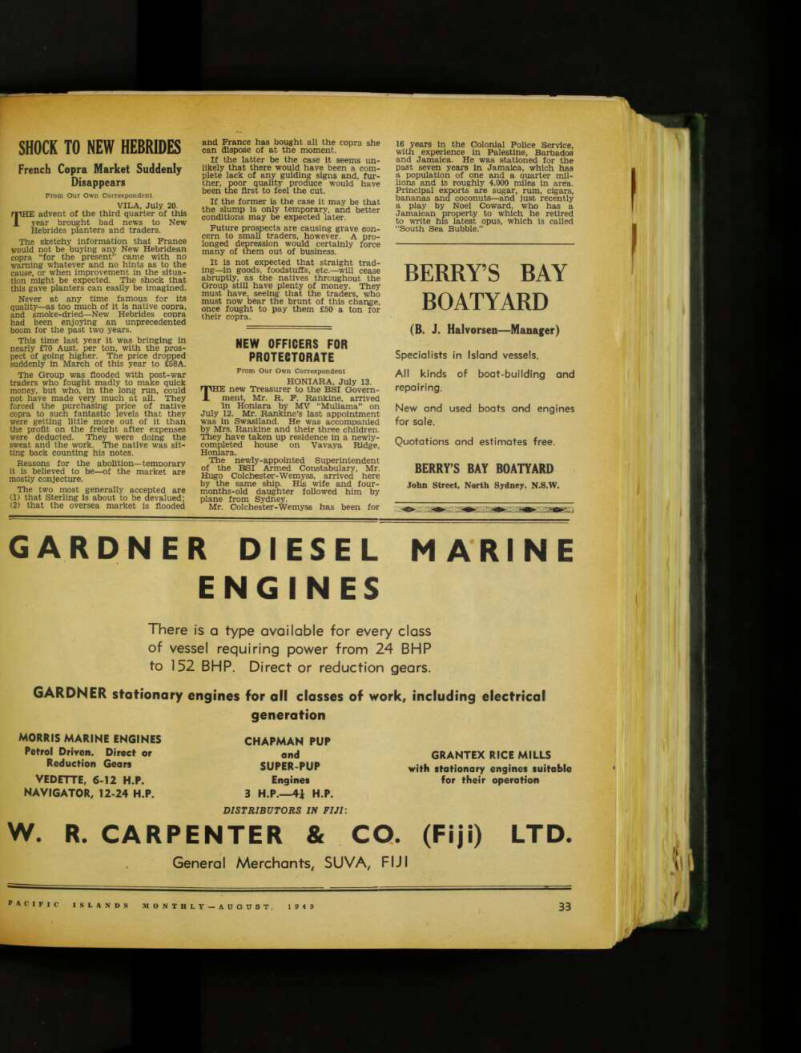
French Copra Market Suddenly Disappears
From Our Own Correspondent VILA, July 20.
THE advent of the third quarter of this year brought bad news to New Hebrides planters and traders.
The sketchy information that Prance would not be buying any New Hebridean copra “for the present” came with no warning whatever and no hints as to the cause, or when improvement in the situa tion might be expected. The shock that this gave planters can easily be imagined.
Never at any time famous for its quality—as too much of it is native copra, and smoke-dried —New Hebrides copra had been enjoying an unprecedented boom for the past two years.
This time last year it was bringing in nearly £70 Aust. per ton, with the prospect of going higher. The price dropped suddenly in March of this year to £58A.
The Group was flooded with post-war traders who fought madly to make quick money, but who, in the long run, could not have made very much at all. They forced the purchasing price of native copra to such fantastic levels that they were getting little more out of it than the profit on the freight after expenses were deducted. They were doing the sweat and the work. The native was sit ting back counting his notes.
Reasons for the abolition—temporary it is believed to be—of the market are mostly conjecture.
The two most generally accepted are (1) that Sterling is about to be devalued; (2) that the oversea market is flooded
and France has bought all the copra she can dispose of at the moment.
If the latter be the case it seems un likely that there would have been a com plete lack of any guiding signs and, fur ther, poor quality produce would have been the first to feel the cut.
If the former is the case it may be that the slump is only temporary, and better conditions may be expected later.
Future prospects are causing grave con cern to small traders, however. A pro longed depression would certainly force many of them out of business.
It is not expected that straight trad ing—in goods, foodstuffs, etc.—will cease abruptly, as the natives throughout the Group still have plenty of money. They must have, seeing that the traders, who must now bear the brunt of this change, once fought to pay them £50 a ton for their copra.