Death Of D. W. Amos
pp. 29-30 · Read in the full issue
Business Man Who Tackled Urgent Pacific Health Problem Single Handed
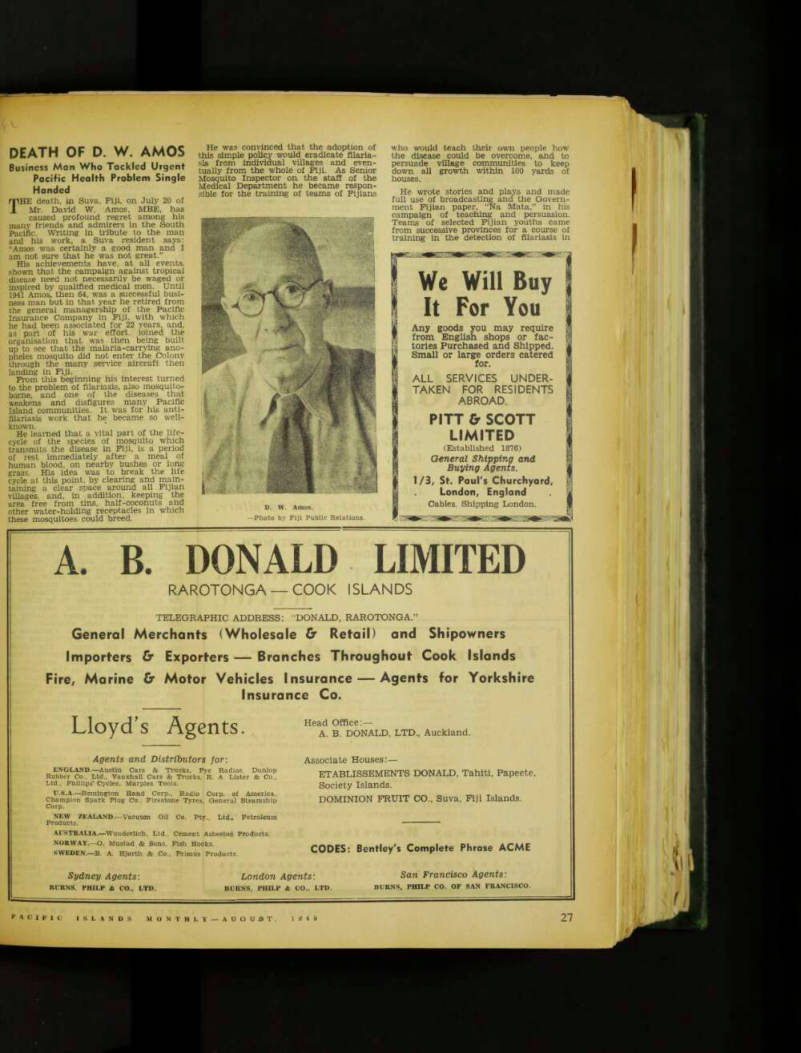
THE death, in Suva, Fiji, on July 20 of Mr. David W. Amos, MBE, has caused profound regret among his many friends and admirers in the South Pacific. Writing in tribute to the man and his work, a Suva resident says: “Amos was certainly a good man and I am not sure that he was not great.”
His achievements have, at all events, shown that the campaign against tropical disease need not necessarily be waged or inspired by qualified medical men. Until 1941 Amos, then 64, was a successful busi ness man but in that year he retired from the general managership of the Pacific Insurance Company in Fiji, with which he had been associated for 22 years, and, as part of his war effort, joined the organisation that was then being built up to see that the malaria-carrying ano pheles mosquito did not enter the Colony through the many service aircraft then landing in Fiji.
Prom this beginning his interest turned to the problem of filariasis, also mosquito borne, and one of the diseases that weakens and disfigures many Pacific Island communities. It was for his anti filariasis work that he became so well known.
He learned that a vital part of the life cycle of the species of mosquito which transmits the disease in Fiji, is a period of rest immediately after a meal of human blood, on nearby bushes or long grass. His idea was to break the life cycle at this point, by clearing and main taining a clear space around all Fijian villages, and, in addition, keeping the area free from tins, half-coconuts and other water-holding receptacles in which these mosquitoes could breed.
He was convinced that the adoption of is simple policy would eradicate fllariasis from individual villages and evendually from the whole of Fiji. As Senior Mosquito Inspector on the staff of the Medical Department he became responsible for training of teams of Fijians
who would teach their own people how the disease could be overcome, and to persuade village communities to keep down all growth within 100 yards of houses.
He wrote stories and plays and made full use of broadcasting and the Govern ment Fijian paper, “Na Mata,” in his campaign of teaching and persuasion.
Teams of selected Fijian youths came from successive provinces for a course of training in the detection of filariasis in
D. W. Amos. —Photo by Fiji Public Relations.
human beings, and in the life habits of mosquitoes of various types. As each team was trained, its members returned to the provinces from which they came to spread the knowledge gained and to direct antifilariasis work in conjunction with ofiicers of the Medical Department and with the Fijian local authorities.
The campaign of persuasion was not successful everywhere but in places where the cleaning-up policy was adopted and maintained there was great improvement in the general health of sufferers from filariasis and no fresh cases appeared.
The whole basis of Mr. Amos training scheme was to impress upon his Fijian trainees the idea of service to their own people, rather than the attitude that they were merely taking on a job of work. He believed implicitly that health education among Pacific peoples could not be imposed upon them from outside, but could be taught only from trained and enthusiastic natives who had not grown away from
their own people. This, he believed, had already been proved conclusively by the successful training of Native Medical Practitioners at the Central Medical School in Suva, who returned to give ser vice to their own native communities, He had little real support, at least in the beginning, but he believed that the work; was worth doing. No disappoint ments—and he had many turned him from his path. He knew that the process of such health education could not be hurried and he resisted those who called for quick results or yelled that he was not getting anywhere.
Just before he died his training pro gramme was almost complete and he looked forward to being able to assess the value of the campaign for which he was responsible.
HIS pioneering work attracted the attention of overseas experts and before the launching of anti-filariasis campaigns in other Pacific territories in recent years, those responsible first came
to Fiji to study Mr. Amos’ methods. He was invited by the New Zealand Govern ment to visit the Cook Islands and Wes tern Samoa to advise on the organisation of a campaign against the disease in those territories.
His anti-mosquito work followed years of public-spirited activities. Mr. Amos was one of the founders of the Suva Rotary Club and remained one of its most enthusiastic supporters. He was an active member of the Fiji Club and was for a number of years its secretary. He was prominent in amateur dramatic circles in Suva. During the latter years of the war, he made himself responsible for the re ception of overseas news for re-broad casting by the Fiji station ZJV.
In this year’s New Year Honours he was awarded the MBE.
He is survived by his widow and two daughters of a former marriage.