Timber!
p. 13 · Read in the full issue
N. Guinea Administration Helps River Natives To Establish New Industry
A contributor describes how, in
NG, Sepik natives take rafts of
logs hundreds of miles down the great river, to a saivmill near the
coast, for the production of
much-needed timber.
DID the natives become tired of waiting for their “big cargo”? Or was it due to the powerful influence of the energetic ADO of Angoram? Or was it brought about by a combination of both?
At all events, we have entered the timber era on the Sepik and all over the land near the main river and its tribu taries the bush is echoing to the sound of axes and the fall of trees —Quila or soft wood —of any size manageable by the natives.
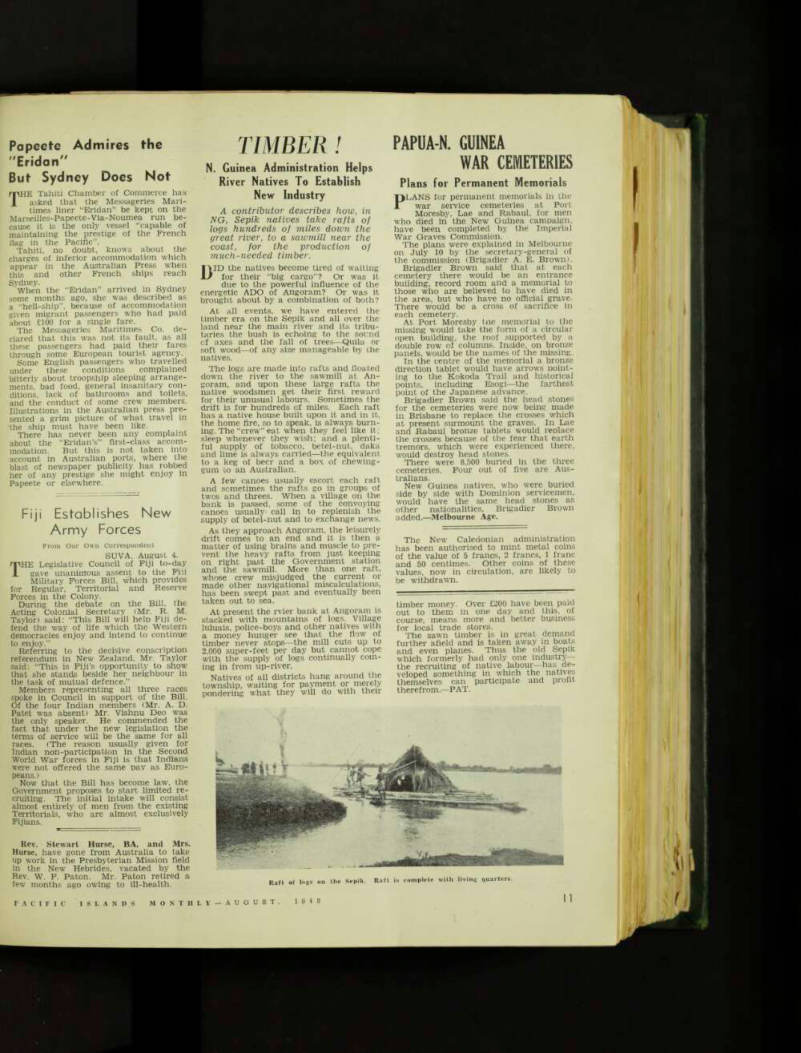
The logs are made into rafts and floated down the river to the sawmill at An goram, and upon these large rafts the native woodsmen get their first reward for their unusual labours. Sometimes the drift is for hundreds of miles. Each raft has a native house built upon it and in it, the home fire, so to speak, is always burn ing. The “crew” eat when they feel like it; sleep whenever they wish; and a plenti ful supply of tobacco, betel-nut, daka and lime is always carried —the equivalent to a keg of beer and a box of chewing gum to an Australian.
A few canoes usually escort each raft and sometimes the rafts go in groups of twos and threes. When a village on the bank is passed, some of the convoying canoes usually call in to replenish the supply of betel-nut and to exchange news.
As they approach Angoram, the leisurely drift comes to an end and it is then a matter of using brains and muscle to pre vent the heavy rafts from just keeping on right past the Government station and the sawmill. More than one raft, whose crew misjudged the current or made other navigational miscalculations, has been swept past and eventually been taken out to sea.
At present the rvier bank at Angoram is stacked with mountains of logs. Village luluais, police-boys and other natives with a money hunger see that the flow of timber never stops—the mill cuts up to 2,000 super-feet per day but cannot cope with the supply of logs continually com ing in from up-river.
Natives of all districts hang around the township, waiting for payment or merely pondering what they will do with their
timber money. Over £200 have been paid out to them in one day and this, of course, means more and better business for local trade stores.
The sawn timber is in great demand further afield and is taken away in boats and even planes. Thus the old Sepik which formerly had only one industry— the recruiting of native labour—has de veloped something in which the natives themselves can participate and profit therefrom. —PAT.
Raft Of logs on the Sepik. Raft is complete with living quarters.