Governor Warns Fiji Indians
pp. 11-93 · Read in the full issue
Of Over-Population Peril
Britain Will Maintain Pledges Given to Fijians
From Our Own Correspondent SUVA, August 2.
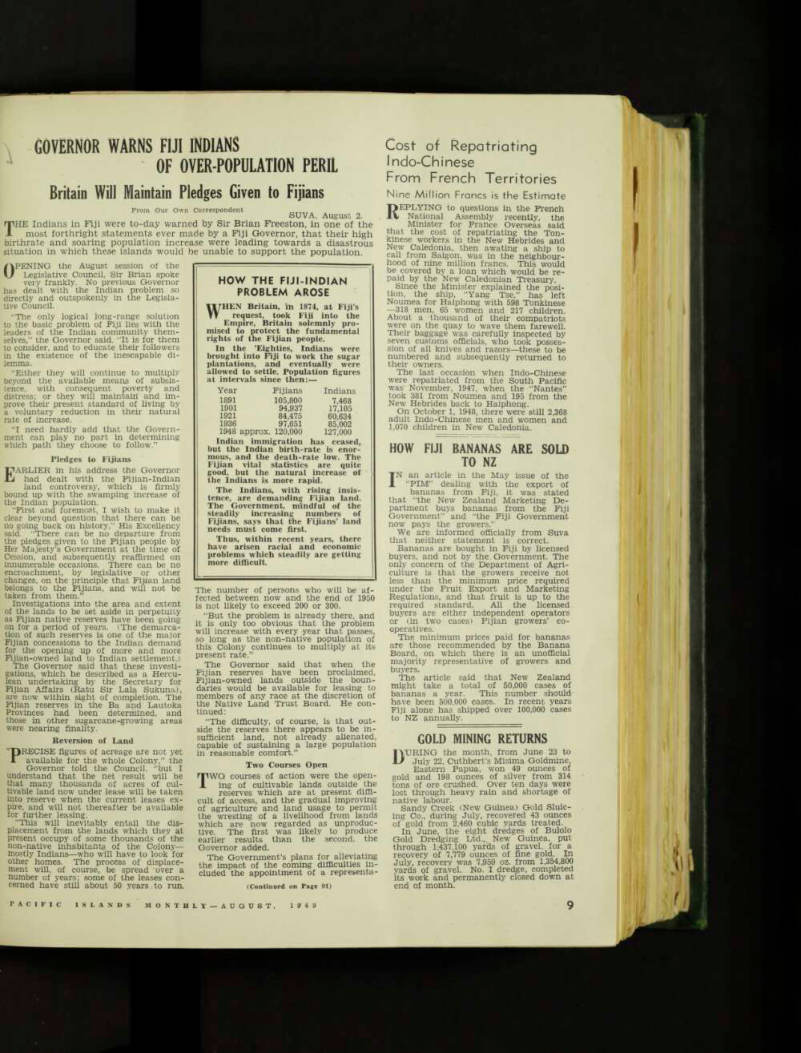
THE Indians in Fiji were to-day warned by Sir Brian Freeston, in one of the most forthright statements ever made by a Fiji Governor, that their high birthrate and soaring population increase were leading towards a disastrous situation in which these islands would be unable to support the population.
OPENING the August session of the Legislative Council, Sir Brian spoke very frankly. No previous Governor has dealt with the Indian problem so directly and outspokenly in the Legisla tive Council.
“The only logical long-range solution to the basic problem of Fiji lies with the leaders of the Indian community them selves,” the Governor said. “It is for them to consider, and to educate their followers in the existence of the inescapable di lemma.
“Either they will continue to multiply beyond the available means of subsis tence, with consequent poverty and distress; or they will maintain and im prove their present standard of living by a voluntary reduction in their natural rate of increase.
“I need hardly add that the Govern ment can play no part in determining which path they choose to follow.”
Pledges to Fijians EARLIER in his address the Governor had dealt with the Fijian-Indian land controversy, which is firmly bound up with the swamping increase of the Indian population.
“First and foremost, I wish to make it clear beyond question that there can be no going back on history,” His Excellency said. “There can be no departure from the pledges given to the Fijian people by Her Majesty’s Government at the time of Cession, and subsequently reaffirmed on innumerable occasions. There can be no encroachment, by legislative or other changes, on the principle that Fijian land belongs to the Fijians, and will not be taken from them.”
Investigations into the area and extent of the lands to be set aside in perpetuity as Fijian native reserves have been going on for a period of years. (The demarca tion of such reserves is one of the major Fijian concessions to the Indian demand for the opening up of more and more Fijian-owned land to Indian settlement.) The Governor said that these investi gations, which he described as a Hercu lean undertaking by the Secretary for Fijian Affairs (Ratu Sir Lala Sukuna), are now within sight of completion. The Fijian reserves in the Ba and Lautoka Provinces had been determined, and those in other sugarcane-growing areas were nearing finality.
Reversion of Land PRECISE figures of acreage are not yet available for the whole Colony,” the Governor told the Council, “but I understand that the net result will be that many thousands of acres of cul tivable land now under lease will be taken into reserve when the current leases ex pire, and will not thereafter be available for further leasing.
“This will inevitably entail the dis placement from the lands which they at present occupy of some thousands of the non-native inhabitants of the Colony— mostly Indians—who will have to look for other homes. The process of displace ment will, of course, be spread over a number of years; some of the leases con cerned have still about 50 years to run.
The number of persons who will be af fected between now and the end of 1950 is not likely to exceed 200 or 300.
“But the problem is already there, and it is only too obvious that the problem will increase with every year that passes, so long as the non-native population of this Colony continues to multiply at its present rate.”
The Governor said that when the Fijian reserves have been proclaimed, Fijian-owned lands outside the boun daries would be available for leasing to members of any race at the discretion of the Native Land Trust Board. He con tinued: “The difficulty, of course, is that out side the reserves there appears to be in sufficient land, not already alienated, capable of sustaining a large population in reasonable comfort.”
Two Courses Open TWO courses of action were the opening of cultivable lands outside the reserves which are at present diffi cult of access, and the gradual improving of agriculture and land usage to permit the wresting of a livelihood from lands which are now regarded as unproduc tive. The first was likely to produce earlier results than the second, the Governor added.
The Government’s plans for alleviating the impact of the coming difficulties in cluded the appointment of a representa
(Continued on Page 91)
Governor Warns Indians (Continued from page 9) tive settlement committee in each of the three districts of the Colony.
Charged with assisting displaced tenants to find other accommodation and
with formulating schemes for making new areas (outside the reserves) available for occupation, these committees’ proposals will be reviewed by a central co-ordinat ing committee at Suva, on which the Native Land Trust Board will be strongly represented.
Indian Leftist Paper’s Views On Population
SUVA, August 4.
A FEW days before the Governor (Sir Brian Freeston) warned the Indians in Fiji that their rapid numerical increase is creating a disastrous situation, as much for themselves as for others, the “Pacific Review,” a Leftist Indian weekly, stated its views in the opposite direction.
The Colony’s European community was described as “migratory, consisting mostly of birds of passage,” and the paper alleges that the fact that more Europeans than Indians came into Fiji in 1948 “throws an interesting sidelight on the immigration policy of the Government of Fiji” (This is an echo of the Immigration Bill battle in 1947 when the Indians fought bitterly for the retention of un restricted Indian immigration while the Fijians, showing an unprecedented de gree of anger, demanded an end to it.) The “Pacific Review,” which in the past has actually claimed to be a cham pion of the Fijians, now declares that
“the Fijian community is a land-owning community which enjoys better housing, better food, better clothing, more literacy, and better medical facilities than the Indian.”
Nothing is added to justify this in credible statement —which is simply un true.
Dealing with the population increase in 1948, when the Indian birthrate leaped to 46.33 per thousand and the Fijian dropped slightly to 36.39, the paper says: “The other communities (non-European), more particularly the Indians and the Fijians, contributed their quota by a natural increase and thereby rendered a very useful and commendable service to the underpopulated Colony.”
It must be added that ever since the 1946 Census (which inspired the Immi gration Ordinance) authorities have been warning that Fiji’s population, thanks mainly to the Indians, is within sight of the danger-line maximum.