Words
pp. 7-8 · Read in the full issue
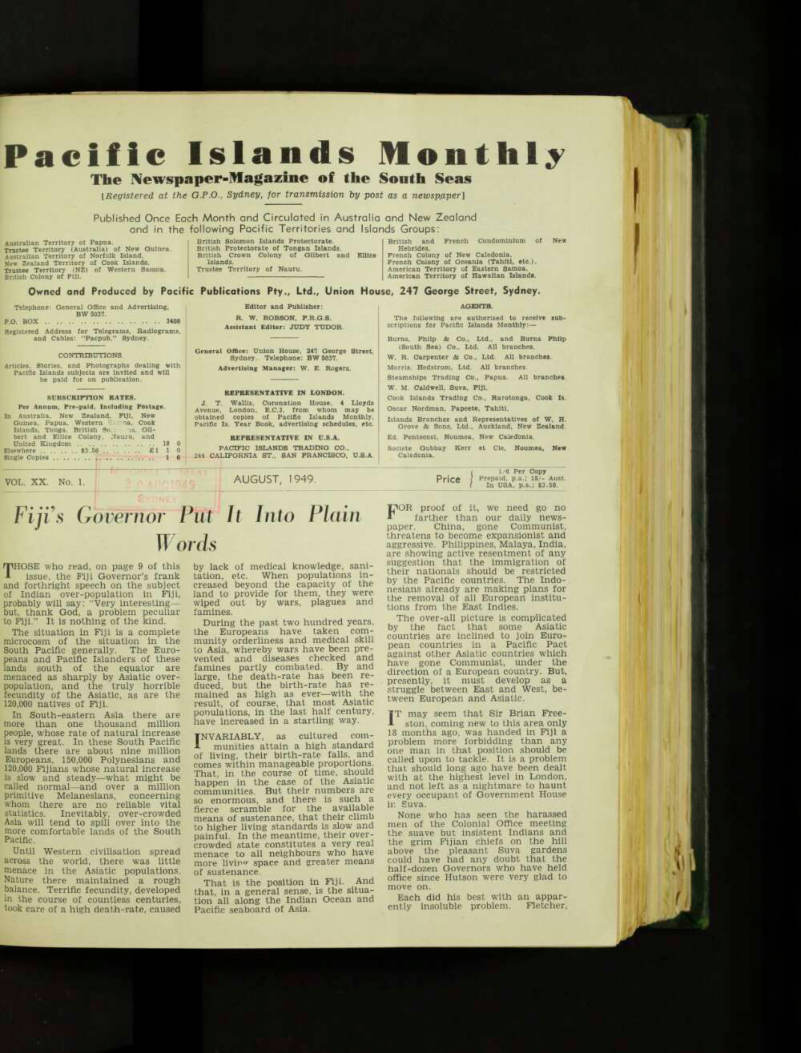
Fiji’s Governor Put It Into Plain Words
THOSE who read, on page 9 of this issue, the Fiji Governor’s frank and forthright speech on the subject of Indian over-population in Fiji, probably will say: “Very interesting— but, thank God, a problem peculiar to Fiji.” It is nothing of the kind.
The situation in Fiji is a complete microcosm of the situation in the South Pacific generally. The Europeans and Pacific Islanders of these lands south of the equator are menaced as sharply by Asiatic overpopulation, and the truly horrible fecundity of the Asiatic, as are the 120,000 natives of Fiji.
In South-eastern Asia there are more than one thousand million people, whose rate of natural increase is very great. In these South Pacific lands there are about nine million Europeans, 150,000 Polynesians and 120,000 Fijians whose natural increase is slow and steady — what might be called normal — and over a million primitive Melanesians, concerning whom there are no reliable vital statistics. Inevitably, over-crowded Asia will tend to spill over into the more comfortable lands of the South Pacific.
Until Western civilisation spread across the world, there was little menace in the Asiatic populations.
Nature there maintained a rough balance. Terrific fecundity, developed in the course of countless centuries, took care of a high death-rate, caused
by lack of medical knowledge, sani tation, etc. When populations in creased beyond the capacity of the land to provide for them, they were wiped out by wars, plagues and famines.
During the past two hundred years, the Europeans have taken corn munity orderliness and medical skill to Asia, whereby wars have been pre vented and diseases checked and famines partly combated. By and large, the death-rate has been re duced, but the birth-rate has re mained as high as ever—with the result, of course, that most Asiatic populations, in the last half century, have increased in a startling way.
INVARIABLY, as cultured communities attain a high standard of living their birth-rate falls and comes within manageable proportions.
That, in the course of time, should happen in the case of the Asiatic communities. But their numbers are so enormous, and there is such a fierce scramble for the available means of sustenance, that their climb to higher living standards is slow and painful. In the meantime, their overcrowded state constitutes a very real menace to all neighbours who have more living space and greater means of sustenance.
That is the position in Fiji. And that, in a general sense, is the situa tion all along the Indian Ocean and Pacific seaboard of Asia.
FOR proof of it, we need go no farther than our daily news paper. China, gone Communist, threatens to become expansionist and aggressive. Philippines, Malaya, India, are showing active resentment of any suggestion that the immigration of their nationals should be restricted by the Pacific countries. The Indo nesians already are making plans for the removal of all European institu tions from the East Indies.
The over-all picture is complicated by the fact that some Asiatic countries are inclined to join Euro pean countries in a Pacific Pact against other Asiatic countries which have gone Communist, under the direction of a European country. But, presently, it must develop as a struggle between East and West, be tween European and Asiatic.
IT may seem that Sir Brian Free ston, coming new to this area only 18 months ago, was handed in Fiji a problem more forbidding than any one man in that position should be called upon to tackle. It is a problem that should long ago have been dealt with at the highest level in London, and not left as a nightmare to haunt every occupant of Government House in Suva.
None who has seen the harassed men of the Colonial Office meeting the suave but insistent Indians and the grim Fijian chiefs on the hill above the pleasant Suva gardens could have had any doubt that the half-dozen Governors who have held office since Hutson were very glad to move on.
Each did his best with an appar ently insoluble problem. Fletcher,
with praiseworthy foresight, killed the electoral system before it could get out of hand. Richards, clearly seeing the crux of the problem, applied him self to the reservation of Fijian lands.
But it has remained for Sir Brian Freeston, with most praiseworthy courage, to put into a public speech a clear and logical summary of a problem that may no longer be ignored. The Indians will snarl at him, and some Europeans perhaps will be critical and hostile; but Sir Brian Freeston will go down in Pacific history as the first man game enough to grab this monster by the throat, and drag it out into the public gaze, and demand that the problem be dealt with, openly and honestly.
“Either they (the Indians) will con tinue to multiply beyond the available means of subsistence, with consequent poverty and distress; or they will maintain and improve their present standard of living by a voluntary re duction in their natural rate of increase.” With those grave words, Sir Brian Freeston proved himself worthy of the trust that is imposed in a British Colonial Governor. There are the alternatives: there is no other way of getting around the Fiji prob lem. He has placed the issue squarely before the Indians.
ANYONE can see, of course, that Sir Brian, in naming the problem’s most embarrassing factor the Indians’ high birth-rate—may find himself in conflict with the most powerful institution of the European world, the Catholic Church. That Church has set its face most resolutely against birth-control; and Sir Brian’s speech could be read as advocacy of birth-control. Sir Brian was well aware of that, when he prepared his statement—which only makes us admire his courage the more.
Actually, there need be no conflict whatever. The Indian birth-rate in Fiji, over 46 per thousand, is pheno menal, and partly the result of a peculiar social and domestic outlook, which the Catholic Church certainly would not endorse. The wise men of the Catholic Church probably see the Fiji problem as clearly as does the Governor, and they almost certainly will agree with him that the solution, if it is to be found, must be provided by the Indians themselves. They will realise that neither the Governor, nor
anyone else in authority, would advocate what might be called mech anical birth-control. What everyone with any intelligent outlook over the Pacific Islands is urging is that a change in Indian living conditions in Fiji could be quite simply brought about by the Indians themselves, re sulting in higher standard of life for the Indians, and a less calamitous rate of natural increase. It would involve mostly a change in the Fiji- Indian way of political thought.
At that point, it should be possible for Europeans, Fijians and Indians to come together in an atmosphere of mutual tolerance and goodwill to jointly seek a solution of the Fiji- Indian problem.