Strange Coincidence
p. 69 · Read in the full issue
How A Lost American Plane Was Located in NG
A year ago, in a personal letter from Technical Sergeant Robert T.
Smith, head of an American Graves Search Unit in New Guinea, the edi tor of the “PIM” received the following account of a remarkable coincidence. He wrote to Sergeant 'Smith, and asked permission to pub lish it. But, in the meantime, Ser geant Smith had returned to the United States and moved around a good deal, and the letter was months in catching up with him. However, we now have made contact with him and have his permission to publish the story.
OUR work in New Guinea is practically finished. In our searches we have visited almost every corner of the great Territory. I must tell you (not for publication) the story of a most remark able coincidence.
In April and May, 1946, I was sent in with my from Boga djim, over the Pinisterre Moun tains, looking for a particular air craft. We did not find it.
In December, 1946, and Janu ary, 1947, I went into the Yupua area looking for ;he same plane, md again follow ng a false lead, rhe parents of ;he co-pilot ap larently had had certain informa tion concerning
the place of the crash, and they were dissatisfied with our efforts—and let us know it. I took a personal in erest in this search and asked that if my further missions were organised in ;onnecction with it, I should be included. [N August and September, 1947, I was on leave in the States, and I ob tained permission to visit these people -a family named Scott—and tell them ibout New Guinea and our work. The irst thing the co-pilot’s little five-years >ld son said to me was: “You couldn’t ind my Daddy’s plane, huh?” He was tged two the day his father’s plane rashed.
I spent a wonderful two days with hat family. They had a New Guinea nap with only one location marked on it.
Ve had been given four locations, but lot that particular one. You can imagine hat I left with a determination to find hat plane, if it was possible.
But when I got back to Manila I found hat the Filipino team had already been ent to Lae, to search that area, including he location shown on the family’s map. here was no chance for me to be as igned there.
Then—do you remember what hap ened? There were New Year celebra ions in Lae, and Mr. John Scott was illed, and the Filipino team at Lae which was reported to be somehow in olved in the tragedy) was sent away to lanokwari, in Dutch New Guinea; and tie Filipino team I was with (in Western 'apua) was also sent away to Dutch New ruinea, to Sorong.
After three months in Dutch New Kiinea I returned to Manila, for another -arch assignment. To my surprise, I mnd I was first on the list to go to Lae
with an All-American team, and my offi cer had allotted to me the Huon Penin sula including the very area where that lost plane was supposed to be.
Well, my three months’ search is finished—and I found the plane, three years and 15 days after it had crashed.
It was 11,000 feet up in the Saruvagel Range, in the Uruava area, just about where the parents’ map had indicated.
But why did it need a chain of events, commencing with the killing of a Mr.
John Scott I had never heard of, to lead me to the remains of the son of Mr. John Scott, in the United States?
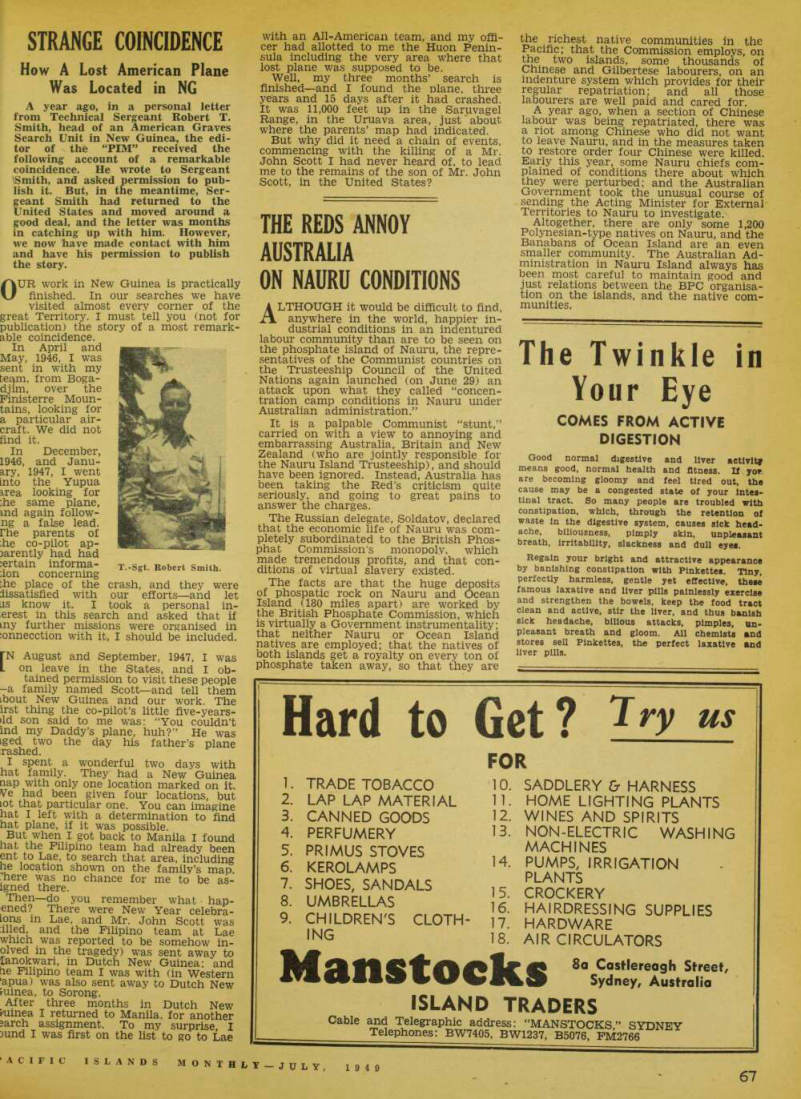
T.-Sgt. Robert Smith.