Fiji , in 1948 , Broke All Trade
pp. 39-40 · Read in the full issue
Records
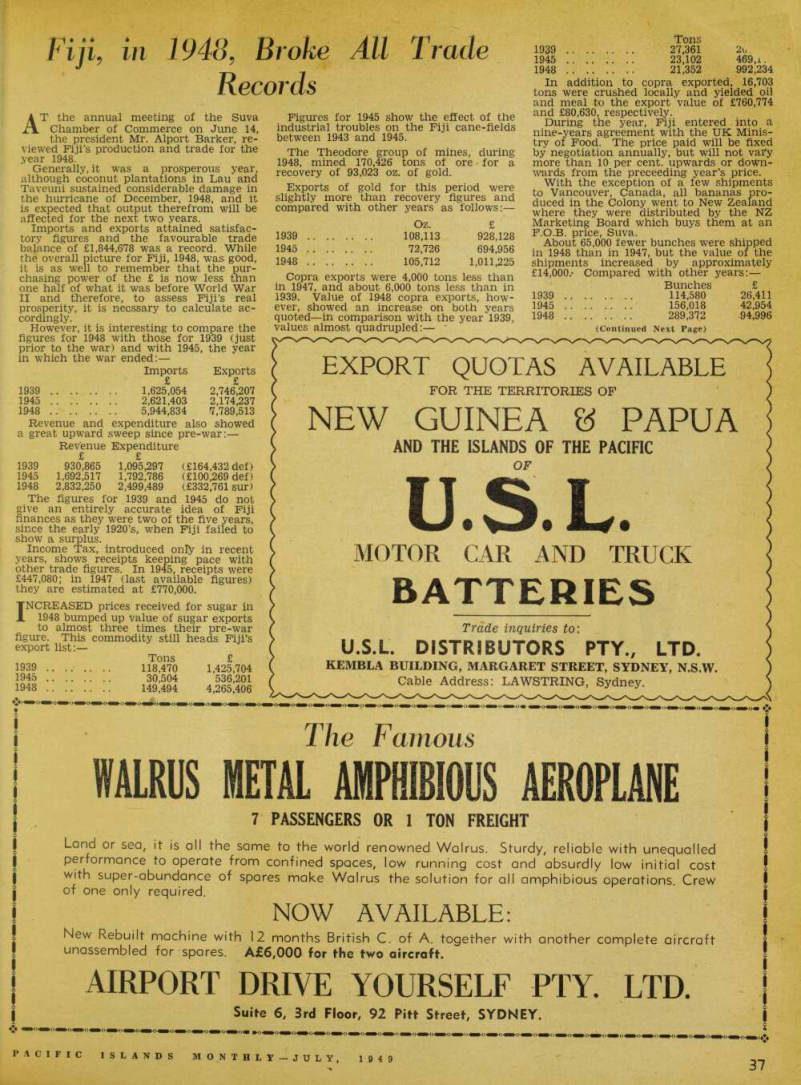
AT the annual meeting of the Suva Chamber of Commerce on June 14, the president Mr. Alport Barker, re viewed Fiji’s production and trade for the year 1948.
Generally, it was a prosperous year, although coconut plantations in Lau and Taveuni sustained considerable damage in the hurricane of December, 1948, and it is expected that output therefrom will be affected for the next two years.
Imports and exports attained satisfac tory figures and the favourable trade balance of £1,844,678 was a record. While the overall picture for Fiji, 1948, was good, it is as well to remember that the pur chasing power of the £ is now less tnan one half of what it was before World War II and therefore, to assess Fiji’s real prosperity, it is necssary to calculate ac cordingly.
However, it is interesting to compare the figures for 1948 with those for 1939 (just prior to the war) and with 1945, the year in which the war ended:—
Revenue and expenditure also showed a great upward sweep since pre-war:— Revenue Expenditure
The figures for 1939 and 1945 do not give an entirely accurate idea of Fiji finances as they were two of the five years, since the early 1920’5, when Fiji failed to show a surplus.
Income Tax, introduced only in recent years, shows receipts keeping pace with other trade figures. In 1945, receipts were £447,080; in 1947 (last available figures) they are estimated at £770,000.
INCREASED prices received for sugar in 1948 bumped up value of sugar exports to almost three times their pre-war figure. This commodity still heads Fiji’s export list:—
Figures for 1945 show the effect of the industrial troubles on the Fiji cane-fields between 1943 and 1945.
The Theodore group of mines, during 1948, mined 170,426 tons of ore for a recovery of 93,023 oz. of gold.
Exports of gold for this period were slightly more than recovery figures and compared with other years as follows:
Copra exports were 4,000 tons less than in 1947, and about 6,000 tons less than in 1939. Value of 1948 copra exports, how ever, showed an increase on both years quoted—in comparison with the year 1939, values almost quadrupled:—
In addition to copra exported, 16,703 tons were crushed locally and yielded oil and meal to the export value of £760,774 and £80,630, respectively.
During the year, Fiji entered into a nine-years agreement with the UK Minis try of Food. The price paid will be fixed by negotiation annually, but will not vary more than 10 per cent, upwards or down wards from the preceeding year’s price.
With the exception of a tew shipments to Vancouver, Canada, all bananas pro duced in the Colony went to New Zealand where they were distributed by the NZ Marketing Board which buys them at an F. 0.8. price, Suva.
About 65,000 fewer bunches were shipped in 1948 than in 1947, but the value of the shipments increased by approximately £14,000.* Compared with other years:—
Oz. £ 1939 108,113 928,128 1945 72,726 694,956 1948 105.712 1,011,225
Tons 1939 27,361 2o 1945 23,102 469,j. . 1948 21,352 992,234
Bunches £ 1939 .. 114,580 26,411 1945 .. 156,018 42,954 1948 .. 289,372 94,996 (Continued Next Pag«)
Imports Exports £ £ 1939 1,625,054 2,746,207 1945 2,621,403 2,174,237 1948 5,944,834 7,789,513
£ £ 1939 930,865 1,095,297 (£164,432 def) 1945 1,692,517 1,792,786 (£100,269 def) 1948 2,832,250 2,499,489 (£332,761 sur)
Tons £ 1939 118,470 1,425,704 1945 30,504 536,201 1948 149,494 4,265,406
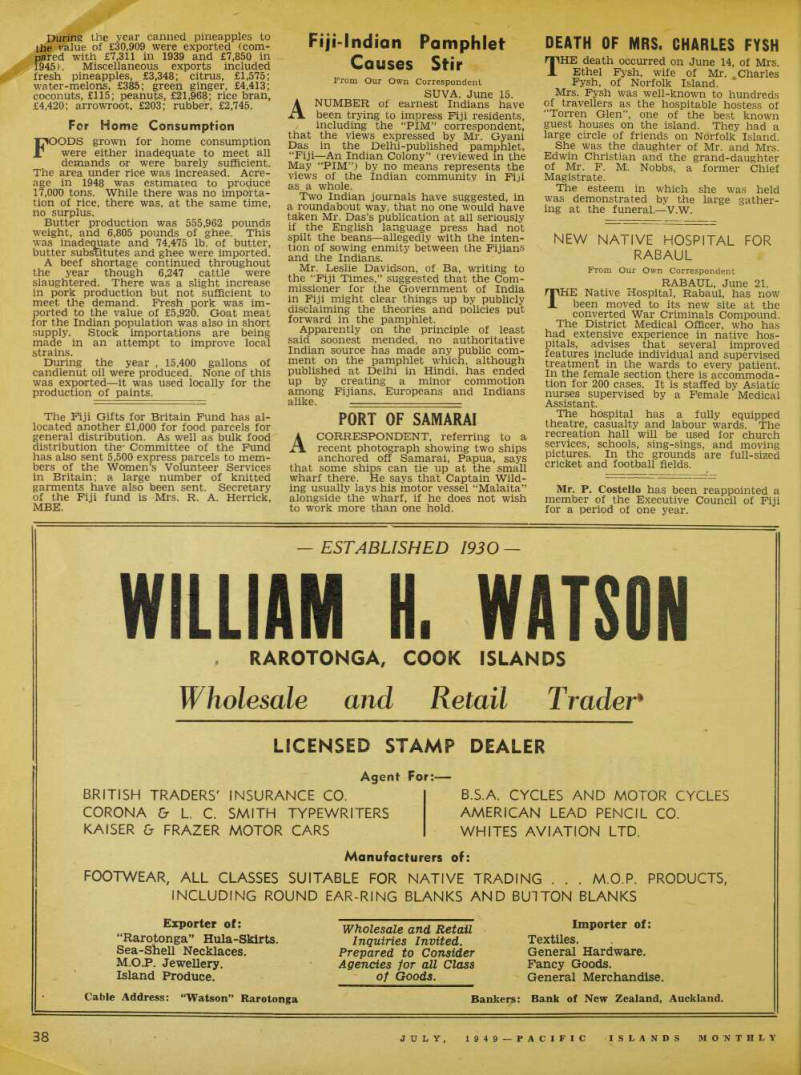
During the year canned pineapples to the value of £30,909 were exported (com pared with £7,311 in 1939 and £7,850 in 1945). Miscellaneous exports included fresh pineapples, £3,348; citrus, £1,575; water-melons, £385; green ginger, £4,413; coconuts, £115; peanuts, £21,968; rice bran, £4,420; arrowroot, £203; rubber, £2,745.
For Home Consumption rODS grown for home consumption were either inadequate to meet all demands or were barely sufficient.
The area under rice was increased. Acre age in 1948 was estimated to produce 17,000 tons. While there was no importa tion of rice, there was, at the same time, no surplus.
Butter production was 555,962 pounds weight, and 6,805 pounds of ghee. This was inadequate and 74,475 lb. of butter, butter substitutes and ghee were imported.
A beef shortage continued throughout the year though 6,247 cattle were slaughtered. There was a slight increase in pork production but not sufficient to meet the demand. Fresh pork was im ported to the value of £5,920. Goat meat for the Indian population was also in short supply. Stock importations are being made in an attempt to improve local strains.
During the year , 15,400 gallons of candlenut oil were produced. None of this was exported—it was used locally for the production of paints.
The Fiji Gifts for Britain Fund has al located another £l,OOO for food parcels for general distribution. As well as bulk food distribution the* Committee of the Fund has also sent 5,500 express parcels to mem bers of the Women's Volunteer Services in Britain; a large number of knitted garments have also been sent. Secretary of the Fiji fund is Mrs. R. A. Herrick,