A Visitor Looks At Lae
p. 15 · Read in the full issue
( Contributed )
IHAVE just visited Lae, New Guinea.
These are my impressions, as a casual visitor.
Arriving by air, one is transported to what is known as “Hotel Cecil”. This consists of an accumulation of ex-army buildings in a state of advanced decay, due to collapse at any moment.
All honour to the proprietor, who has, I am told, struggled for three years under appalling conditions. Some time ago she was allocated a site in the “New Town ship” and duly paid £lOO, plus survey fees, but cannot obtain possession as Government Buildings occupy part of the site for which the Administration accepted the fees. She must still carry on at the old site until something can be done to alter this strange position.
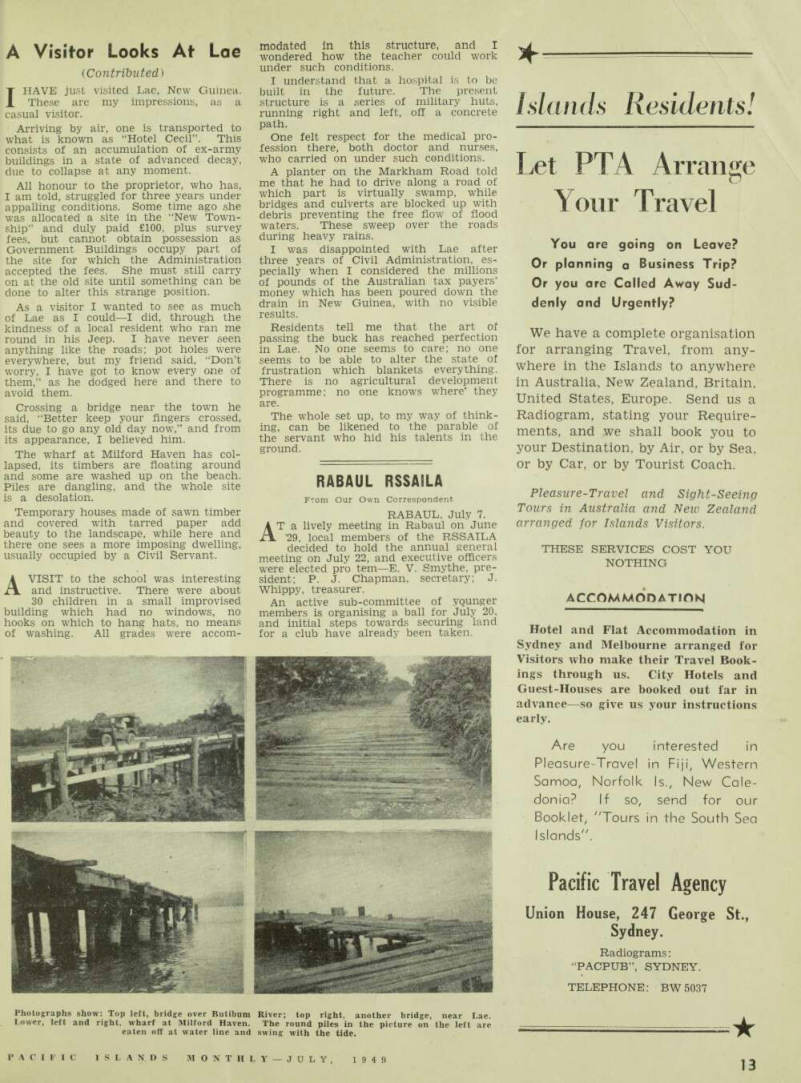
As a visitor I wanted to see as much of Lae as I could —I did, through the kindness of a local resident who ran me round in his Jeep. I have never seen anything like the roads; pot holes were everywhere, but my friend said, “Don’t worry, I have got to know every one of them,” as he dodged here and there to avoid them.
Crossing a bridge near the town he said, “Better keep your fingers crossed, its due to go any old day now,” and from its appearance, I believed him.
The wharf at Milford Haven has col lapsed, its timbers are floating around and some are washed up on the beach.
Piles are dangling, and the whole site is a desolation.
Temporary houses made of sawn timber and covered with tarred paper add beauty to the landscape, while here and there one sees a more imposing dwelling, usually occupied by a Civil Servant.
A VISIT to the school was interesting and instructive. There were about 30 children in a small improvised building which had no windows, no hooks on which to hang hats, no means of washing. All grades were accom
modated in this structure, and I wondered how the teacher could work under such conditions.
I understand that a hospital is to be built in the future. The present structure is a series of military huts, running right and left, off a concrete path.
One felt respect for the medical pro fession there, both doctor and nurses, who carried on under such conditions.
A planter on the Markham Road told me that he had to drive along a road of which part is virtually swamp, while bridges and culverts are blocked up with debris preventing the free flow of flood waters. These sweep over the roads during heavy rains.
I was disappointed with Lae after three years of Civil Administration, es pecially when I considered the millions of pounds of the Australian tax payers’ money which has been poured down the drain in New Guinea, with no visible results.
Residents tell me that the art of passing the buck has reached perfection in Lae. No one seems to care; no one seems to be able to alter the state of frustration which blankets everything.
There is no agricultural development programme; no one knows where’ they are.
The whole set up, to my way of think ing, can be likened to the parable of the servant who hid his talents in the ground.
Photographs show: Top left, bridge over Butibum River; top right, another bridge, near Lae.
Lower, left and right, wharf at Milford Haven. The round piles in the picture on the left are eaten off at water line and swing with the tide.