South Pacific Commission Approves
pp. 13-89 · Read in the full issue
Extensive Research Programme Next Session, Noumea, October: South Pacific Conference, Suva, April
THE third session of the South Pacific Commission concluded a: SPC head quarters, Noumea, New Caledonia, on May 17. Chairman of the session was Mr. J. B. D. Pennink, Senior Commis sioner for the Netherlands. .
The fourth session will be held in Noumea in October, 1949. The chairman will be the Senior Commissioner for New Zealand.
A South Pacific Conference will be held in Suva, Fiji, in April, 1950, according to plans now being made by the SPC. Dele gates will be invited from 15 Pacific Terri tories: Papua-New Guinea (Australian Trust Territory), Nauru, New Caledonia and Dependencies, French Oceanic Es tablishments, Netherlands New Guinea, Western Samoa, Tokelau Islands, Cook Islands (including Niue), Fiji, British Solomon Islands Protectorate, Gilbert Islands, Ellice Islands, American Samoa, New Hebrides. The Kingdom of Tonga will also be represented.
Mr. B. E. V. Parham, of Fiji, Associate Member for Economic Development on the South Pacific Commission Research Council, was requested by the Commis sion to represent it at the Conference on Conservation and Utilisation of Resources being held by the United Nations at Lake Success in August, 1949.
Before the third session broke up it approved 28 research projects that had been recommended to it by the Research Council which met in Noumea from April 25 to May 9. The 28 projects will cover the fields of health and social and economic development among non-self governing native peoples in the Pacific.
They are:—
Plans To Improve Health
Collection and distribution of epidemiological information and investigation of quarantine regulations.
A project in improvement of infant and maternal welfare, the weaning of infants among Island peoples.
A co-ordinated attack on the problems of tuberculosis by an investigation of field methods for tuberculosis survey and a comparison of the different forms of tuberculosis found in the area.
Provision of liaison between the various field groups investigating the epidemiology treatment and control of filariasis; and the co-ordination of work in this field.
Collection and examination of existing data relating to nutritional and dietary problems in the area as a necessary background for formu lating detailed proposals.
Economic Projects
The introduction of economic plants to the South Pacific area, their study in introduction gardens, and their distribution to all Territories.
An immediate review of scientific research facilities relating to cash crops such as the coconut and its products, rice and cocoa; to gether with an examination of their economic future.
Studies of tropical pasture improvement lead ing to an improvement in animal nutrition and the development of mixed farming essential for raising standards of human diet.
A pilot land-use survey project relating to the establishment of hydrological and forestry re serves, the control of erosion, and the de limitation of crop and pasture lands. New Guinea land-use survey.
Proposals for regional co-operation in estab lishing a standard system of grading fruit and vegetable produce for commerce in the area.
A pilot project designed to introduce improve ments possible in cash and subsistence crops in coral islands and atolls. Economic survey hav ing special reference to the by-products of the islands.
Proposals for the encouragement of positive fisheries research and close liaison with the Indo- Pacific Fisheries Council.
Research into the diet and working tools of indigenous peoples with a view to improvement of subsistence economies.
Proposals for co-operative effort in the exe cution of work on biological control of insect pests and weeds.
The pooling of information on credit facilities and other forms of financial assistance avail able to Island peoples for agricultural and indus trial development.
The collaboration of Member Governments in the 1950 World Agricultural Census organised by
Fao.
Encouragement of the proposed research pro jects sponsored by the Fiji and Western High Commission Territories Research Council.
The pooling of information on current and proposed research thorughout the South Pacific area.
Social Development
The collection and dissemination of infor mation of technical and professional training of Islanders throughout the area and examination of the possibilities for further developing centra lised training Institutions for Island peoples.
An experimental survey of the use of visual aids in the development of dependent peoples.
A study of methods of literacy training.
Conference of educationists.
A review of the research work already carried out in social anthropology and the formulation of future lines of research in that field.
A survey of the work done in linguistic research and requirements for the area.
A study of existing native co-operative societies and groups operating in the South Pacific and of methods for creating and developing the movement throughout the area.
A survey to determine the most suitable types of native building.
The establishment of pilot projects designed to develop a selected community in each terri tory through the combined operations of the community itself and a team of specially trained native leaders.
Recording and preservation of archaeological sites.
(Continued on Page 87)
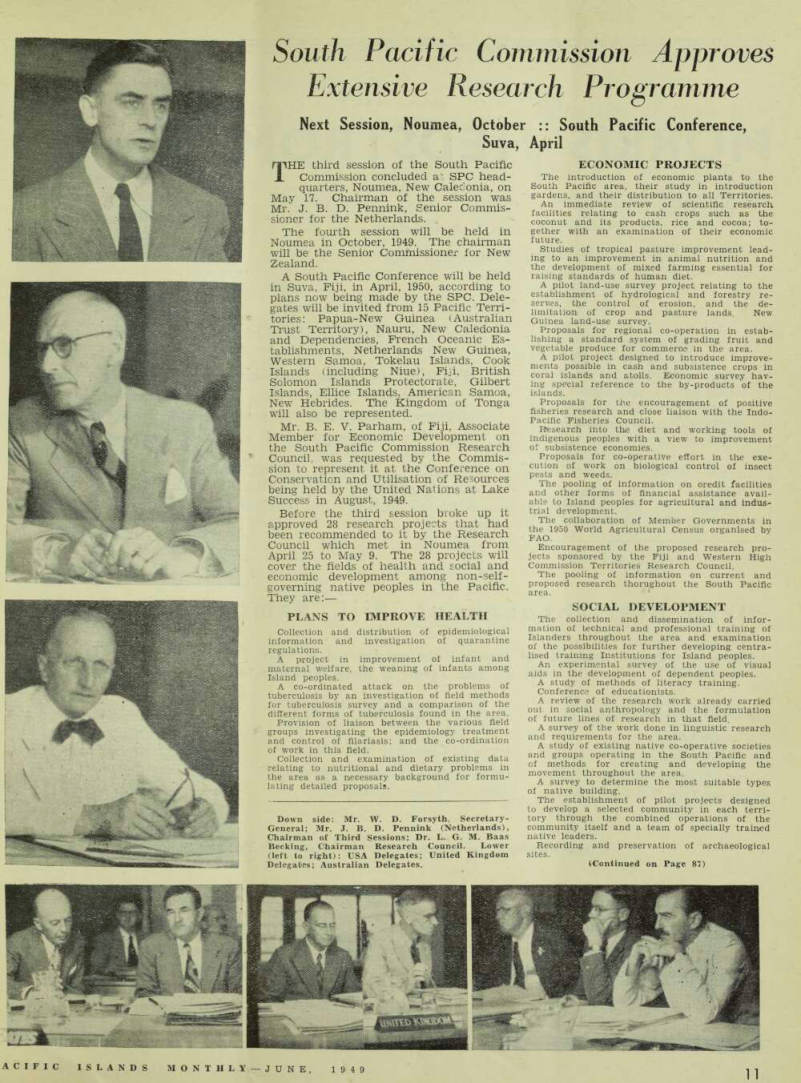
Down side: Mr. W. D. Forsyth, Secretary- General; Mr. J. B. D. Pennink (Netherlands), Chairman of Third Sessions; Dr. L. G. M. Baas Becking, Chairman Research Council. Lower (left to right): USA Delegates; United Kingdom Delegates; Australian Delegates.
THE projects outlined call for the pro vision of £7,440 in 1949 and £35,275 in 1950. Of the latter amount, £7,000 represents research contingencies voted and £4,000 possibly to be incurred for a conference of educationists.
The Third Session authorised the Secretary-General to maintain the Com mission subsidiary office in Sydney as long as need for the office exists.
Accomodation In Noumea
IT was reported that the question of providing permanent housing for the Commission and its staff in Noumea was surrounded by difficult problems, and any idea of undertaking a new building programme was set aside —probably for a long time. The Commission expressed utmost appreciation of the active and generous co-operation of the French authorities in adapting the Pentagon Building to its requirements. A sum of £66,000 Sterling has been spent on the Pentagon Building by the French authori ties, and £60,000 of this will remain as a debt against the Commission, repayable yearly at the rate of 4i per cent., includ ing interest.
The Commission’s staff has been housed in the Pentagon Building, where a central mess has been provided. Arrangements were made to construct four self contained flats in the west wing of the Pentagon Building, for the use of Com
mission personnel.
Cost-of-living allowances, about £5 sterling per week, have been made to most of the Commission’s permanent officers.
The high cost of living in New Caledonia has already proved an embarrassment to the Commission and its officers.
The next Session of the Commission will commence in Noumea about Satur day, October 21, 1949.
Technical Help
QTEPS were taken by the Commission to implement the resolutions of the UNO Economic and Social Council on March 4, relating to the need for giving technical assistance to under-developed areas.
Inquiries are being made of the six member Governments (United Kingdom, United States, Netherlands, France, Aus tralia and New Zealand) to ascertain what, in their view, should be done to afford technical help to the people of the South Pacific area.
Finance—A Problem
r pHE Research Council informed the JL Commission that the permanent members of the Council required one Research Assistant at £1,003 per annum, three Research Assistants, at £7OO per an num, and four Secretary-Typistes at £5OO per annum. Finance is likely to be one of the chief problems of this new organ isation. Up to date, the six Governments concerned have contributed about £64,000 in cash (of which Australia has provided about £27,000). The accounts suggest that the regular contribution to the Commis sion from the six Governments will total between £30,000 and £35,000 Sterling per annum. This will not be enough, if the plans at present in contemplation are carried out.