Islanders
p. 75 · Read in the full issue
Leprosarium For Solomon
LEPERS in the Solomon Islands— estimated at 1 per cent., of the population—will in time be accom modated and treated at the Government Leper station now slowly taking shape 30 miles from Honiara, on the coastline of Guadalcanal.
Until now there has been no Govern ment attempt to segregate lepers, although work on a small scale has been attempted by various missions. The new Government scheme is made possible by a grant of £60,000 from the Colonial Development Fund and £lO,OOO from the New Zealand Leprosy Trust.
The leper station is situated at Tetere, a former Burns Philp plantation, on an area of 8,000 acres, 600 of which are under coconuts. Under the direction of Mr. F. Witty, supervisor of the leprosy scheme, the station is being built with salvage building materials from old army camps along the coast. Quarters for two Roman /Catholic nursing sisters,
trained in leper work, and already wait ing in the Protectorate, have been com pleted and accommodation is ready for about 50 patients.
The station was recently visited by Mr. Twomey, secretary of the New Zealand Leper Trust who conferred here with local medical officers, Mr. Witty and representatives of all missions en gaged in leper work. Mr. Twomey and Miss Kiely, the Trust’s assistant secre tary, travelled in the Southern Cross.
Since a Government survey of leper victims waa made before the war, a check has been kept on known cases and village headmen have, during the past year, been asked to spread the news of the new hospital. Some of the most recent drug discoveries will be used in treating patients, a proportion of whom are expected to be cured by organised treatment and regime.
Situated on the fertile grass plains, the leprosarium has admirable agri cultural possibilities and is expected to be practically self-supporting after a while.
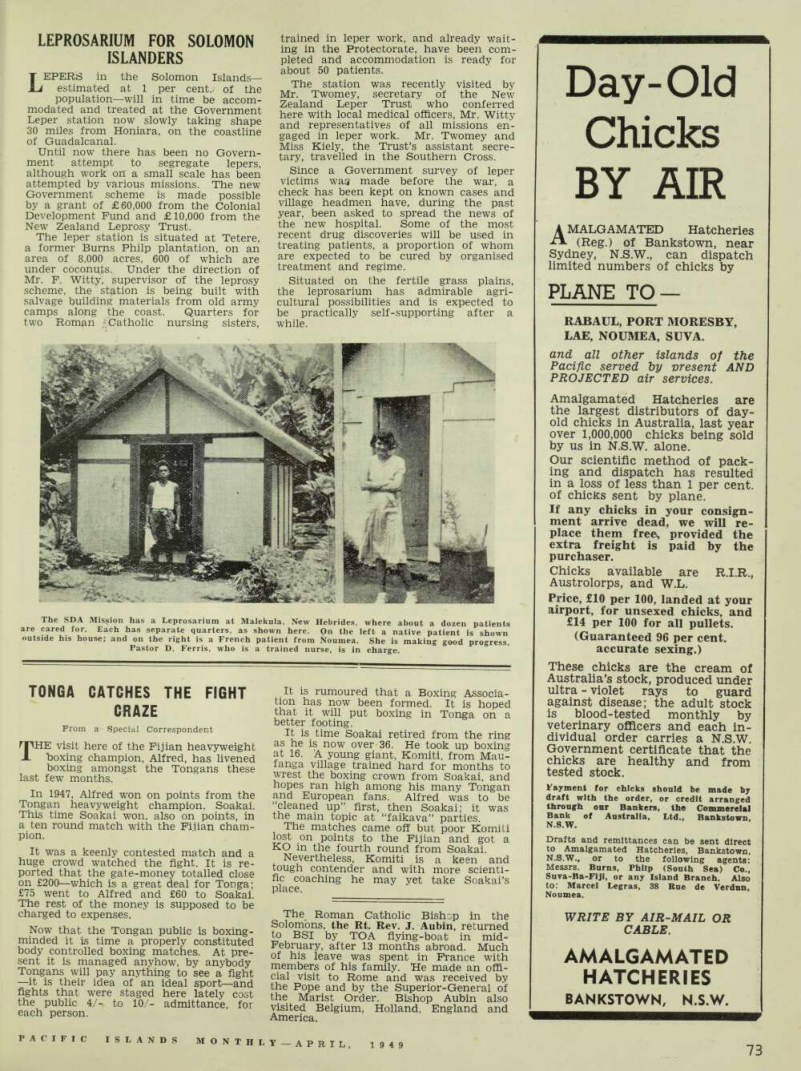
The SDA Mission has a Leprosarium at Malekula, New Hebrides, where about a dozen patients are cared for. Each has separate quarters, as shown here. On the left a native patient is shown outside his house; and on the right is a French patient from Noumea. She is making good progress.
Pastor D. Ferris, who is a trained nurse, is in charge.