Eruptions
pp. 71-72 · Read in the full issue
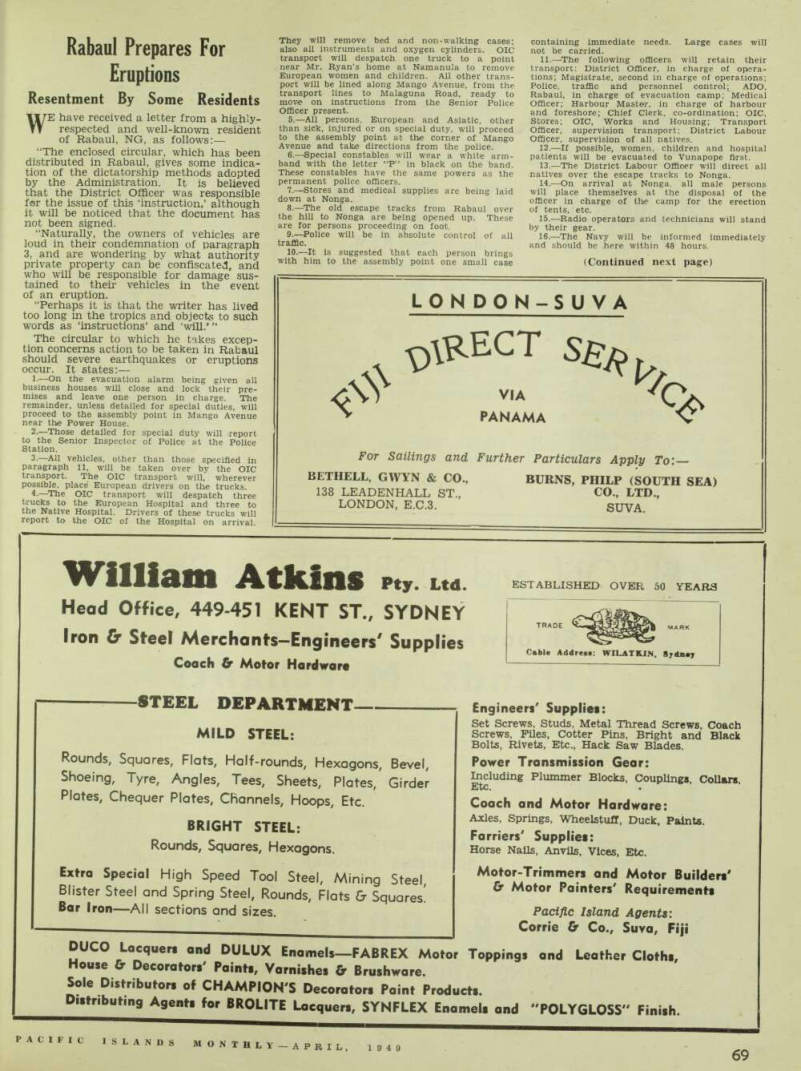
Rabaul Prepares For Eruptions Resentment By Some Residents
WE have received a letter from a highly respected and well-known resident of Rabaul, NG, as follows: “The enclosed circular, which has been distributed in Rabaul, gives some indica tion of the dictatorship methods adopted by the Administration. It is believed that the District Officer was responsible for the issue of this ‘instruction,’ although it will be noticed that the document has not been signed.
“Naturally, the owners of vehicles are loud in their condemnation of paragraph 3, and are wondering by what authority private property can be confiscated, and who will be responsible for damage sus tained to their vehicles in the event of an eruption.
“Perhaps it is that the writer has lived too long in the tropics and objects to such words as ‘instructions’ and ‘will.’”
The circular to which he takes excep tion concerns action to be taken in Rabaul should severe earthquakes or eruptions occur. It states:— 1- —On the evacuation alarm being given all business houses will close and lock their pre mises and leave one person in charge. The remainder, unless detailed for special duties, will proceed to the assembly point in Mango Avenue near the Power House. 2.—Those detailed for special duty will report to the Senior Inspector of Police at the Police Station. 3-—All vehicles, other than those specified in paragraph 11, will be taken over by the OIC transport. The OIC transport will, wherever possible, place European drivers on the trucks. 4 ~The OIC transport will despatch three trucks to the European Hospital and three to the Native Hospital. Drivers of these trucks will report to the OIC of the Hospital on arrival.
They will remove bed and non-walking cases; also all instruments and oxygen cylinders. OIC transport will despatch one truck to a point near Mr. Ryan’s home at Namanula to remove European women and children. All other trans port will be lined along Mango Avenue, from the transport lines to Malaguna Road, ready to move on instructions from the Senior Police Officer present. 5. —All persons, European and Asiatic, other than sick, injured or on special duty, will proceed to the assembly point at the corner of Mango Avenue and take directions from the police. 6. —Special constables will wear a white arm band with the letter “P” in black on the band.
These constables have the same powers as the permanent police officers. 7. —Stores and medical supplies are being laid down at Nonga, 8. The old escape tracks from Rabaul over the hill to Nonga are being opened up. These are for persons proceeding on foot. 9. —Police will be in absolute control of all traffic. 10. —lt is suggested that each person brings with him to the assembly point one small case
containing immediate needs. Large cases will not be carried. 11. —The following officers will retain their transport: District Officer, in charge of opera tions; Magistrate, second in charge of operations; Police, traffic and personnel control; ADO, Rabaul, in charge of evacuation camp; Medical Officer; Harbour Master, in charge of harbour and foreshore; Chief Clerk, co-ordination; OIC, Stores; OIC, Works and Housing; Transport Officer, supervision transport; District Labour Officer, supervision of all natives. 12. —lf possible, women, children and hospital patients will be evacuated to Vunapope first. 13. —The District Labour Officer will direct all natives over the escape tracks to Nonga. 14. —On arrival at Nonga. all male persons will place themselves at the disposal of the officer in charge of the camp for the erection of tents, etc. 15. —Radio operators and technicians will stand by their gear. 16. —The Navy will be informed immediately and should be here within 48 hours.
(Continued next page)
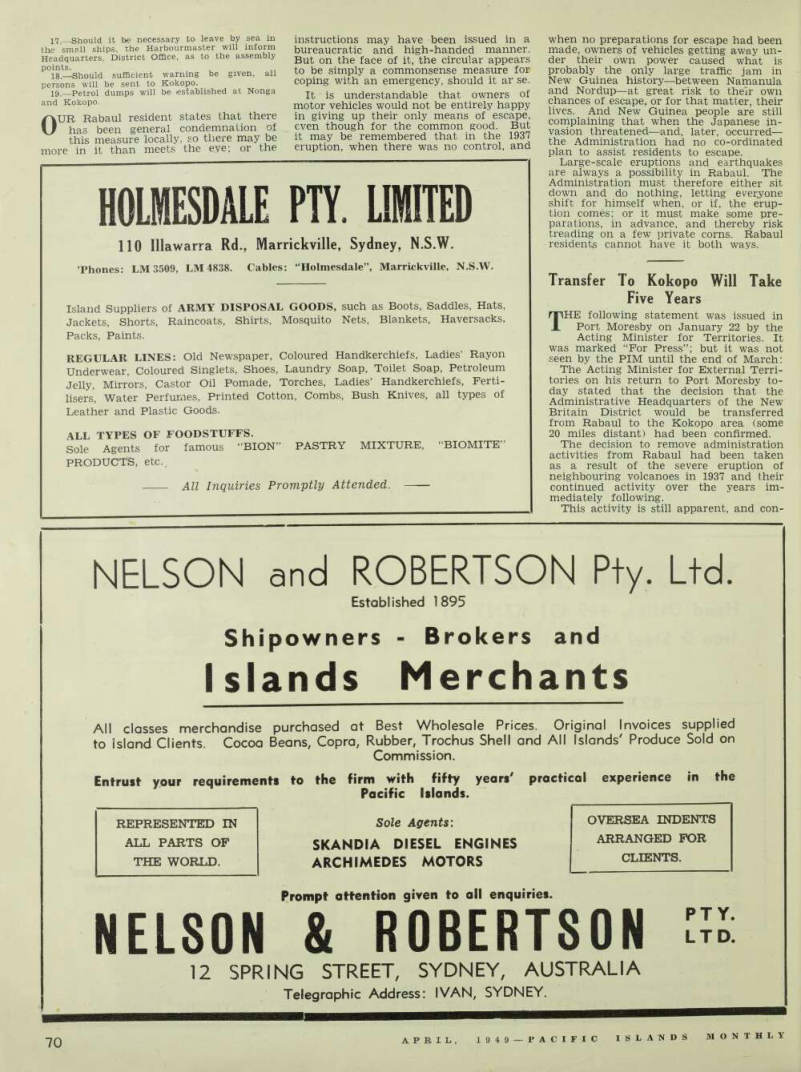
17. —should it be necessary to leave by sea in the small ships, the Harbourmaster will inform Headquarters, District Office, as to the assembly points. 18. —Should sufficient warning be given, all persons will be sent to Kokopo. 19. —petrol dumps will be established at Nonga and Kokopo.
OUR Rabaul resident states that there has been general condemnation of this measure locally, so there may be more in it than meets the eye; or the
instructions may have been issued in a bureaucratic and high-handed manner.
But on the face of it, the circular appears to be simply a commonsense measure for coping with an emergency, should it ar se.
It is understandable that owners of motor vehicles would not be entirely happy in giving up their only means of escape, even though for the common good. But it may be remembered that in the 1937 eruption, when there was no control, and
when no preparations for escape had been made, owners of vehicles getting away un der their own power caused what is probably the only large traffic jam in New Guinea history—between Namanula and Nordup—at great risk to their own chances of escape, or for that matter, their lives. And New Guinea people are still complaining that when the Japanese in vasion threatened —and, later, occurred— the Administration had no co-ordinated plan to assist residents to escape.
Large-scale eruptions and earthquakes are always a possibility in Rabaul. The Administration must therefore either sit down and do nothing, letting everyone shift for himself when, or if, the erup tion comes: or it must make some pre parations, in advance, and thereby risk treading on a few private corns. Rabaul residents cannot have it both ways.