Lord Howe Island’s Lost Treasure
pp. 49-50 · Read in the full issue
By Geoffrey Shepherd
I HAD been on Lord Howe Island only a week when I heard about the buried treasure in George’s Bay. At first I was sceptical. Just another island yarn that was reserved for tourist con sumption, I thought.
But my informant, an ex-school teacher with long residence on Lord Howe, was persistent and convincing.
Into his archives of Lord Howe he dived and produced documentary evidence to support his claim, and if it were not ab solutely conclusive, it indicated that the island could well hold lost riches. Briefly, it was supposed that somewhere on the island’s most southerly, mountainous ana unsettled region, there was buried some 6,000 sovereigns.
It appears that in 1830 the brig “George,” of 185 tons, under a Captain Rattunburg, sailed from London for Hobart Town with a consignment of me chandise for W. Bethune & Co .
Arriving there after. an uneventual voyage, the cargo was discharged and the “George” ,was fitted up as a whaler. The Middle Banks was now its destination, a rich whaling area in the Tasman Sea.
Success met the expedition: a profitable haul of whales was gathered. On reach ing Sydney proceeds from the sale of oil realised £6,000, paid in sovereigns, the coin of the day.
With the money safely placed on board, the “George” lost little time in putting out again for the Middle Banks. Thus time the whaler met with less success, and was forced to spend a longer period at sea, whereupon the water supply ran
short. Then, sighting the high i:eaks of Lord Howe Island, the skipper decided to put in and send a landing party ashore to search for water and provisions.
IN early colonial days little was known about Lord Howe. It had been dis covered 42 years previous to the “George’s” visit, by Lieutenant Ball, on his way to Norfolk Island in the “Supply,” but during the intervening years no settle ment had taken place and it was not until 1834 that the first settlers arrived.
Viewed from the sea it offered the “George’s” crew no hint of the verdant beauty to be found ashore. They saw it only as a gaunt island of massive peaks, whose summits were clothed in rain mists—a forbidding-looking island of an unknown quantity, that reared up from foam-fringed seas which were studded with rocky islets and the white wash of submerged reefs.
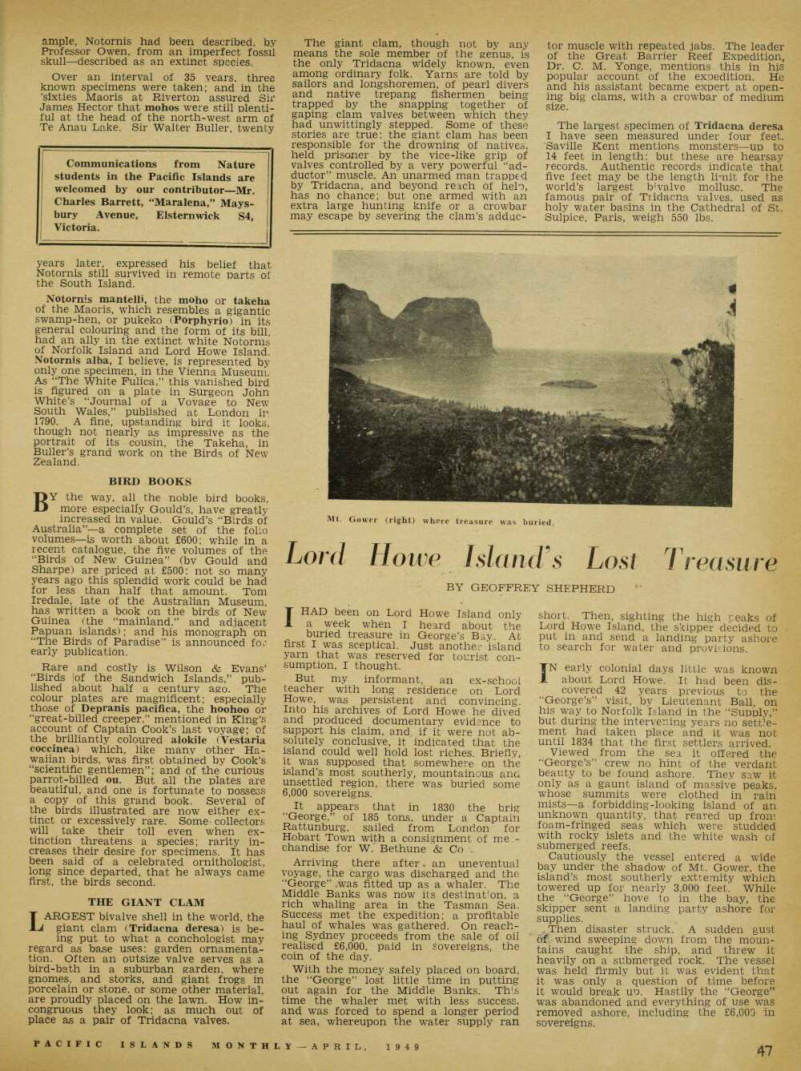
Cautiously the vessel entered a wide bay under the shadow of Mt. Gower, the island’s most southerly extremity which towered up for nearly 3,000 feet. While the “George” hove to in the bay, the skipper sent a landing party ashore for supplies. . Then disaster struck. A sudden gust 6# wind sweeping down from the moun tains caught the ship, and threw it heavily on a submerged rock. The vessel was held firmly but it was evident that it was only a question of time before it would break uo. Hastily the “George” was abandoned and everything of use was removed ashore, including the £6,000 in sovereigns.
Mt. Gower (right) where treasure was buried.
Ashore, the miserable castaways took stock of their surroundings. They found themselves stranded on a rocky beach, apparently shut off from the rest of the island by the two precipitous peaks that rose, in places, sheer from the sea. A iungle-like growth of palms clothed then scarps and the dense valley that separated the two mountains appeared impenetrable.
The island did not inspire them with con fidence and fearing that it might be in habited by savage natives they made their camp in the bay and there they remained.
During the weeks that they were marooned on Lord Howe they suffered from neither hunger nor thirst. The island teemed with a large variety of bird life, the seas yielded fish and turtle, and rainfall around the peaks was plentiful.
At last, five weeks later, a sail ap peared. This was the brig “Mary Eliza beth” bound for Norfolk Island, and also short of water. On reaching shore the newcomers found the “George’s” crew.
Then another sail appeared when the barque "Nelson,” Sydney bound, arrived.
The "George’s” crew now split up, the "Mary Elizabeth” taking the skipper and four men while the remainder of the crew sailed for Sydney on the “Nelson.”
The “George’s” skipper did not disclose the whereabouts of the planted coins to his rescuers. No doubt he preferred to leave it on the island until he was in a position to return under more propitious circumstances.
So the vessels put off and. left to the birds and the winds, the island again re verted to nature. The now disintegrat ing “George” was still clasped by the rock that to-day bears its name. The treasure lay buried in a spot known only to the skipper and his four trusted companions.
Meanwhile the “George’s” skipper had reached Sydney and was waiting an op portunity, a ship, and a chance to call at Lord Howe again and regain the buried gold.
But delays and frustrations were his lot and at last, in desperation, he signed on as mate in the whaler “Caroline” un der a Captain Tregurtha. This vesse was bound for Lord Howe Island waters.
Nearing Lord Howe on November 15. 1831, after confiding to the captain that gold coins were buried on the island, little difficulty was experienced in inducing him to make a call.
With the lesson of the ill-fated "George” in mind, the “Caroline” stood well off the island, and thus, before the crew reached the shore, they were weary with hours of
rowing.
TO the utter amazement of Rattunburg, he found that the ap pearance of the bay and beach had changed out of re cognition. During his absence a tremen dous landslide had occurred, and/ from the southern face of Mt. Gower millions of tons of rock had avalanched down in a pulverising mass of basalt. This had en gulfed the narrow beach and removed, for all time, any signs of previous landmarks.
The disillusioned treasure-seekers soon realised that the task of locating the treasure was now be yond them. After all his planning and waiting, Rattunburg
was dazed by the cruel trick the moun tain had played on him. Empty handed, the dejected party set about the long re turn journey to the ship.
It seemed almost as if the mountain had coveted the treasure; conspiring with nature, in a moment of violence it had buried it, placing it far beyond the reach of humans.
There are few spots on Lord Howe where the peaks of Gower and Lidgbird are not visible. Of grim beauty and adamant as the Sphinx, the southern base of Mt.
Gower still closely guards the secret of Lord Howe Island’s treasure trove. As nobody knows the exact spot where the treasure was supposed to be buried there has never been any organised attempt by treasure seekers.