Burdened With
p. 61 · Read in the full issue
Writs
‘Cheng Ho’ In Honolulu
THE converted Chinese junk “Cheng Ho,” well known in the South Pacific before World War 11, has been in legal trouble lately; and, at last advices, she was tied up in Honolulu, “restrained” by sufficient attachments, writs, Court orders and what-not to sink her at her berth beside No. 7 Pier.
When war came, she belonged to the Archbold Expedition, which had been doing important scientific work in New Guinea. She was used during the war by the United States Admiralty; and in 1946 or 1947 she was sold by Mrs. Anne Archbold to Mr. Otto Degener, a well known botanist, and resident of Honolulu.
Mr. Degener sold her to the Cheng Ho Trading and Exploring Co., which was in corporated in Honolulu on July 7, 1947, with Mrs. Eric de Bisschop as president and Mr. Degener as secretary-treasurer, to trade between Hawaii and French Oceania. There were changes in the en suing three months; but apparently in the final agreement, Degener was to re ceive 4,353 dollars; had the right to make one round-trip in the ship each year for scientific purposes; and the fur ther right to purchase the vessel for 15,000 dollars not later than July, 1952.
Under the command of Captain Eric de Bisschop, the “Cheng Ho” sailed from Honolulu in November, 1947. This pic turesque French sailor and writer has been frequently in the Pacific news.
In 1935, he built a two-hulled South Pacific type canoe in Honolulu and, with a crew of one, took her under sail to France, via the Cape of Good Hope—a
remarkable feat. When war came, he was French Consul in Hawaii; and he got himself into the bad graces of the Allies by adhering to the Vichy Admin istration. Since then, he has acquired a beautiful South Pacific Island (Eiao, in the Marquesas) and a beautiful wife—the former Constance Constable, a talented artist. Apparently, de Bisschop acquired most of Degener’s shares in the Cheng Ho Company, and he, William Scholtz and Harry Brookes between them hold the majority of shares.
The voyage from Honolulu to French Oceania was quite successful. While in Papeete, the “Cheng Ho” was registered under the French flag, with Captain de Bisschop as owner. This started the trouble.
IMMEDIATELY after the Cheng Ho returned to Honolulu,, ort July 31, 1948, Degener issued a writ of attach ment. He claimed that only 500 dollars of his 4,353 dollars had been paid—he sued for the balance. The minority shareholders (some half-dozen, including Degener) took legal action to compel the three majority shareholders to give an accounting; two Hawaiian crew-men lodged a special claim; and eight Tahitian members of the crew sued for wages due.
From then on, the “Cheng Ho” was “under restraint” frequently before various Hawaiian Courts —and was not kindly re garded by the judges, who found the Co’s, legal and financial affairs “extraordin arily complicated.” In October, a Court awarded 1,000 dollars each to the Hawaiian crew members as back pay, al though de Bisschop claimed they had been fully paid off at Tahiti, and had been allowed to work their passages home to Honolulu. On November 8, the eight Tahitian members of the crew—who had been living ashore in Honolulu, with friends, and whose wages claims had been adjusted—got away to Tahiti as members
of the crew of the unique gaff-rigged, Nova Scotia-built schooner “Ornant” (E.
J. Thomas, skipper-owner.
On November 18, another judge ordered that the “Cheng Ho” should remain in Honolulu, pending litigation. The case of the minority against the majority stock holders was due to commence hearing on December 8. A judge said: “I don’t want that ship to sail until I see the new registry act.” Captain de Bisschop ex plained that the registration of the ship in Tahiti in his name, instead of that of the Co., was due to a clerical error in the office of the Governor of Tahiti; and every effort was being made to have the error corrected.
In the course of these proceedings, a Honolulu broker officially valued the “Cheng Ho” at 60,000 dollars.
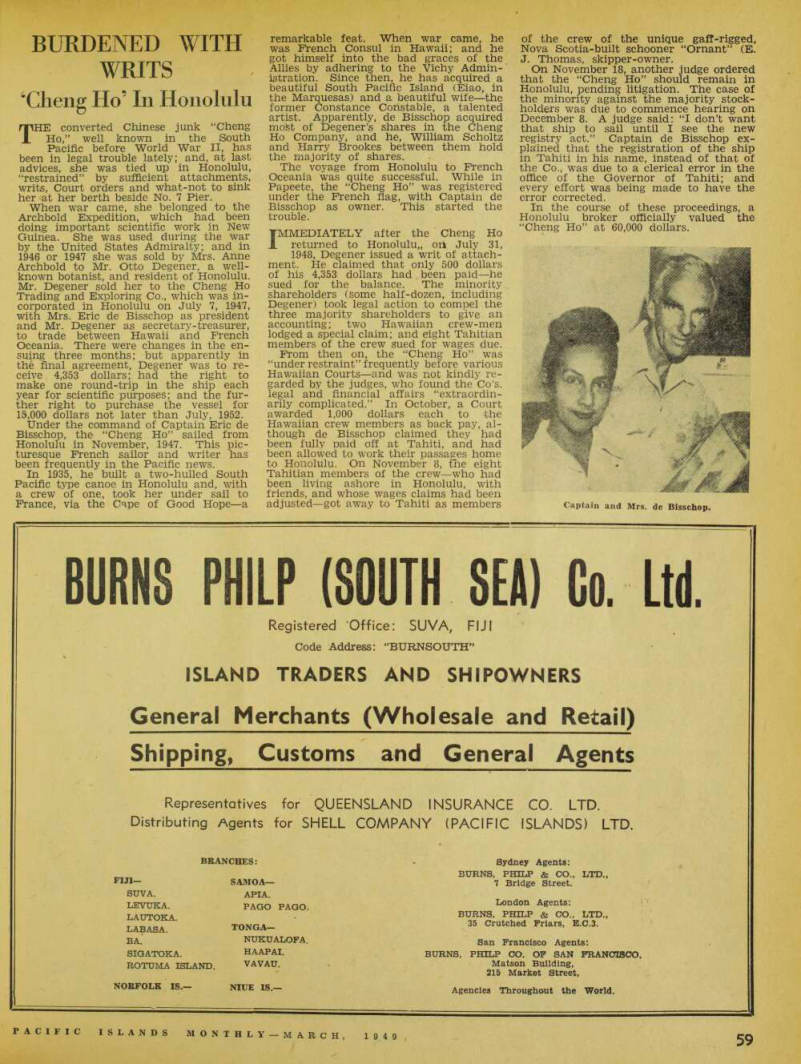
Captain and Mrs. de Bisschop.