Tropicalities
p. 49 · Read in the full issue
IT’S a small world, these days. At the end of February a Skymaster aircraft belonging to Trans-Australia Airlines was used to return children in Western Samoa to school in New Zealand. The TAA aircraft sandwiched the return Auckland-Samoa trip in between its regular trans-Tasman charter flights.
The children in Samoa had gone there from NZ to spend the Christmas school holidays with their parents but could not be accommodated on the February “Matua” which is generally regarded as the back-to-school special.
It was expected that the Skymaster would take nine hours on the trip be tween Auckland and Western Samoa. * * * THERE will be no luxury jobs for typists in Fiji (see February “Tropi calities”).
Questions “at an official level” went from Fiji to New Zealand after the “Fiji Times” had drawn attention to an Auck land press advertisement offering super luxury jobs to New Zealand typists with a “newly-established American concern in Fiji.” The concern, new or otherwise, did not exist in Fiji, as far as anyone could discover.
On February 12, another advertisement in the NZ “Herald,” Auckland, announced that everything was “off” and that ap plications would be returned. —“S” ♦ * ♦ THE first Indian born in Fiji, Mr. Marbi Dayaram, celebrated his 70th birth day on February 17. For many years he was a well-known Suva taxi proprietor.
Of his 14 children, 12 survive. Two daughters were married on February 19.
Other married children have already as sembled 28 grandchildren.
THIS was published in a London daily paper under the by-line, “William Courtenay, now on a Far East assignment”: Here is the story of a 280-years-old Charles II tankard which became in volved in the Pacific war.
Long the property of a family settled at Yame Island, near New Guinea it was buried by Mr. Fred Archer on his family’s coconut plantation when the Japs invaded in 1942.
Mr. Archer escaped from Yame Island, in the Buka Passage, with other Euro peans to Australia, but his boy who helped to bury the treasure was cut off behind the Japanese advance. Fearing that natives might find it he removed the tan kard and other valuables to the Buka mainland where all but some cash were stolen.
When the war ended, Mr. Archer re turned to his plantation, and started to search for the tankard. Many months later, when on patrol in an inland village, he saw a naked piccaninny sitting happily in shallow water scooping up and empty ing wet sand with the tankard. The clanking of the lid, as it opened and closed, drew attention to the baby’s toy.
Natives said that it was something be long all Japan soldiers—meaning that it was like a Japanese mess tin, to be dis carded. Two sticks of trade tobacco se cured the coveted antique for its delighted owner.
To-day it adorns the plantation home again in far-away Yame Island and the descendants of its owner will be able to embellish its history in England, with the tales of the strange fate which be fell it in the Second World War. * * * MR. F. P. ARCHER, the owner of the tankard, has this to say: The above article goes to show that news printed in the “PIM” also appeals to those who dwell in parts other than the Pacific.
The story first appeared in the PIM of August 1947, and gave an account of the burying and subsequent recovery of the old tankard. The London daily paper story has obviously been “collected” from PIM and enlarged upon. It certainly goes off the rails in parts!
Presumably, William Courtenay, who is responsible, is the well-known war cor respondent who went over the Kokoda trail with the Australian troops.
But the reference to “a family settled at Yame Island” is quite wrong as there had been only myself—a bachelor —and native employees resident there for 14 years prior to arrival of Mr. Tojo’s rep resentatives.
I did not “escape from Yame Island in Buka Passage with pther Europeans” to be evacuated to Australia early in 1942.
Certainly, I saw the Japs arrive in Buka Passage one fine morning, and, acting on a sudden hunch, I straightway departed for the higher spots in Bougainville feel ing tnat the mountain air was more brac ing and the view better!
I was in Bougainville until 1943, and during that time was variously reported as “killed” and “missing,” and I recall that the PIM thought it was one or the other. But my subsequent re-appearance proved these reports to have been “greatly exaggerated.’
What I think is quite unjustifiable, and may well come within the laws of libel, is for Mr. Courtenay to say, when referring to the tankard that “the descendants of its owner will be able to embellish its history, etc.”
I repeat—l am a bachelor, and, as is well known, the word “descendants” is plural and suggests an unspecified num ber! Although I admit to belonging to “the planter class” (of whom almost any thing may be expected these days!), I claim to have led a reasonably respectable
life! But “descendants” —Hell! If this meets the eye of our Mr. Courtenay I trust that he will have the grace to retract and apologise! Fair go, Aussie! ♦ * ♦ jrrjHE sophistication of the South Sea JL Islanders is being rapidly helped along by the introduction of the “talkies” into many of the smaller and remoter isles. Whether this is a good thing or not is a question—although, with intelligent censoring of the films, there is perhaps no reason why the natives should be deprived of this form of education and entertainment.
Talk of movies and sophistication re calls a story that is told of the early days of silent films in the Cook Islands. It was before the era of motor-driven pro jectors, the motive power being a crank handle turned by the native assistant.
Naturally the speed of activities on the screen were in direct proportion to the tiredness or otherwise of the cranker, plus the number of prods from the “boss”.
However, this particular time the schooner was making a trip round the Outer Group, and as she was to be two days at one isle, our schooner camera man took the opportunity to put on a show. There were one or two difficulties to overcome, the chief one being that although the natives were fairly well endowed with worldly possessions, money in hard cash was very scarce, as it had been a long time since the last fruit “payout”.
The next difficulty was a hall and seating accommodation. There was neither. But there are ways and means in Polynesia not dreamt of in other lands; and soon the drums were beating up the village to advertise a Wild-West thriller to be shown in the packing-shed that night. Admission: Two chickens — and bring your own seat!
All went well, and next day a well filled temporary chicken-run testified to the success of the show —so much so that it was decided to put on a repeat per formance —same show, same time, same place, same admission.
Well, of course, any native with the rudiments of sophistication naturally deduced “some chickens”; and, while our showman was safe at the shed, it was a simple matter to collect the price of ad mission from his temporary chicken-run on the way down!—PERITI.
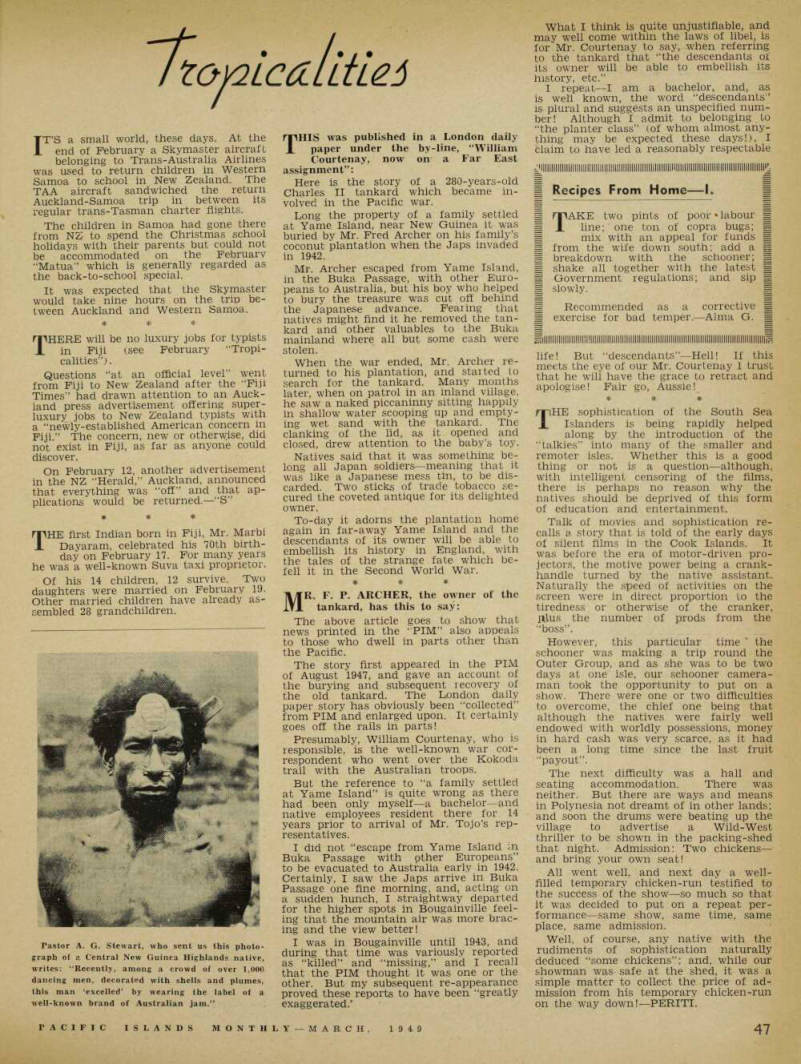
Pastor A. G. Stewart, who sent us this photo graph of a Central New Guinea Highlands native, writes: “Recently, among a crowd of over 1,000 dancing men, decorated with shells and plumes, this man ‘excelled’ by wearing the label of a well-known brand of Australian jam.”