Centenary Of Protestant
p. 35 · Read in the full issue
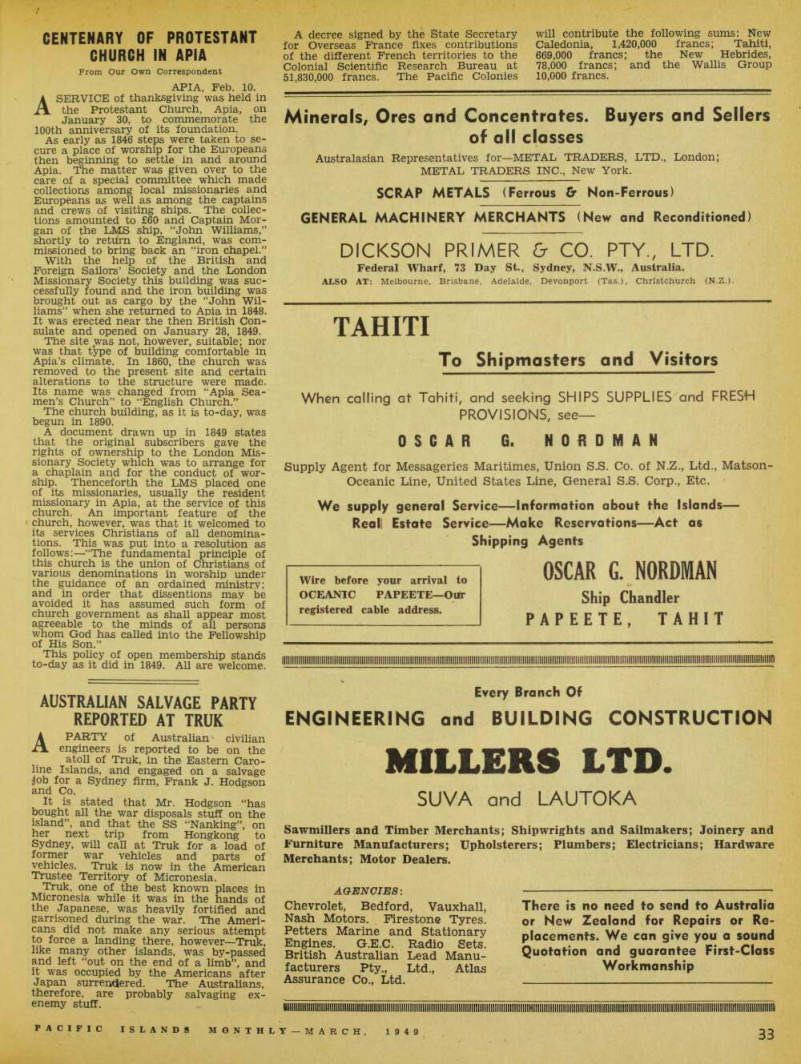
Church In Apia
From Our Own Correspondent
Apia, Feb. 10.
A SERVICE of thanksgiving was held in the Protestant Church, Apia, on January 30, to commemorate the 100th anniversary of its foundation.
As early as 1846 steps were taken to se cure a place of worship for the Europeans then beginning to settle in and around Apia. The matter was given over to the care of a special committee which made collections among local missionaries and Europeans as well as among the captains and crews of visiting ships. The collec tions amounted to £6O and Captain Mor gan of the LMS ship, “John Williams,” shortly to return to England, was com missioned to bring back an “iron chapel.”
With the help of the British and Foreign Sailors’ Society and the London Missionary Society this building was suc cessfully found and the iron building was brought out as cargo by the “John Wil liams” when she returned to Apia in 1848.
It was erected near the then British Con sulate and opened on January 28, 1849.
The site t was not, however, suitable; nor was that type of building comfortable in Apia’s climate. In 1860, the church was removed to the present site and certain alterations to the structure were made.
Its name was changed from “Apia Sea men’s Church” to “English Church.”
The church building, as it is to-day, was begun in 1890.
A document drawn up in 1849 states that the original subscribers gave the rights of ownership to the London Mis sionary Society which was to arrange for a chaplain and for the conduct of wor ship. Thenceforth the LMS placed one of its missionaries, usually the resident missionary in Apia, at the service of this church. An important feature of the church, however, was that it welcomed to its services Christians of all denomina tions. This was put into a resolution as follows:—“The fundamental principle of this church is the union of Christians of various denominations in worship under the guidance of an ordained ministry; and in order that dissentions may be avoided it has assumed such form of church government as shall appear most agreeable to the minds of all persons whom God has called into the Fellowship of His Son.”
This policy of open membership stands to-day as it did in 1849. All are welcome.