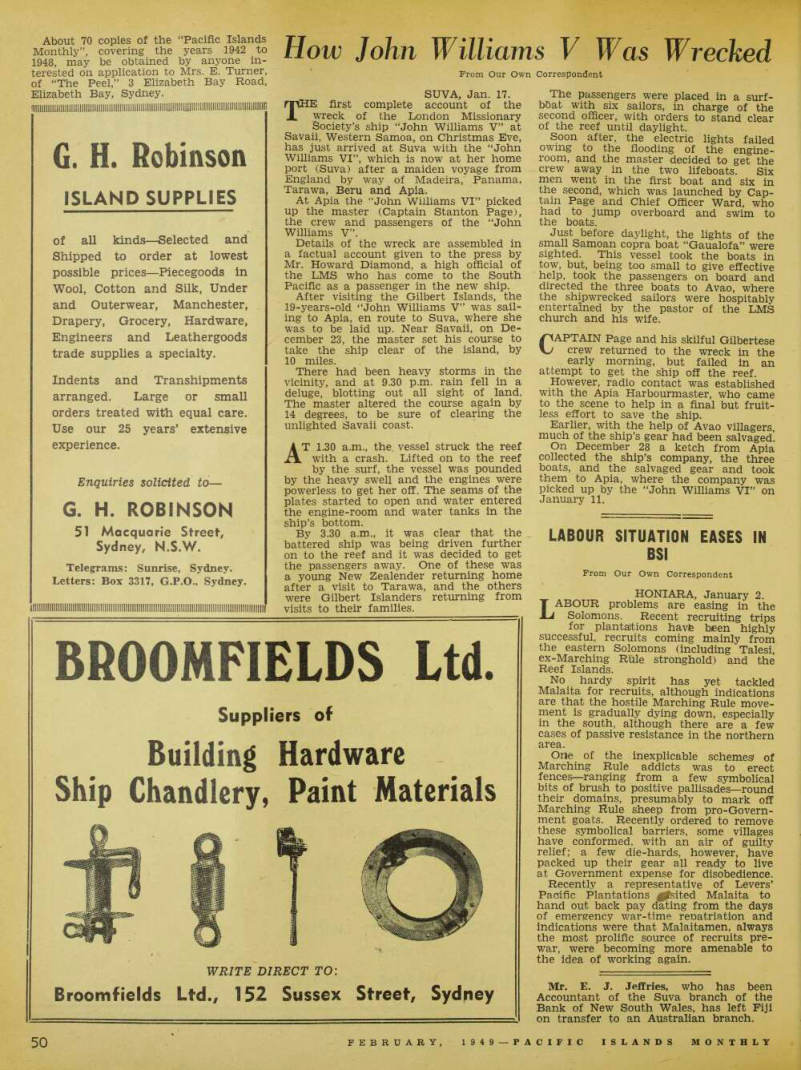
How John Williams V Was Wrecked
p. 52 · Read in the full issue
From Our Own Correspondent
Suva, Jan. 17.
THE first complete account of the wreck of the London Missionary Society’s ship “John Williams V” at Savaii, Western Samoa, on Christmas Eve, has just arrived at Suva with the “John Williams VI”, which is now at her home port (Suva) after a maiden voyage from England by way of Madeira, Panama, Tarawa, Beru and Apia.
At Apia the “John Williams VI” picked up the master (Captain Stanton Page), the crew and passengers of the “John Williams V”.
Details of the wreck are assembled in a factual account given to the press by Mr. Howard Diamond, a high official of the LMS who has come to the South Pacific as a passenger in the new ship.
After visiting the Gilbert Islands, the 19-years-old “John Williams V” was sail ing to Apia, en route to Suva, where she was to be laid up. Near Savaii, on De cember 23, the master set his course to take the ship clear of the island, by 10 miles.
There had been heavy storms in the vicinity, and at 9.30 p.m. rain fell in a deluge, blotting out all sight of land.
The master altered the course again by 14 degrees, to be sure of clearing the unlighted Savaii coast.
AT 1.30 a.m., the, vessel struck the reef with a crash. Lifted on to the reef by the surf, the vessel was pounded by the heavy swell and the engines were powerless to get her off. The seams of the plates started to open and water entered the engine-room and water tanks in the ship’s bottom.
By 3.30 a.m., it was clear that the battered ship was being driven further on to the reef and it was decided to get the passengers away. One of these was a young New Zealender returning home after a visit to Tarawa, and the others were Gilbert Islanders returning from visits to their families.
The passengers were placed in a surf bbat with six sailors, in charge of the second officer, with orders to stand clear of the reef until daylight.
Soon after, the electric lights failed owing to the flooding of the engine room, and the master decided to get the crew away in the two lifeboats. Six men went in the first boat and six in the second, which was launched by Cap tain Page and Chief Officer Ward, who had to jump overboard and swim to the boats.
Just before daylight, the lights of the small Samoan copra boat “Gaualofa” were sighted. This vessel took the boats in tow, but, being too small to give effective help, took the passengers on board and directed the three boats to Avao, where the shipwrecked sailors were hospitably entertained by the pastor of the LMS church and his wife.
CAPTAIN Page and his skilful Gilbertese crew returned to the wreck in the early morning, but failed in an attempt to get the ship off the reef.
However, radio contact was established with the Apia Harbourmaster, who came to the scene to help in a final but fruit less effort to save the ship.
Earlier, with the help of Avao villagers, much of the ship’s gear had been salvaged.
On December 28 a ketch from Apia collected the ship’s company, the three boats, and the salvaged gear and took them to Apia, where the company was picked up by the “John Williams VI” on January 11.