Asian Approaches
pp. 28-30 · Read in the full issue
A Ghost-Town Guards Australia’s Asian Approaches
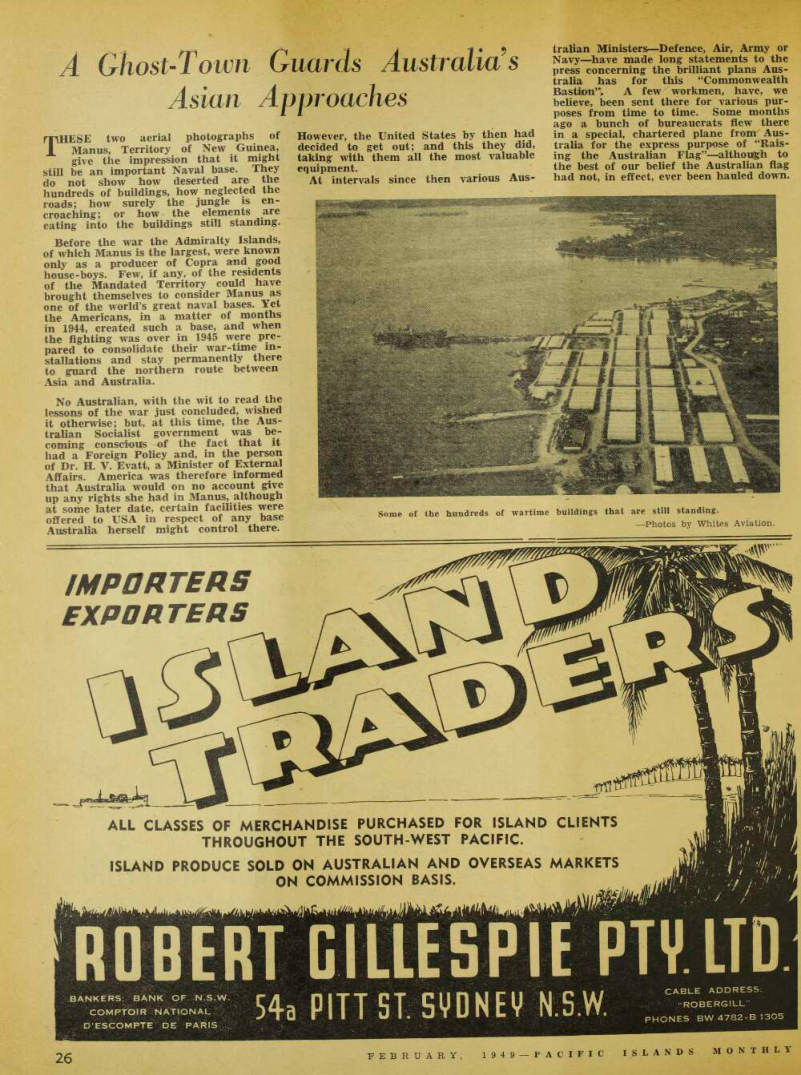
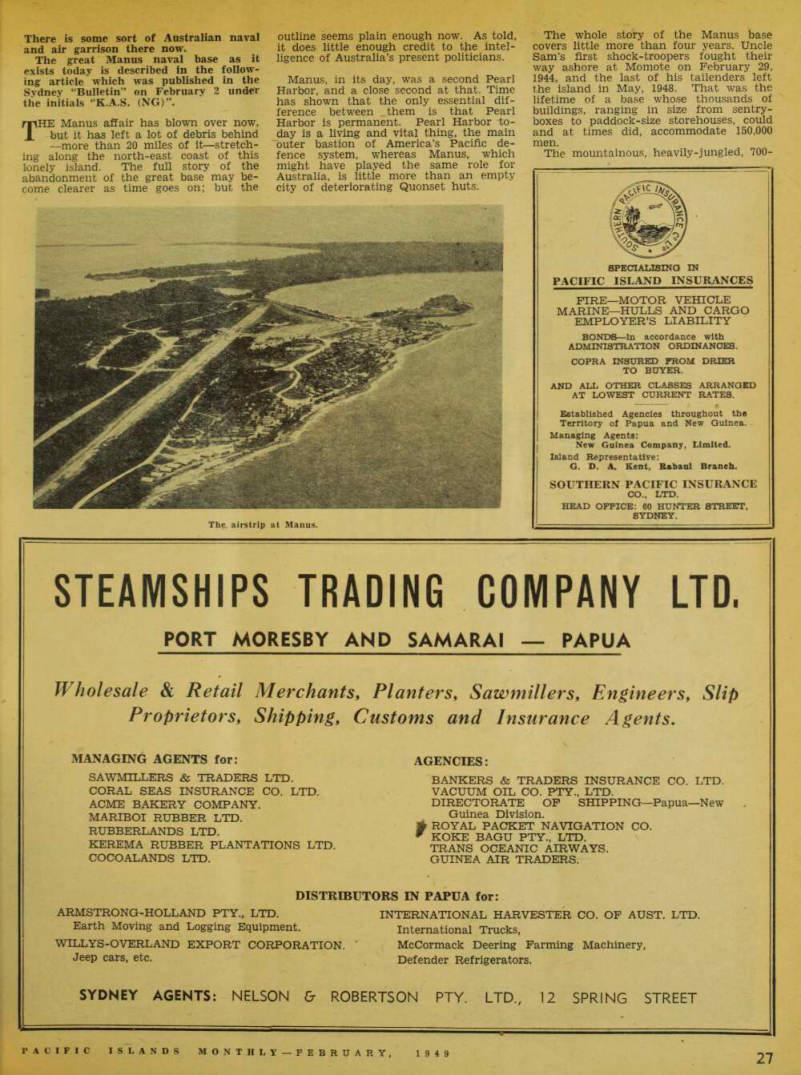
THESE two aerial photographs of Manus, Territory of New Guinea, give the impression that it might still be an important Naval base. They do not show how deserted are the hundreds of buildings, how neglected the roads; how surely the jungle is en croaching; or how the elements are eating into the buildings still standing.
Before the war the Admiralty Islands, of which Manus is the largest, were known only as a producer of Copra and good house-boys. Few, if any, of the residents of the Mandated Territory could have brought themselves to consider Manus as one of the world’s great naval bases. Yet the Americans, in a matter of months in 1944, created such a base, and when the fighting was over in 1945 were pre pared to consolidate their war-time in stallations and stay permanently there to guard the northern route between Asia and Australia.
No Australian, with the wit to read the lessons of the war just concluded, wished it otherwise; but, at this time, the Aus tralian Socialist government was be coming conscious of the fact that it had a Foreign Policy and, in the person of Dr. H. V. Evatt, a Minister of External Affairs. America was therefore informed that Australia would on no account give up any rights she had in Manus, although at some later date, certain facilities were offered to USA in respect of any base Australia herself might control there.
However, the United States by then had decided to get out; and this they did, taking with them all the most valuable equipment.
At intervals since then various Aus-
tralian Ministers—Defence, Air, Army or Navy—have made long statements to the press concerning the brilliant plans Aus tralia has for this “Commonwealth BastUm” A few workmen, have, we believe, been sent there for various pur poses from time to time. Some months ago a bunch of bureaucrats flew there in a special, chartered plane from Aus tralia for the express purpose of “Rais ing the Australian Flag”—although to the best of our belief the Australian flag had not, in effect, ever been hauled down.
Some of the hundreds of wartime buildings that are still standing, Photos by Whites Aviation.
There is some sort of Australian naval and air garrison there now.
The great Manus naval base as it exists today is described in the follow ing article which was published in the Sydney "Bulletin” on February 2 under the initials “K.A.S. (NG)”.
THE Manus affair has blown over now, but it has left a lot of debris behind —more than 20 miles of it—stretching along the north-east coast of this lonely island. The full story of the abandonment of the great base may become clearer as time goes on; but the
outline seems plain enough now. As told, it does little enough credit to the intel ligence of Australia’s present politicians, Manus, in its day, was a second Pearl Harbor, and a close second at that. Time has shown that the only essential dif ference between them is that Pearl Harbor is permanent. Pearl Harbor to day is a living and vital thing, the main outer bastion of America’s Pacific de fence system, whereas Manus, which might have played the same role for Australia, is little more than an empty city of deteriorating Quonset huts.
The whole story of the Manus base covers little more than four years. Uncle Sam’s first shock-troopers fought their way ashore at Momote on February 29, 1944, and the last of his tailenders left the island in May, 1948. That was the lifetime of a base whose thousands of buildings, ranging in size from sentry boxes to paddock-size storehouses, could and at times did, accommodate 150,000 men.
The mountainous, heavily-jungled, 700-
The airstrip at Manus.
square-mile island of Manus is the main member of the Admiralty Group a “hen-and-chicken” cluster 370 miles north-west of Rabaul and 200 miles off New Guinea’s north coast. Its geographi cal position determined its choice as supply-base and starting-point for the great drives against the Japanese in the East Indies and the Philippines. Though this was its primary war-time function, it has an obvious permanent value as the guardian of the gateway to Eastern Aus tralia and the South-West Pacific. Today, that gateway is wide open. The men who might have guarded it have gone. Only the silent buildings remain.
The base was sited mainly on the shores and reef-islands of 'Seeadler Harbor, a huge expanse whose eastern and better-protected half is cradled be tween the north-east coast of Manus and the western coast of Los Negros, which is
itself only a flat bow-shaped extension of Manus, projecting eastward from the main island and then swinging away to the north-west in a long narrow strip.
The two islands are separated only by a narrow bridgeable passage. The build ings and installations lay in jungle surrounded patches all round the eastern half of Seeadler Harbor, from Lugos on the mainland to Mokarang on the north west tip of Los Negros. The main naval area was on Manus itself, while the two big airports were Mokarang (heavy bombers) and near-by Momote (fighters).
All parts of the base, except the installa tions on the reef-islands protecting the harbor seaward, were connected by a first-class 25-mile road.
CONSIDERING the isolation of the Admiralty Group, before the war only a quiet copra-producing Pacific backwater supporting about 40 Europeans
and 13,000 natives, the scale and nature of the military installation in this pre viously almost unknown group seems in credible.
Manus had everything—first-class air fields, docks, repair-shops and workshops that could handle anything used in the Pacific war, huge deep-water jetties, enormous military stores, machinery of every imaginable type. Amenities for troops were on a grand scale. On one occasion—the launching of the Philip pines invasion—there were 800 ships gathered in Seeadler Harbor, and Momote andJMokarang were, in their heyday, two of the busiest airstrips in the world. It was a big show, and, except for a couple of RAAF and RNZAF squadrons, it was 100 per cent. American. Now it is gone, and the protection it could have afforded Australia has been thrown away, because, on the face of it, Australia’s politicians did not have the sense to know when they were on a good thing.
The Americans, on their departure, dis posed of the huge quantity of fine machinery and equipment by removing it themselves, by destroying it, or by selling it. Chief buyers were a couple of international private concerns and the Commonwealth Government. Much of the stuff acquired by the Commonwealth has deteriorated through neglect and ex posure, as instanced by the scores of motor landing-craft rotting in the man groves of Loniu Passage. The equatorial climate, with its 120 in. to 150 in. annual rainfall, has no mercy On man-made materials. The roads still in use are for the most part in a shocking condition.
Nevertheless, Manus is to figijre in Australia’s defence set-up, perhaps in conjunction with Britain. A few RAAF and RAN at Momote are keeping the airport open, and plans are said to be forward for an eventual establishment of several hundred or even a few thousand men. Even taking the most optimistic view, that is not enough to hold a large scale attack. As the Pacific war abund antly proved, isolated insufficient gar risons invite disaster.
Manus today still shows a few sparks of life. There are the handful of service people at Momote, and there is the Ad ministration at Lorengau, the “capital,” where, apart from the issuing of ukases and the filling-in of forms, the principal activity is provided by 40 Balts and Poles from Works and Housing pulling down Quonsets. Most of Manus’s over-all white population of under 100 is one way or another on the Government payroll.
There are 20 administrative officials to day in place of the pre-war seven, and one planting concern in place of the former nine—a picture, in this respect, that might be drawn of many parts of New Guinea.
Form a purely defence outlook at least, Manus inspires regret for the past rather than confidence in the future.