Sea Rovers
p. 92 · Read in the full issue
George Dibbern and ‘Crew’
Resume a Wander Interrupted By War
By William Bond
WHEN the 32 ft. double-ended ketch “Te Rapunga” sailed out of Avarua anchorage, Rarotonga, on Novem ber 22, bound for Penrhyn atoll, another chapter was added to the remarkable career of German-born Captain George Dibbern, world-wandering yachtsman.
With him on the ketch are his loyal comrade, New Zealander Eileen Morris, and 14-month-old Michele Lalani —a rosy cherub with a taste for deep-water sail ing—who is the apple of their eye.
George Dibbern’s introduction to the South Seas was not auspicious. He landed in Australia in 1910 by way of tne mooring ropes on a German square rigger. His progress up the wharf was speeded by a revolver shot from the irate German mate.
Australia was kind to the little German.
He travelled far and did many jobs and learned the English language. He crossed to New Zealand, where ne made many friends, and formed a deep affection for the Maoris. Presently, he found his way to the Cook Islands, and spent some happy months in Rarotonga. He decided to return to New Zealand to earn suf ficient money to settle permanently in Rarotonga as a planter and trader.
Unfortunately for his plans the 1914 war started; and Dibbern had Ger man nationality. For the first three years he was not troubled much, being required only to report to the police twice a week.
He lived quietly as a farmer, and he had plenty of friends, both white and brown.
Then, early In 1918, came the war’s crisis and feelings against Germany hardened.
Under escort, George Dibbern proceeded to an internment camp. In May, 1919 he was released and sent home to Germany.
IN Germany, he worked hopelessly for years, trying to build a future for his family. As a labourer in an un employment relief gang his free spirit re belled at the pattern that was forming under the growing Nazi power. He made up his mind to escape to New Zealand and freedom before it was too late.
With the aid of friends he acquired the little vessel which he named “Te Rapunga,” and made her ready for sea.
Lack of funds delayed the start of the big adventure; but after preliminary cruising in the Mediterranean, he even tually set out, with two companions, in the track of Columbus —to Portugal, Canary Islands, out across the Atlantic to Jamaica. Then across the Caribbean, through the Panama Canal, up the coast to San Francisco, and the first Pacific hop to Honolulu. Then right across the Pacific, in two big stretches—to Samoa, and at last to New Zealand.
Many old friends greeted Dibbern and he made new ones. He was invited to take part in the Trans-Tasman Yacht Race, which had been won the previous year by another sea-rover just arrived in New Zealand —Erling Tambs in his “Teddy.” Out of an original six entries there were finally only two starters, “Te Rapunga” and Johnny Wray’s staunch little home-made “Ngataki.” It was a gruelling race, in bad weather, and “Te Rapunga” arrived first in Melbourne. A grand welcome awaited both crews.
There followed an invitation for “Te Rapunga” and “Ngataki” to race to Hobart. Again it was a rough passage, and again “Te Rapunga” was first in.
From Hobart, “Te Rapunga” was sailed back to New Zealand. This was 1935. At Napier the little ship was prepared for a new adventure in the South Seas. A
Competent young New Zealand girl, Eileen Morris, was now George Dibbern’s chief helper and companion.
So, after 22 eventful years, George Dibbern returned in 1915 to Rarotonga.
He found it still a pleasant island. After two months’ stay, the liesurely voyage was continued to Tahiti, the Tuamotus, Marquesas, Honolulu, California, Canada —wanderings that covered years.
Back once more to Honolulu, “Te Rapunga” lazed for 72 days in Hawaiian waters while Dibbern wrote his book His sole companion now, Eileen Morris was as helpful in writing a book as she
was in sailing the little ship across the great ocean.
The book was finished and found a publisher. It was titled “Quest.” It is a very good book, a book of deep philos ophy as well as an adventure story of men—and women—against the sea.
But political storm clouds were gather ing. The uneasy peace on earth once more came, to an end in 1939. Soon the British Empire and the United States were again at war with Germany.
George Dibbern was again an alien —a man without a country. Wherever he set foot on shores that had so recently been friendly his freedom would come to an end. He might have sought refuge in South America; but he felt that it was his duty to see his young companion, Eileen Morris, safely back to her home land.
TE RAPUNGA” made her third Pacific crossing. The only halt this time was at Palmerston Atoll, where the two wanderers were warmly welcomed by the hospitable Marsters clan.
Back in New Zealand, it was home for Eileen, but the internment camp for George—the same prison that he had left in 1919. This time it was for 4i years— long, dreary years for a man with the spirit of a sea-bird, a gentle philosopher who desired only to be a friend of all the world.
This time, though, there was one warm thought to cheer his long internment.
“Te Rapunga” was being well cared for.
it was Eileen, the sun-tanned sea-gypsy, who seraped and painted and tended the old ‘Te Rapunga,” keeping her in good shape for that happy day when the seas would be once more free.
Dibbern was free again in 1946. But much work was required to earn the money to make the little ship ready for pcean wandering. But they sailed at last in 1948, for Rarotonga, and once more “Te Rapunga” frolicked over the long Pacific swells, with her little crew of happy philosophers. The addition of little Lani to the ship’s -company made happiness complete.
One day in October, just after the de parture of Jack Earl’s double-ender, world-circumnavigating ketch “Kathleen,” we here in Rarotonga were intrigued to see another double-ender, smaller and cutter-rigged, sail confidently into the anchorage. Who was she? She seemed to know her way about.
There was intense interest when it was learned that she was “Te Rapunga,” back again in these waters with George Dib bern and Eileen Morris, after an absence of many tragic years. They had been 30 days an the run from Auckland.
To the old friends who greeted them, they introduced the third member of their crew—charming Miss Michele Lalani, aged 14 months, rosy and happy after her first taste of deep-water sailing.
Eileen and George love children—soon their yacht was over-run by the local kids.
Maori friends of the other generation warmly embraced the little sailorman, who is almost an “old Rarotongan.” They recalled his happy days in Rarotonga In 1913, before two wars had torn the world; and again in 1935, when he arrived with his own little “Te Rapunga.”
Since 1935, the three names, “Te Ra punga,” George Dibbern and Eileen Morris, have become synonymous, and known throughout the Pacific and further afield.
AFTER a pleasant stay in Rarotonga, “Te Rapunga” set sail on November 22, on a northerly course, for Pen rhyn Island, to shelter there during the hurricane season. While living the sim ple atoll life, George and Eileen will com plete their second book. We hope they will have better luck than with the first book. The royalties gained from “Quest” were frozen as alien assets. Friends in America are still trying—so far in vain— to soften hearts in Washington to get the release of the money. If only those gentlemen in Washington knew how badly the money was needed!
At the end of the hurricane season the wanderers will set out on a long cruise to look up old friends; undoubtedly, they will make many new ones. First they will go to Honolulu, then to California and Canada, back across the Pacific again to familiar ports in Australia, down to Tas mania, and so back to New Zealand.
It all sounds pleasant and easy—until you see the size of “Te Rapunga” and re member that the ocean is not always smiling and gentle. “Te Rapunga” has no engine or radio.
“With engine and radio,” says Captain Dibbern, “we should only have trouble.
The engine would be sure to let us down just when we were depending on it, and a radio would only bring us troubles of the world out on the ocean where there is true peace,”
We wish them lots of the luck, this blue-eyed little man who calls himself “a citizen of the world and a friend of all who wish to be friends,” and his jolly crew.
At the masthead of “Te Rapunga” flies George Dibbern’s own “International”— a white flag with a red cross and a blue circle, and a blue star in the corner. It is best to get George himself to explain the flag. Simply, it means, “freedom of the spirit and friendship among all peoples.”
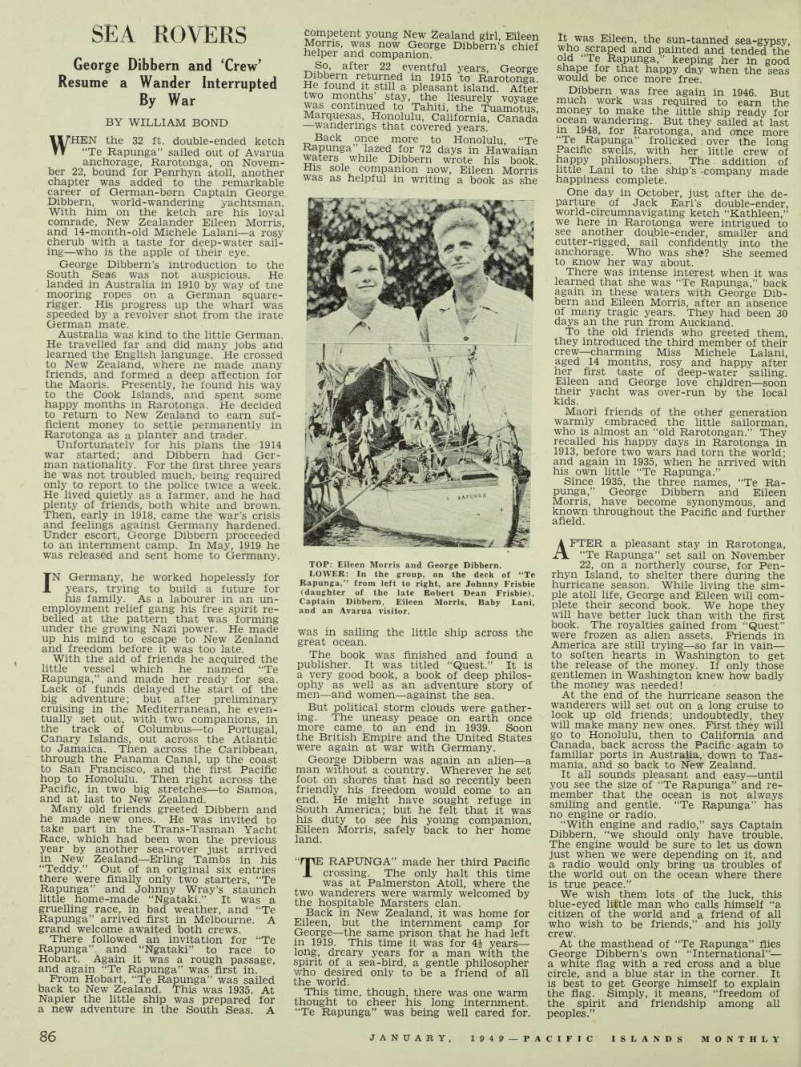
TOP: Eileen Morris and George Dibbern.
LOWER: In the group, on the deck of “Te Rapunga,” from left to right, are Johnny Frisbie (daughter of the late Robert Dean Frisbie), Captain Dibbern, Eileen Morris, Baby Lani, and an Avarua visitor.