Robert Dean Frishie the Puka-Pukaßooks is Dead
p. 72 · Read in the full issue
Puka-Pukaßooks is Dead
AFTER a brief illness in Rarotonga hospital, Robert Dean Frisbie died on November 19. So passes another Pacific literary warrior.
He had been in ill-health for a number of years and in and out of hospital frequently. When he was well he worked feverishly at his writing—probably for the sake of his children, of whom he was exceedingly fond.
He is survived by his five youngsters —Charlie, Jakey, Johnny (Florence), Elaine and Nga, all of whom have become known to readers of the Frisbie books as
a sort of modern Swiss Family Robinson.
Frisbie called them his Cowboys, and as such they have now become part of liter ary history.
Robert dean frisbie was an American. He served in World War I and later sought adventure in the South Seas—like many Americans of his time, first in Tahiti. In 1924 he left Tahiti for Puka Puka, in the Northern Cooks, where he opened a trading station for A. B. Donald Ltd. Here he married a Cook Islands girl, Ngatokorua, and
(according to his young daughter) left immediately with her to sail all over the Central and Eastern Pacific. Charlie was born in Rarotonga, Johnny and Jakey in Tahiti, and Elaine and Nga when the couple had returned again to Puka-Puka.
Eighteen months after Nga was born, Ngatokorua died of tuberculosis.
Apparently RDF had always had a predisposition to writing. He edited a Servicemen’s paper during the First War and turned to authorship again soon after he became foot-loose in the Pacific. He has stated that he was helped consider ably in finding an American publisher by his friend James Norman Hall, who already had established himself in Tahiti.
Frisbie wrote one story about Tahiti, but most of his books were linked in some way with the Cook Islands and concerned his life as a trader on Puka-Puka Moonlight’s Island,”
“Book of Puka- Puka,” etc.
Probably his best and most popular story was ‘Tsland of Desire,” pub lished during the war, which told the story of his wife and later the marooning of the Frisbies on Suwar row. Bince then
he has published “Amaru.” Another book, “Dawn Sails North” was to be published in New York in January. He was hard at work on another manuscript and a few days before his death had posted the first half of this story to the publishers. Some of the remainder had been roughed out, and Johnny Frisbie is typing it. She says she knows how the story ends, and hopes that if she sends the outline to James Norman Hall he may be able to finish it.
Frisbie, an erratic and somewhat tact less genius, made enemies as well as friends—particularly among the more in sular of the Island residents. There still are many, however, to regret his passing and to feel sympathy for the orphaned Frisbie children to whom he was the centre of the universe.
The two Frisbie boys have been in New Zealand training to be jockeys; the three girls are living with friends in Rarotonga.
There will be no lack of people who will wish these youngsters well. Their bright intelligence has captured the imagination of all who have read the Frisbie books, but their personal problems are unlikely to be any less for that. They will need guidance and help if they are to attain the happiness and peace-of-mind that Frisbie himself wished for them.
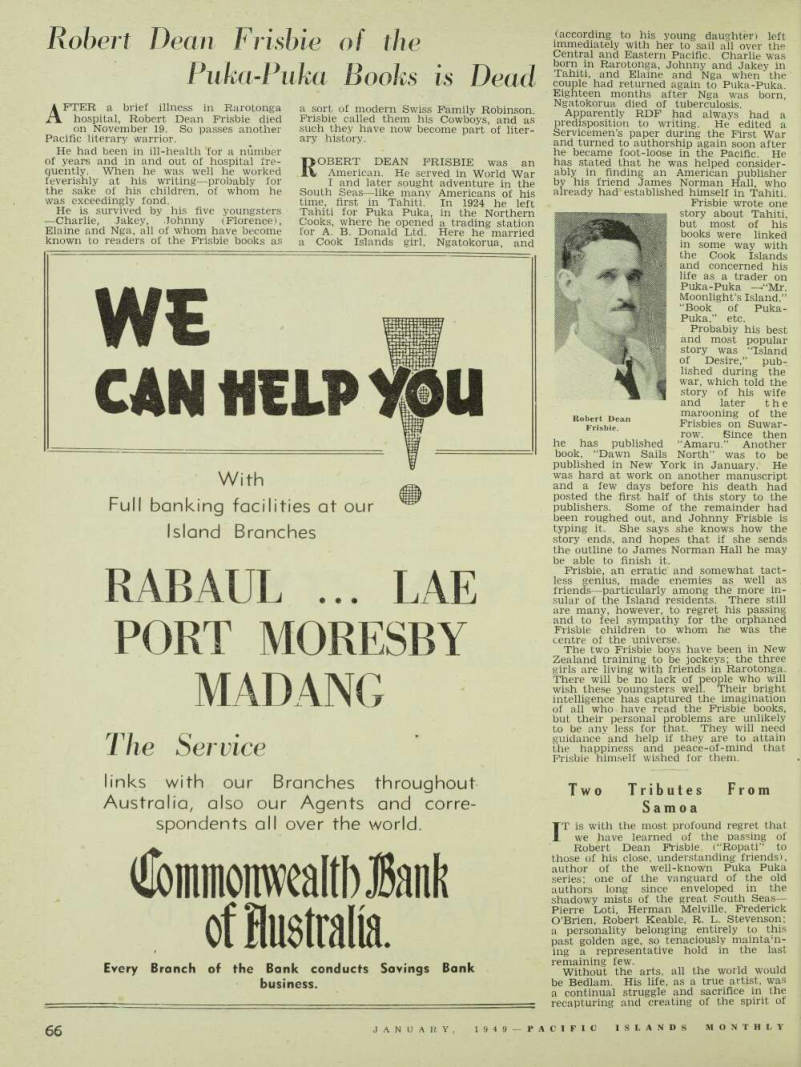
Robert Dean Frisbie.