Father Glovers Death
pp. 63-64 · Read in the full issue
After Plane Crash War-Time Exploits in N. Guinea Recalled
NEW Guinea’s Flying Priest is dead.
Father John Glover, a missionary of the Society of the Divine Word, passed away after his Dragon plane crashed in the mountains south of Lae on New Year’s Day. It is thought that this was to have been his last flight be fore he retired from flying.
Father Glover was 39; he was born in Perth and studied for the priesthood in New South Wales. He was held in the highest regard by Territorians, irrespec tive of creed, and his adventures during the dark days of 1942 have become a New Guinea legend.
His exploits and bravery, when he as sisted to evacuate the men who had gathered in the New Guinea Highlands in 1942 have been recorded by Mr. E. V.
O’Brien of Madang, NG, and Pastor A.
J. Campbell of the Seventh Day Adven tist Mission, in Central New Guinea.
They were published in the “PIM” in August and November, 1943.
WHEN the Japs invaded New Britain and New Guinea in 1942, European residents of Northern New Guinea made their way to the Highland areas and congregated at Kainantu and Mt.
Hagen.
One day, Pastor Campbell explains, the ominous sound of a plane was heard and natives and Europeans alike sought slit trenches. But it was soon realised that the plane was approaching too slowly for a Jap Zero and police-boys were in structed to lower the trip-wires that were stretched across the landing field. The piane landed; the pilot stepped out. It was Father Glover who previously had had only a few hours’ flying experience and who had never flown a passenger.
The plane was a small Spartan, loaned to Father Glover by Mr. Norman Wilde of Bulolo. It had a 75 HP motor and a ceiling of 7,000 feet—scarcely the kind of plane in which to go flitting about among Central New Guinea’s lofty peaks, in the bad weather which is usually associated with them.
Father Glover used the Spartan for several weeks but its limitations were obvious and he then remembered a Fox Moth which was lying at Madang. With his faithful mechanic, Carl Nagy, he set off on the 150 miles walk to get it. The
Moth was in very bad shape, but Nagy patched and mended until he considered it had a slight chance of making the Highlands. Father Glover climbed in and set off alone. What might have been Nagy’s place in the plane was taken by a drum of lubricating oil. Nagy walked back to the Highlands.
Back at Kainantu, Father Glover worked out a plan for flying those who were ill to Mt. Hagen where they could be cared for by Sister Jones, who had walked overland from Madang. But this plan had to be abandoned.
Soon after his return, too, the Spartan had been wrecked when it had failed to make the Purari Divide on an at tempted trip to Hagen and had to return to Kainantu, where it hit the trip wire across the landing ground.
During these long weeks the refugees, stranded on top of New Guinea, had hoped for air rescue but this was long in coming; so, aftgr Nagy returned from Madang in March, Father Glover devel oped a plan for flying to Australia for help.
Nagy and others again worked on the Moth and, when it was considered that it had reached the peak of its potential per fection, it was wheeled out onto the
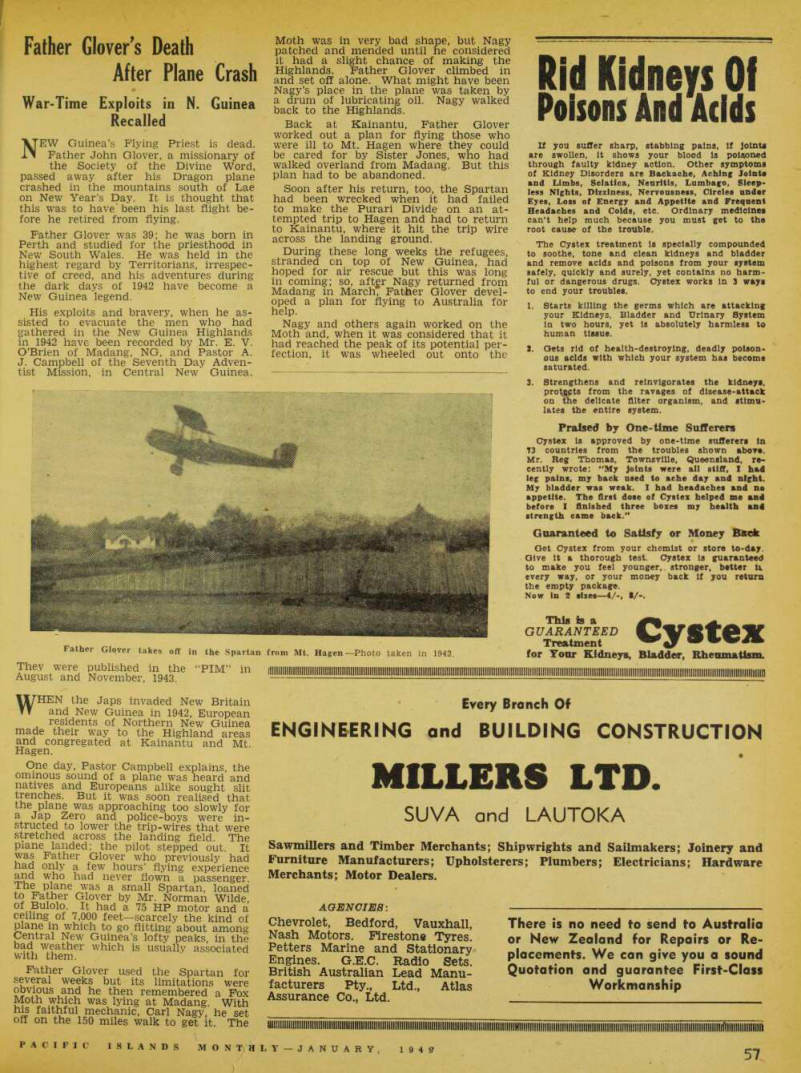
Father Glover takes off in the Spartan from Mt. Hagen—Photo taken in 1942.
drome and pilot and mechanic climbed aboard. The first attempt to take off for Hagen failed, and a drum of lubricating oil and all personal gear had to be left behind. But on the second attempt the plane rose sufficiently to clear the moun tains, and they reached Hagen.
Here, according to Mr. O’Brien, they took on extra petrol, which Nagy nursed on his knee, in a covered lavatory pan,
and fed to the engine with an enema; and on March 28, they were ready for their brazen attempt to reach Australia.
Father Glover had no knowledge of navigation: the Moth had no instruments.
He put his faith in God and a coloured map out of a school atlas. He calculated that he would fly 150 miles due south until he saw the Papuan coast, then south-west along the coast until he picked up the Fly River and Daru and then 100 miles across the Torres Strait to Thursday Island. The take-off from Hagen was accomplished and so was the climb across the central mountains; but, as so often happens, the coast of Papua was shrouded in thick rain. He flew out over the sea for some time but when petrol was getting dangerously low he turned back and about six that evening landed on an unknown beach. They learned afterwards that they had come down near the Dutch Border.
Next morning Nagy was ill with malaria but the indomitable priest began scouring the district and finally found a village where he persuaded the natives to take him and Carl Nagy in an outrigger canoe across Torres Strait to Thursday Island. They were two days in the canoe before being picked up by a lugger.
Once in Australia, Father Glovet was extremely busy. For once the authorities listened and an organisation was created for the rescue of the people who were stranded in the Highlands. They put Father Glover in charge of the operation with the rank of Captain, and gave him all facilities.
In May, the refugees on the Tablelands were told that they might soon expect rescue by air and bn May 13, 1942, a large plane came out of the clouds and landed on Hagen drome. Soon after a second plane appeared. The evacuation was completed without incident.