Rarotonga was like that in the Nineties!
pp. 51-52 · Read in the full issue
By James E. Cormack
“fl N the arrival of the steamer from w New Zealand the regular labourers refused to work unless they received 3 6 per diem, or at the rate of 6d. per hour.
"We hear that the Avarua boys who worked on the wharf whilst the steamer was loading cargo on her last trip were summoned before the Ariki’s court for working without the consent of their superiors. No fine was inflicted, but after the judge had lectured them, he strongly advised them to resume work.”
How comforting to this generation of slave-driving capitalists and despotic auto crats to know that they are merely follow ing precedent established by their grand fathers in the good old days when the century was in swaddling clothes.
The items quoted above are from Rarotonga’s leading newspaper, “loa Karanga,” of May 4. 1901. A public notice in the same issue offers work at the waterside at 3/- per day of ten hours and 6 - per night of the same length. And Albert Henry was not around!
Two weeks later the following appears: “Some 25 young men of Arorangi were before the Ariki’s court at Arorangi on Friday last in answer to a charge of absenting themselves on Monday even ing from the dancing practice. It appeared from the evidence that a com plimentary Ute had been tendered to Mr.
Taylor of the Union SS Company on Monday. In the middle of the Ute the police walked in and took the names of all the young men.”
After hearing the case, the judge warned the young men that they must have per mission from the proper authorities be fore they could absent themselves from the weekly dance. That was in the good old days of native rule.
THE intrepid
apostle to Papua, James Chalmers, who spent twelve years on Rarotonga, p u b lished the first news paper in the Cook Islands, but when he moved on the paper was allowed to lapse.
Fifteen years later “Te Torea” was born, a bilingual weekly of from four to six pages, this expositor of local and world news enjoyed circu lation for four years, mostly over the im print of Mr. H.
Nicholas, but later
with Mr. H. Ellis at the helm. It com menced humbly as a hand-written sheet, but in six months was proudly in print.
Later the “loa Karanga” arose in opposition, triumphantly carried off the “Te Torea” printing press, and with the blessing of the powers that then were, continued to enlighten the populace till the close of the Boer War. After a few chequered months of mud slinging, Ellis found his profits were insufficient to pay court costs in numerous libel and ccpntempt of court suits and “Te Torea” died as it was born, a humble hand written sheet.
A PERUSAL of the files of fifty years ago is of absorbing interest. Foi instance: “A very enjoyable evening was spent on Wednesday last in the Parliament House by a large crowd of residents, both Euro pean and Maori. Mr. W. Taylor having recently received one of those wonderful machines—the Phonograph—had, by re quest, very kindly consented to give the public the benefit of hearing it, and we are certain nobody regretted it. Mr Taylor manipulated the machine and the records were distinctly played. Several of them were repeated.”
And again, “The phonograph now being exhibited is a very good one and well worth a visit. It would be much more interesting to our Maori people if an ex planation in Maori of its working could be given at each exhibition. The same with the Panorama of the Sudan War. And as for Punch and Judy, why shouldn’t they speak Maori in Rarotonga?”
And for bird lovers: “Mr. Ross (The British Resident) wishes to find out if any of the quail, magpies, canaries, linnets, or larks introduced about three years ago are alive. Can any
of our readers supply the desired infor mation?’ Perhaps the übiquitous myna birds will answer that one.
From an article on the island’s horses —“These animals are, with a few ex ceptions, in a disgraceful condition. Sore backs and shoulders, and half-starved animals, are every-day sights. Where is the inspector? Or rather, what is the good of such an. officer, if he does not attend better to this important work?” Of course that was way back in 1895. To-day—oh,’ well, just read the paragraph again.
The same year—“ Dogs are an increasing nuisance.” We can do better than that to-day—they are now an established menace.
After soundly advising locals to manure and cultivate and thus produce more coffee: “Think of the shipping, the tram ways, the electric light, and all sorts of improvements that would be within our reach!”
Fifty-two years later we are still think- P/ th e s hiPPi n g. but one sweet dream of the long ago materialised in 1948 when Avarua was snatched from the Dark Ages by the press of a button and now sits gloriously in a flood of electric light.
Well, perhaps the shipping will come, too. some day.
This appeared in 1896: “There was a stir some time ago to light up Avarua settlement with ordinary kerosene lamps.
This would be a mistake. New inventions are constantly coming out. The last is acetylene, a compound formed by mixing coal dust and chalk together and passing through a stream of electricity—The re sult is a light so brilliant that small print can be read at a distance of 600 yards. (Does he mean inches?) We suspect however that it must be proportionately dark outside the influence of the light,
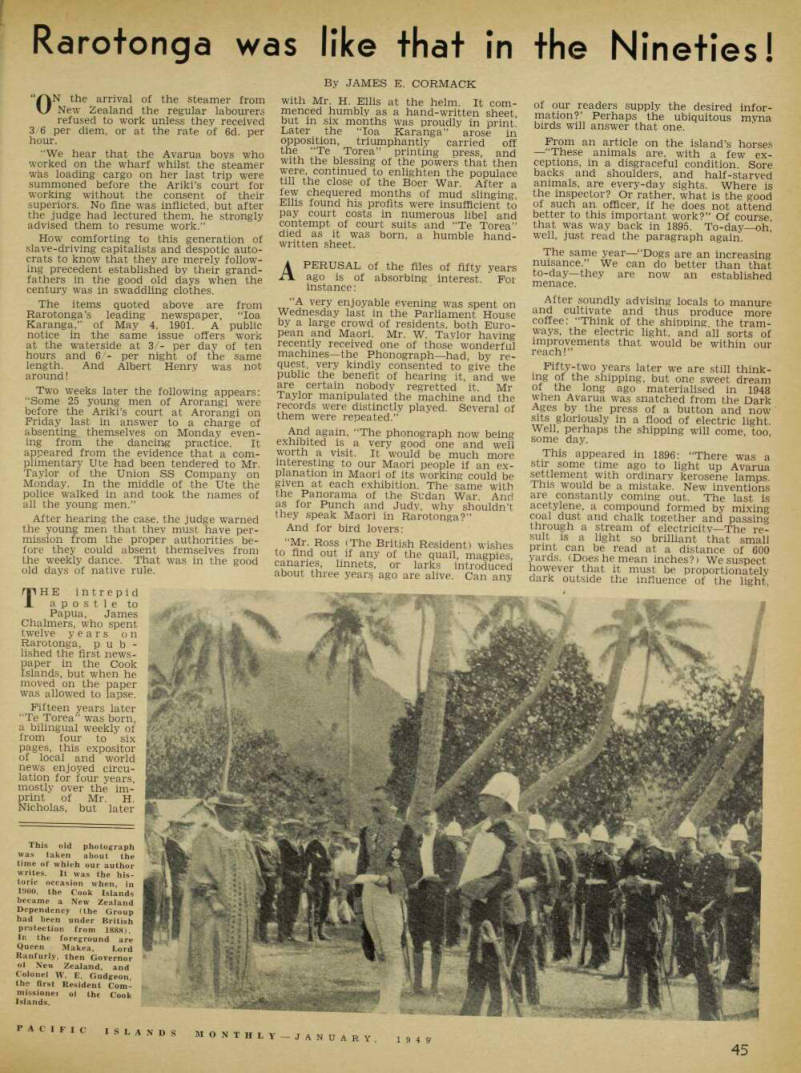
This old photograph was taken about the time of which our author writes. It was the his toric occasion when, in 1900, the Cook Islands became a New Zealand Dependency (the Group had been under British protection from 1888).
In the foreground are Queen Makea, Lord Ranfurly. then Governor of New Zealand, and Colonel W. E. Gudgeon, the first Resident Com missioner of the Cook Islands.
which would be a great objection for street lighting.”
Evidently the business firms were more enterprising; “A number of lamps have just been placed on the wharf by the firm, Messrs. Donald and Edenborough, and have proved a great convenience while so much loading has to be done at night. . . . On Monday night the new lamps on the Wharf were lit for the first time, and added greatly to the effect of the scene, and, as some of the excursionists re marked, they seemed to have suddenly dropped into the middle of Queen Street, Auckland. We must certainly compliment Messrs. Donald and Edenborough on their enterprise, which shows the good faith they have in the advancement and pro gress of Rarotonga.”
And we can add, with the switching on of the lights fifty years later, their con fidence was not misplaced.
PHOTOISED” cyclists, pioneers of this modern wheel-age, are the subjects of a clipping from “Te Torea,” of October 10, 1896: “On Saturday afternoon last, our friend, Mr. George Crummer, had quite a busy time. On the lawn fronting Mr. Scard’s residence all the members of the Rarotonga Cycling Club had assembled for the purpose of being photoised.
Though the light was not favourable for the purpose, Mr. Crummer succeeded in taking some capital views of the mem bers grouped in various positions. After the ‘operation’ the members, amongst whom were a number of ladies—natives and European—pedalled round the ground in procession, and the sight at times was both pretty and interesting. The wheel craze has reached our little island in all its vorulence. (Where werei those dictionaries?) Even advanced age has suc cumbed to its wonderful influence, as we noticed more than one member of an tiquity, while endeavouring to preserve a rigid equilibrium, suddenly hug the machine and Mother Earth in affectionate embrace.”
And a week later—“We have just been shown an exceeding neat specimen of photography executed by Mr. George Crummer, of Rarotonga. The view con sists of a group of cyclists, residents of the island. The likeness of each member of the group is really capital, while the background of the forest foliage gives the picture a pleasing and unique appear ance. We compliment Mr. Crummer on the skill and taste displayed.”
Well done, George! Mr. Crummer is with us to-day, and when I called on him recently, he proudly showed me an assortment of vintage model wooden cameras and magic-lanterns which are housed in a room literally packed with glass photographic plates, triumphs of other days.
ADVERTISEMENTS, too, have their in terest: “The Factorie Societe Com merciale de L’Oceanie, Rarotonga (Von Hoff, manager) offers good, strong bicycles for sale. Worth $200.00, now sold for $120.00 (Chilian dollars were currency in those days). Solid rubber tyres. No holes, no pumping up. The very thing for Rarotonga. Discount given to cash buyers. We make the price low expecting many orders from our Maori friends.
Come and judge for yourselves.”
The giddy pace of social life in the gay nineties is shown by the following: “A very successful magic-lantern entertain ment was given by Messrs. Salmon and Neumergen at the Osana Hall last even ing. As entertainment of any kind in Rarotonga is very rare, the little hall was crowded with natives amongst whom was a large sprinkling of the European popu lation. . .
“In the interval some capital music was given by Mr. Neumergan on the organ, and Mr. S. Savage on the cornet, while Mrs. Rice sang the beautifully sympa thetic melody, ‘Where Is My Wandering Boy To-night?’ very sweetly indeed. The music emitted by the organ was grand in the extreme, especially the well-known air, ‘Home Sweet Home,’ which was given with all its beautiful variations, and was greatly relished by the European portion of the audience, bringing so vividly to their minds the old-time memories so dearly cherished by the British-born.”
The second half of the entertainment consisted of views of various cities and some local scenes, but these were too dark to be plainly recognised from the body of the hall. "However, the incident con nected with each view was pleasantly de scribed by the lecturer, and much re lished by all present. The whole wound up with some more capital music by the same artists, and the National Anthem finished one of the most plesant and in
structive entertainments held in Raro tonga for a long time.”
THROUGH the years, “Te Torea” clamoured vociferously for the build ing of a lock-up in Avarua. One of the last issues commented: “The lock up in Avarua is, we are glad to say, nearly finished. The police will then be able to do as in other places. . . We warn the judge and the police that if they are too lenient with bad characters, Raro tonga will soon become a refuge for un desirable people.”
Shortly after this news item appeared in the rival “loi Karanga—“Rarotonga’s first gaol, a building in the Government grounds, was proclaimed this week. The first prisoner is Mr. H. Ellis, secretary of the Law and Order League and editor owner of ‘Te Torea.’ Mr. Ellis is serving a sentence of 14 days, with hard labour, for contempt of court.”