Fijian Copra
pp. 19-22 · Read in the full issue
Serious Loss Of
Hurricane Damage to 1949 Crop
From Our Own Correspondent
Suva, Dec. 19.
NO over-all estimate of the devastation caused by the December hurricane, which, between December 6 and 8, swept from Rotuma round the eastern islands of Fiji and down through the Lau Group, ultimately dying out in the region of Niue, is possible for some time yet.
From Rotuma, eastern Vanua Levu, Rabi, Taveuni and Lau, the reports in dicate the loss of from 40 per cent to 75 per cent of the 1949 copra crop.
Wherever the hurricane struck, food crops were devastated and heavy damage was done to buildings.
Copra production is Fiji’s second in dustry. A loss of a large proportion of the crop must have far-reaching economic
repercussions.
On December 13, 14 and 15 the Royal New Zealand Air Force operated a Catalina “airlift” to the Lau Islands, making three trips daily and parachuting emergency food and medical supplies wherever it was not practicable for flying-boats to alight.
Only one fatality has been reported.
Sauito, the District Chief of Juju, Rotuma, died as the result of being crushed by three falling coconut-palms.
The Burns, Philp inter-island ship “Yanawai” had landed passengers and mails at Rotuma before the hurricane struck. She immediately put to sea and fought out the storm, returning to land 250 tons of stores.
On the ship’s return to Suva on De cember 14, Captain W. R. Percy paid the highest possible tribute to the ship’s European. Fijian and Banaban per sonnel.
Five buildings were destroyed at the Government Station at Rotuma.
The official report on a preliminary aerial survey of Lau stated that the ap pearance of many islands recalled scenes in the Solomons and Gilberts after heavy bombing and artillery bombard ment.
The worst-hit copra areas will require at least three years to recover—providing that there are no more hurricanes. The Colony’s best copra comes from these eastern districts.
Excellent service was given during the emergency by the Meteorological Office and ZJV Suva. No part of the Group failed to receive the preliminary warn ing; and all the areas directly affected were given the final warning in ample time. On the other hand, the difficulty of getting information from the stricken islands to Suva has led to a demand for more adequate communication with out lying islands. A comprehensive radio telephone system is strongly advocated.
“Appalling Damage”
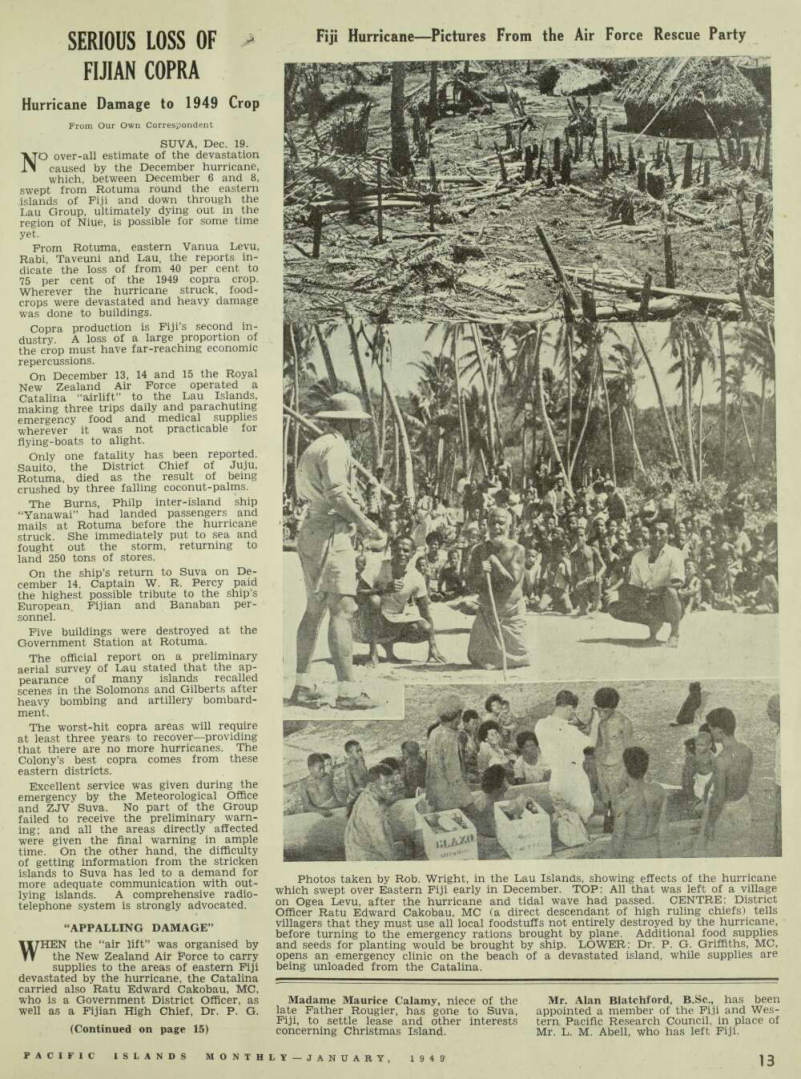
WHEN the “air lift” was organised by the New Zealand Air Force to carry supplies to the areas of eastern Fiji devastated by the hurricane, the Catalina carried also Ratu Edward Cakobau, MC, who is a Government District Officer, as well as a Fijian High Chief, Dr. P. G.
(Continued on page 15)
Madame Maurice Calamy, niece of the late Father Rougier, has gone to Suva, Fiji, to settle lease and other interests concerning Christmas Island.
Mr. Alan Blatchford, B.Sc., has been appointed a member of the Fiji and Wes tern Pacific Research Council, in place of Mr. L. M. Abell, who has left Fiji.
Griffiths (medical officer) and Mr. Rob.
Wright (official photographer).
The following description of what he saw is taken from a broadcast address given by Dr. Griffiths over ZJV: Not one case of injury was seen; and only few seriously ill. No epidemic had broken out, and water supplies were, by and large, no worse than they were in 1947.
I find myself incapable of describing the appalling damage which the hurricane has done to housing, food-crops, and coconuts. This was almost equally bad at each of the islands we visited. The morale of the Fijians throughout the devastated area was not affected. The bringing of food to them so early after the disaster, and in such large amounts, brought forth from them more apprecia tion than I have ever seen from any people other than the Dutch when our liberating army freed them from the German occupation,
Edward Cakobau At Work
SOMETHING which, impressed me was the extreme competence of Ratu Edward Cakobau. I had never before seen a Fijian chief who was prepared to “muck in” with his people, to help in fetching and carrying, to a load as heavy as any other man’s, and who yet retains the most reverent re spect, to which‘may now be added the gratitude, of his people. Many of the Lauans had never seen Ratu Edward before, but they all knew him for his war record, and they were delighted to receive him in their villages and re peatedly mentioned in speeches their knowledge of the fact that he is a “turaga ni lewa vavalagi” (a District Officer) as well as a high chief. Ratu Edward knows how to organise the Fijians, and I have never seen Fijians get down to any job so quickly and so efficiently as they did on our recent calls.
I suppose the best example which I can give is what I saw at the tiny village of Ogea. When the Catalina landed in the lagoon between Ogea Levu and Ogea Driki, it was about one mile from the village. The large canoes were on the hard when we arrived, and the small canoes which came out to meet us could not cope with the weight of food which we had brought.
When Ratu Edward got to the village (on a small canoe which he handled as well as any of the locals) he organised every man, woman, and child to carry one of the large canoes down to the sea—a matter of half a mile over the sands.
The children ran round and round the body and the outrigger of the canoe, putting in place small lengths of tree branches to act as rollers; and the men and women pushed, pulled, heaved and strained, joking and laughing, and with Ratu Edward heaving at the rear; and they had that huge canoe down to the sea in an amazingly short time. That was a sight to remember.
Methods of getting the food from the seaplanes varied from island to island.
At Lomaloma. Mr. Fred Kaad of Kanacea was of great assistance, as he put his large launch at our service. Ono-i-Lau (a very go-ahead community with a keen and well-educated Bull) has its own launch.
But at other islands we were dependent largely upon canoes, which are far from easy to bring alongside a seaplane with out damaging at least the aerial. Time and again the air crews detached their aenai, with no sign of a grumble, to let the rather unweildly canoes come well into the side of the plane.
At other islands a new form of trans portation was used. The seaplane’s in flatable rubber dinghies, big enough to hold seven men, were put over the side, and were hauled ashore by a small canoe.
Again, at Moce, where there was a stiff breeze, making it particularly difficult to bring even a small canoe alongside, an other method was used. As soon as the plane had landed, a couple of score of the village school-boys swam out to us, about a quarter of a mile. They clambered all over the seaplane except the wings; and, when we found that it was going to be some time before the canoes could reach us, the boys jumped back into the water and swam us ashore, led by a Fiji soldier who was there on leave. One of the boys swam back-stroke, with the rubber dinghy towrope in his teeth, and the rest swam at our sides, holding on to the rope around the dinghy with one hand.
Conditions In The Villages
rE conditions under which the Fijians are living in many of the villages are frightful. Many are sheltering in all that is left of their bure, the roof having been lifted high off the house and dumped down away from the flattened walls. Others are using the shelter of the more durable wood and iron churches— though not even all of these are standing.
Others are sharing the few bures which are still habitable.
In some parts of the Lau group, food gardens are no longer recognisable. Even in good times some of the southern Lau islands have a hard time for food, and
they are now very hard hit.
Water supplies generally were of a simple enough nature to be little affected.
The smaller islands have no creeks, and
depend upon rain water entirely. Only Ogea was in difficulties, as the concrete
rain-water tank had been filled to five feet deep by sea water when the tidal wave swept over the village.
I was amazed that not one person was reported as drowned. Refuge was taken in the rafters of houses and in some places the people got on to higher land, knowing what to expect.
The condition of the coconut planta tions is so bad that there will be no copra worth speaking of for at least one year, and possibly two. The trees on high ground looked like so many match
stalks with a few pathetic-looking leaves hanging down at one side. Many of these have been so badly bruised as to be killed. The devastation was very much like that of warfare on its terrible modern scale.
A small schooner which we saw in Ono-i-Lau lagoon had ridden out the hurricane between Tonga and Fiji, and we found the “Tui Wailevu” safe and sound at Ono also. Not so fortunate was the “Cakau Balavu”, which stood high and dry at the high water mark at Lomaloma. The people were busily dig ging away the sand to get her back into the water.
The Lau people generally were already hard at work getting things ship-shape before we got out to them, and house building had been commenced on the sites of bures that had been blown away.