The Problems Of New
pp. 73-75 · Read in the full issue
Caledonia
Search For Labour :: Planters Want Help From France
By Our Noumea Correspondent
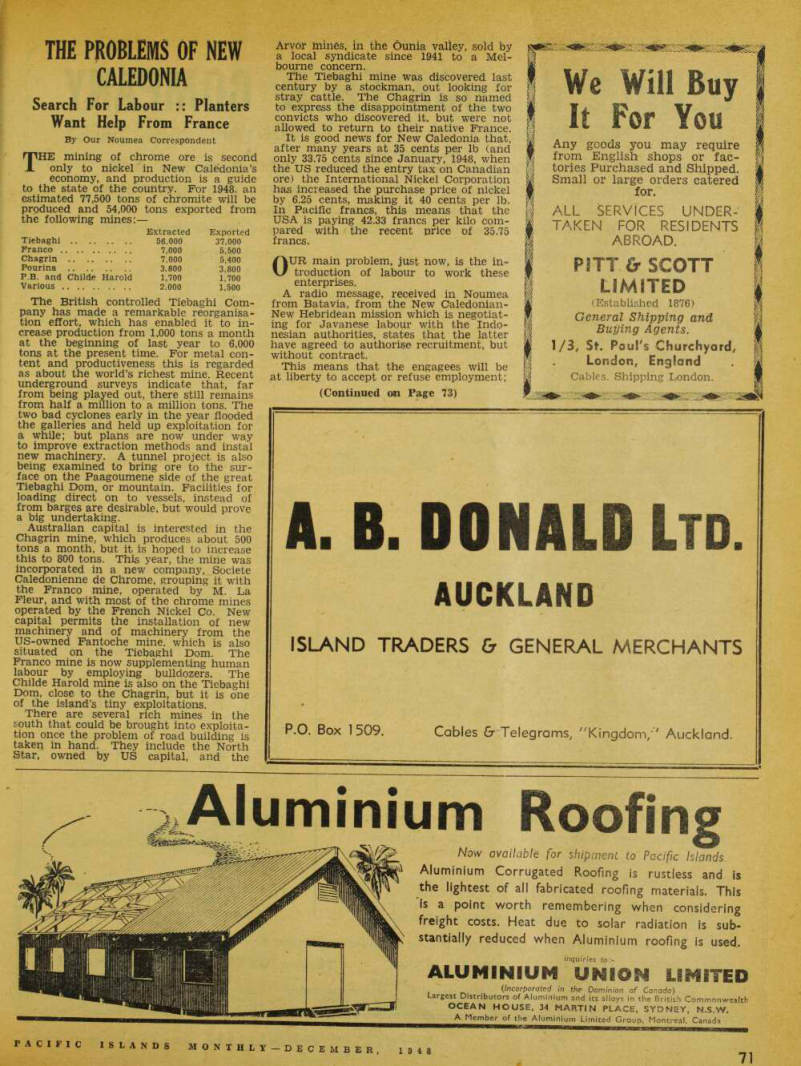
THE mining of chrome ore is second only to nickel in New Caledonia’s economy, and production is a guide to the state of the country. For 1948. an estimated 77,500 tons of chromite will be produced and 54,000 tons exported from the following mines:— Extracted Exported Tiebaghi 56,000 37,000 Franco 7,000 5,500 Chagrin 7.000 5,400 Pourina 3,800 3,800 P.B. and Childe Harold 1,700 1,700 Various 2,000 1,500 The British controlled Tiebaghi Com pany has made a remarkable reorganisa tion effort, which has enabled it to in crease production from 1,000 tons a month at the beginning of last year to 6,000 tons at the present time. For metal con tent and productiveness this is regarded as about the world’s richest mine. Recent underground surveys indicate that, far from being played out, there still remains from half a million to a million tons. The two bad cyclones early in the year flooded the galleries and held up exploitation for a while; but plans are now under way to improve extraction methods and instal new machinery. A tunnel project is also being examined to bring ore to the sur face on the Paagoumene side of the great Tiebaghi Dom, or mountain. Facilities for loading direct on to vessels, instead of from barges are desirable, but would prove a big undertaking.
Australian capital is interested in the Chagrin mine, which produces about 500 tons a month, but it is hoped to increase this to 800 tons. This year, the mine was incorporated in a new company, Societe Caledonienne de Chrome, grouping it with the Franco mine, operated by M. La Fleur, and with most of the chrome mines operated by the French Nickel Co. New capital permits the installation of new machinery and of machinery from the US-owned Fantoche mine, which is also situated on the Tiebaghi Dom. The Franco mine is now supplementing human labour by employing bulldozers. The Childe Harold mine is also on the Tiebaghi Dom, close to the Chagrin, but it is one of the island’s tiny exploitations.
There are several rich mines in the south that could be brought into exploita tion once the problem of road building is taken in hand. They include the North Star, owned by US capital, and the
Arvor mines, in the Ounia valley, sold by a local syndicate since 1941 to a Mel bourne concern.
The Tiebaghi mine was discovered last century by a stockman, out looking for stray cattle. The Chagrin is so named to express the disappointment of the two convicts who discovered it. but were not allowed to return to their native France.
It is good news for New Caledonia that, after many years at 35 cents per lb (and only 33.75 cents since January, 1948, when the US reduced the entry tax on Canadian ore) the International Nickel Corporation has increased the purchase price of nickel by 6.25 cents, making it 40 cents per lb.
In Pacific francs, this means that the USA is paying 42.33 francs per kilo com pared with the recent price of 35.75 francs.
OUR main problem, just now, is the in troduction of labour to work these enterprises.
A radio message, received in Noumea from Batavia, from the New Caledonian- New Hebridean mission which is negotiat ing for Javanese labour with the Indo nesian authorities, states that the latter have agreed to authorise recruitment, but without contract.
This means that the engagees will be at liberty to accept or refuse employment;
(Continued cm Page 73)
also they must be guaranteed repatriation without any condition as to their length of stay here.
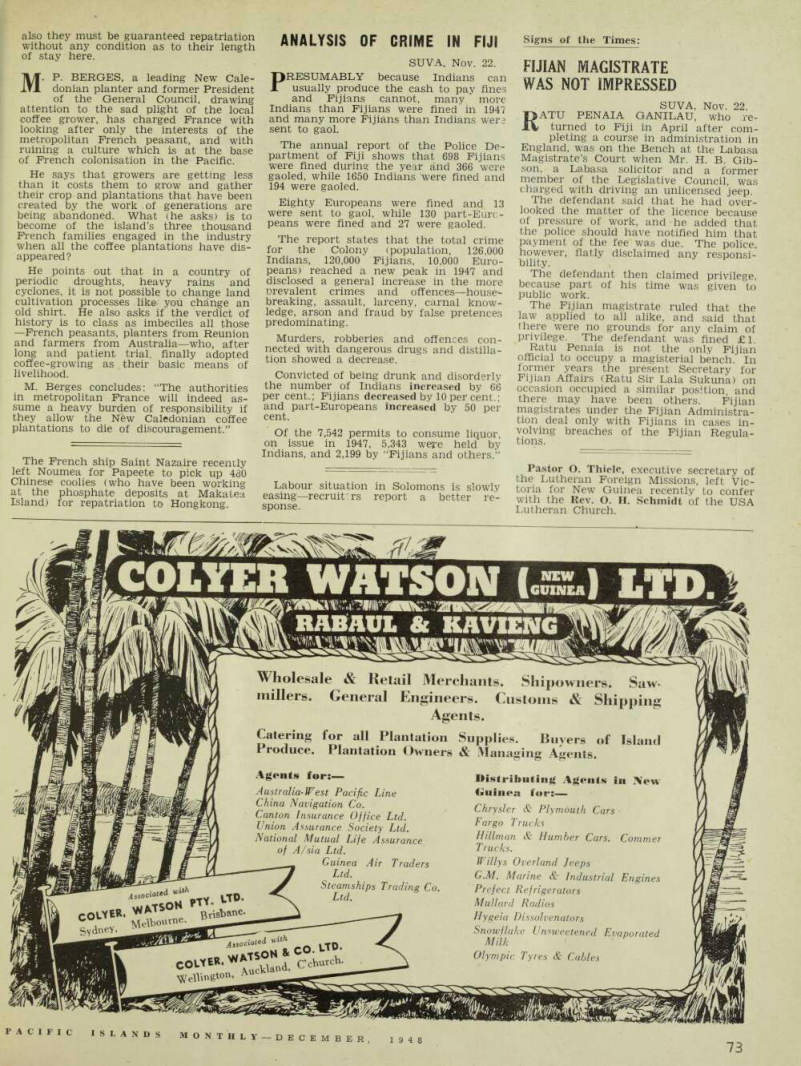
M. P. BERGES, a leading New Cale donian planter and former President of the General Council, drawing attention to the sad plight of the local coffee grower, has charged France with looking after only the interests of the metropolitan French peasant, and with ruining a culture which is at the base of French colonisation in the Pacific.
He says that growers are getting less than it costs them to grow and gather their crop and plantations that have been created by the work of generations are being abandoned. What (he asks) is to become of the island’s three thousand French families engaged in the industry when all the coffee plantations have dis appeared?
He points out that in a country of periodic droughts, heavy rains and cyclones, it is not possible to change land cultivation processes like you change an old shirt. He also asks if the verdict of history is to class as imbeciles all those —French peasants, planters from Reunion and farmers from Australia—who, after long and patient trial, finally adopted coffee-growing as their basic means of livelihood.
M. Berges concludes: “The authorities in metropolitan Prance will indeed as sume a heavy burden of responsibility if they allow the New Caledonian coffee plantations to die of discouragement.”
The French ship Saint Nazaire recently left Noumea for Papeete to pick up 480 Chinese coolies (who have been working at the phosphate deposits at Makatea Island) for repatriation to Hongkong.