Noumea Had A Gaudy Past!
pp. 48-49 · Read in the full issue
By H. E. L. Friday
NOW that they have selected it as their headquarters, members of the South Pacific Commission mav like to know that Noumea was once a lively and an interesting place to live in; but that was a very long time ago.
During the two years of the first nickel boom the port was busier than it has ever been before or since—except for the war years following Pearl Harbour—even though the official quay was then only 100 yards long.
The principal streets, leading from the quay, at right angles, were much as they are to-day, for the “Port Said of the Pacific” has not changed much. These streets of 1875 were white-looking, and broad enough for the old horse traffic, and they were even worse lighted than now. Houses, stores, cafes, shops, bistros were verandahed weatherboard buildings, sometimes of a most primitive nature—as, indeed, many are to-day.
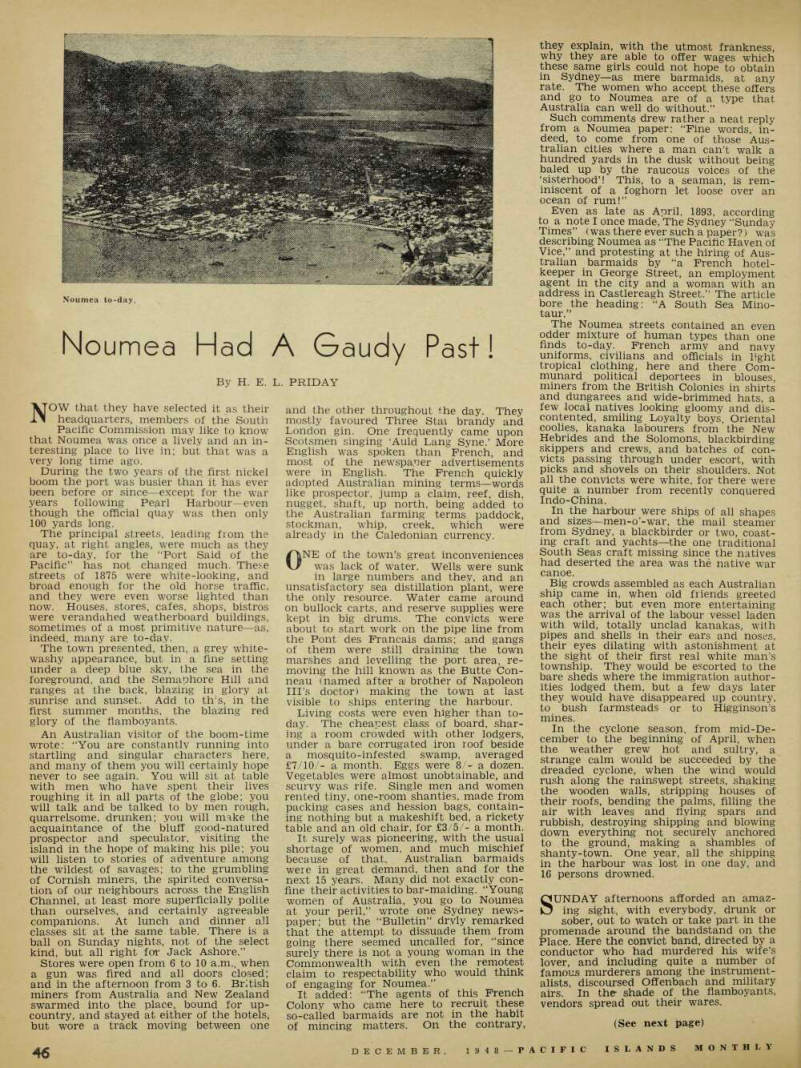
The town presented, then, a grey whitewashy appearance, but in a fine setting under a deep blue sky, the sea in the foreground, and the Semaphore Hill and ranges at the back, blazing in glory at sunrise and sunset. Add to th's, in the first summer months, the blazing red glory of the flamboyants.
An Australian visitor of the boom-time wrote: “You are constantly running into startling and singular characters here, and many of them you will certainly hope never to see again. You will sit at table with men who have spent their lives roughing it in all parts of the globe; you will talk and be talked to by men rough, quarrelsome, drunken; you will make the acquaintance of the bluff good-natured prospector and speculator, visiting the island in the hope of making his pile; you will listen to stories of adventure among the wildest of savages; to the grumbling of Cornish miners, the spirited conversation of our neighbours across the English Channel, at least more superficially polite than ourselves, and certainly agreeable companions. At lunch and dinner all classes sit at the same table. There is a ball on Sunday nights, not of the select kind, but all right for Jack Ashore.”
Stores were open from 6 to 10 a.m., when a gun was fired and all doors closed; and in the afternoon from 3 to 6. British miners from Australia and New Zealand swarmed into the place, bound for upcountry, and stayed at either of the hotels, but wore a track moving between one
and the other throughout the day. They mostly favoured Three Stai brandy and London gin. One frequently came upon Scotsmen singing ‘Auld Lang Syne.’ More English was spoken than French, and most of the newspaper advertisements were in English. The French quickly adopted Australian mining terms—words like prospector, jump a claim, reef, dish, nugget, shaft, up north, being added to the Australian farming terms paddock, stockman, whip, creek, which were already in the Caledonian currency, /"|NE °f the town’s great inconveniences was lack of water. Wells were sunk in large numbers and they, and an unsatisfactory sea distillation plant, were the only resource. Water came around on bullock carts, and reserve supplies were kept in big drums. The convicts were about to start work on the pipe line from the Pont des Francais dams; and gangs of them were still draining the town marshes and levelling the port area, re moving the hill known as the Butte Con neau (named after ai brother of Napoleon m’ S doctor) making the town at last visible to ships entering the harbour, Living costs were even higher than to day. The cheapest class of board, shar ing a room crowded with other lodgers, under a bare corrugated iron roof beside a mosquito-infested swamp, averaged £7/10/- a month. Eggs were 8 - a dozen, Vegetables were almost unobtainable, and scurvy was rife. Single men and women rented tiny, one-room shanties, made from packing cases and hession bags, contain ing nothing but a makeshift bed, a rickety table and an old chair, for £3/5/- a month, It surely was pioneering, with the usual shortage of women, and much mischief because of that. Australian barmaids were in great demand, then and for the next 15 years. Many did not exactly con fine their activities to bar-maiding. “Young women of Australia, you go to Noumea at your peril,” wrote one Sydney news paper; but the “Bulletin” dryly remarked that the attempt to dissuade them from going there seemed uncalled for, “since surely there is not a young woman in the Commonwealth with even the remotest claim to respectability who would think of engaging for Noumea.”
It added: “The agents of this French Colony who came here to recruit these so-called barmaids are not in the habit of mincing matters. On the contrary,
they explain, with the utmost frankness, why they are able to offer wages which these same girls could not hope to obtain in Sydney—as mere barmaids, at any rate. The women who accept these offers and go to Noumea are of a type that Australia can well do without.”
Such comments drew rather a neat reply from a Noumea paper: “Fine words, in deed, to come from one of those Aus tralian cities where a man can’t walk a hundred yards in the dusk without being baled up by the raucous voices of the ‘sisterhood’! This, to a seaman, is rem iniscent of a foghorn let loose over an ocean of rum!”
Even as late as April, 1893, according to a note I once made, The Sydney “Sunday Times” (was there ever such a paper?) was describing Noumea as “The Pacific Haven of Vice,” and protesting at the hiring of Aus tralian barmaids by “a French hotel keeper in George Street, an employment agent in the city and a woman with an address in Castlereagh Street.” The article bore the heading: “A South Sea Mino taur.”
The Noumea streets contained an even odder mixture of human types than one finds to-day. French army and navy uniforms, civilians and officials in light tropical clothing, here and there Com munard political deportees in blouses, miners from the British Colonies in shirts and dungarees and wide-brimmed hats, a few local natives looking gloomy and dis contented, smiling Loyalty boys, Oriental coolies, kanaka labourers from ’ the New Hebrides and the Solomons, blackbirding skippers and crews, and batches of con victs passing through under escort, with picks and shovels on their shoulders. Not all the convicts were white, for there were quite a number from recently conquered Indo-China.
In the harbour were ships of all shapes and sizes—men-o’-war, the mail steamer from Sydney, a blackbirder or two, coast ing craft and yachts—the one traditional South Seas craft missing since the natives had deserted the area was the native war canoe.
Big crowds assembled as each Australian ship came in, when old friends greeted each other; but even more entertaining was the arrival of the labour vessel laden with wild, totally unclad kanakas, with pipes and shells in their ears and noses, their eyes dilating with astonishment at the sight of their first real white man’s township. They would be escorted to the bare sheds where the immigration author ities lodged them, but a few days later they would have disappeared up country, to bush farmsteads or to Higginson’s mines.
In the cyclone season, from mid-De cember to the beginning of April, when the weather grew hot and sultry, a strange calm would be succeeded by the dreaded cyclone, when the wind would rush along the rainswept streets, shaking the wooden walls, stripping houses of their roofs, bending the palms, filling the air with leaves and flying spars and rubbish, destroying shipping and blowing down everything not securely anchored to the ground, making a shambles of shanty-town. One year, all the shipping in the harbour was lost in one day, and 16 persons drowned.
SUNDAY afternoons afforded an amaz ing sight, with everybody, drunk or sober, out to watch or take part in the promenade around the bandstand on the Place. Here the convict band, directed by a conductor who had murdered his wife’s lover, and including quite a number of famous murderers among the instrument alists, discoursed Offenbach and military airs. In the- shade of the flamboyants, vendors spread out their wares.
(See next page)
Noumea to-day.
Fights were frequent between the tribes of the mainland and the Mare and Lifou boys, the natives being cheered on bv their women (in bright Mother Hubbard dresses) who had just come down from the hymn-singing at the Protestant temple. The unfortunate New Hebrideans unpopular with the locals, got it from all quarters, and were fast taking to drink, much to the concern of their bourgeois employers. Gin and rum and cheap Algerian wine, fortified to preserve its drinking qualities on the long voyage out, were the cause of the rough-house atmos phere. As usual, the black was eager to learn the white man’s ways, vicious or otherwise.
That excellent journalist, “Vagabond,” of the Melbourne “Argus,” came to the conclusion that the most respectable section of the white populace were the deportees of the Commune. Noumea, he afterwards wrote, changed for the worse with their departure. He missed the cafe where of a Sunday evening they used to resort to drink their bock in company and talk of a Paris they had not seen for years.
He adds: “To-day the Rue d’Alma has its English hotels, and its Australian bar maids. I can’t say I think much of the change. If a girl, through force of cir cumstances, has to work behind a bar there is no reason why she should be treated w*th less respect than that normally shown to women. I would advise no young girl to go to Noumea. In the pre vailing circumstances she can preserve neither her modesty nor her self-respect.”