Phosphate Fortune
p. 32 · Read in the full issue
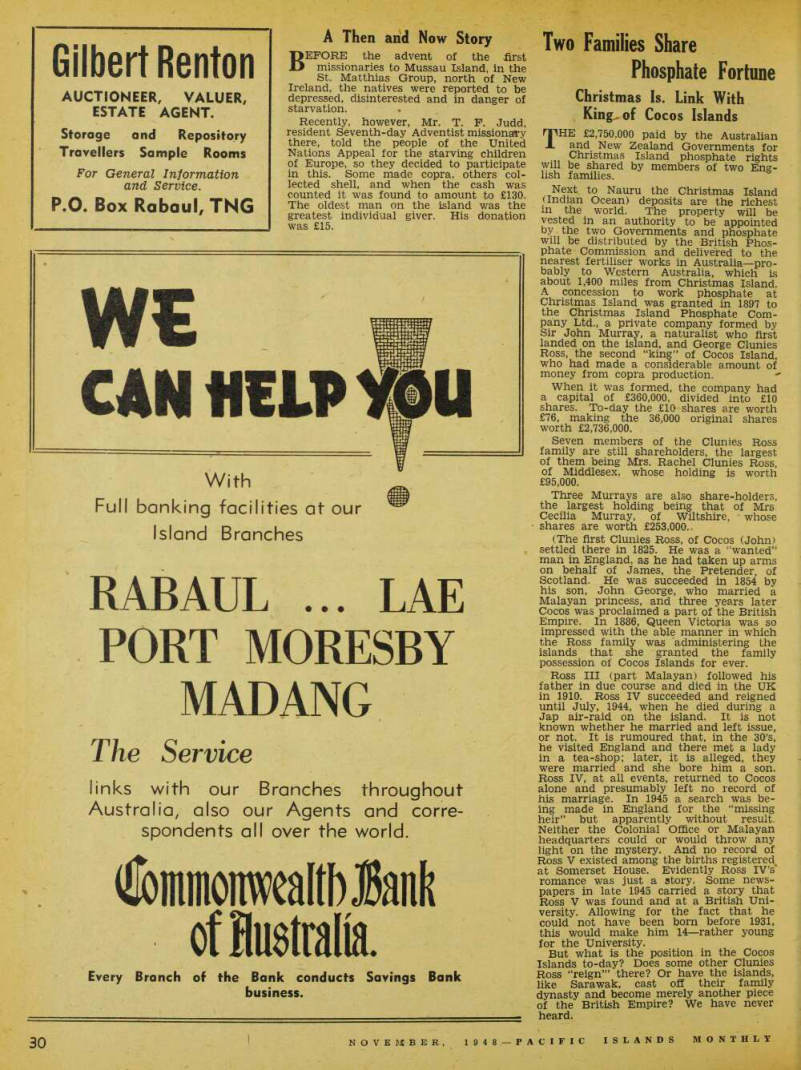
Two Families Share Phosphate Fortune Christmas Is. Link With King, of Cocos Islands
THE £2,750,000 paid by the Australian and New Zealand Governments for •ii Christmas Island phosphate rights will be shared by members of two Eng lish families.
Next to Nauru the Christmas Island (Indian Ocean) deposits are the richest in the world. The property will be vested in an authority to be appointed by the two Governments and phosphate will be distributed by the British Phos phate Commission and delivered to the nearest fertiliser works in Australia—pro bably to Western Australia, which is about 1,400 miles from Christmas Island.
A concession to work phosphate at Christmas Island was granted in 1897 to the Christmas Island Phosphate Com pany Ltd., a private company formed by Sir John Murray, a naturalist who first landed on the island, and George Clunies Ross, the second “king” of Cocos Island, who had made a considerable amount of money from copra production.
When it was formed, the company had a capital of £360,000, divided into £lO shares. To-day the £lO shares are worth £76, making the 36,000 original shares worth £2,736,000.
Seven members of the Clunies Ross family are still shareholders, the largest of them being Mrs. Rachel Clunies Ross, of Middlesex, whose holding is worth £95,000.
Three Murrays are also share-holders, the largest holding being that of Mrs Cecilia Murray, of Wiltshire, whose shares are worth £253,000. (The first Clunies Ross, of Cocos (John) settled there in 1825. He was a “wanted” man in England, as he had taken up arms on behalf of James, the Pretender, of Scotland. He was succeeded in 1854 by his son, John George, who married a Malayan princess, and three years later Cocos was proclaimed a part of the British Empire. In 1886, Queen Victoria was so impressed with the able manner in which the Ross family was 'administering the islands that she granted the family possession of Cocos Islands for ever.
Ross 111 (part Malayan) followed his father in due course and died in the UK in 1910. Ross IV succeeded and reigned until July, 1944, when he died during a Jap air-raid on the island. It is not known whether he married and left issue, or not. It is rumoured that, in the 30’s, he visited England and there met a lady in a tea-shop; later, it is alleged, they were married and she bore him a son.
Ross IV, at all events, returned to Cocos alone and presumably left no record of his marriage. In 1945 a search was be ing made in England for the “missing heir” but apparently without result.
Neither the Colonial Office or Malayan headquarters could or would throw any light on the mystery. And no record of Ross V existed among the births at Somerset House. Evidently Ross IV’s romance was just a story. Some news papers in late 1945 carried a story that Ross V was found and at a British Uni versity. Allowing for the fact that he could not have been born before 1931, this would make him 14—rather young for the University.
But what is the position in the Cocos Islands to-day? Does some other Clunies Ross “reign”’ there? Or have the islands, like Sarawak, cast off their family dynasty and become merely another piece of the British Empire? We have never heard.