New Commissioner Acclaimed
pp. 29-30 · Read in the full issue
As Fiji-India Link
Suva. Oct. 24.
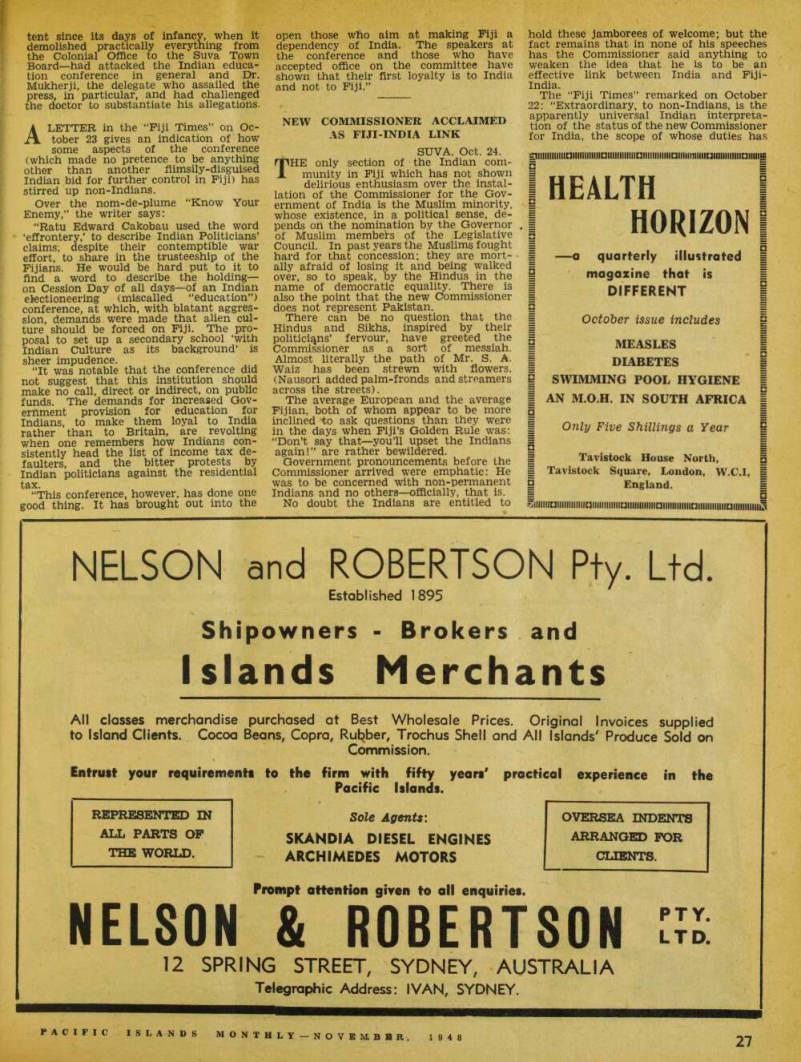
THE only section of the Indian com munity in Fiji which has not shown delirious enthusiasm over the instal lation of the Commissioner for the Gov ernment of India is the Muslim minority, whose existence, in a political sense, de pends on the nomination by the Governor of Muslim members of the Legislative Council. In past years the Muslims fought hard for that concession: they are mort ally afraid of losing it and being walked over, so to speak, by the Hindus in the name of democratic equality. There is also the point that the new Commissioner does not represent Pakistan, There can be no question that the Hindus and Sikhs, inspired by their politicians’ fervour, have greeted the Commissioner as a sort of messiah.
Almost literally the path of Mr, S. A.
Waiz has been strewn with flowers. (Nausori added palm-fronds and streamers across the streets).
The average European and the average Fijian, both of whom appear to be more inclined 4;o ask questions than they were in the days when Fiji’s Golden Rule was: “Don’t say that—you’ll upset the Indians again!” are rather bewildered.
Government pronouncements before the Commissioner arrived were emphatic: He was to be concerned with non-permanent Indians and no others —officially, that is.
No doubt the Indians are entitled to
hold these jamborees of welcome; but the fact remains that in none of his speeches has the Commissioner said anything to weaken the idea that he is to be an effective link between India and Fiji- India.
The “Fiji Times” remarked on October 22: “Extraordinary, to non-Indians, is the apparently universal Indian interpreta tion of the status of the new Commissioner for India, the scope of whose duties has
been explicitly stated more than once by the Government of Fiji,”
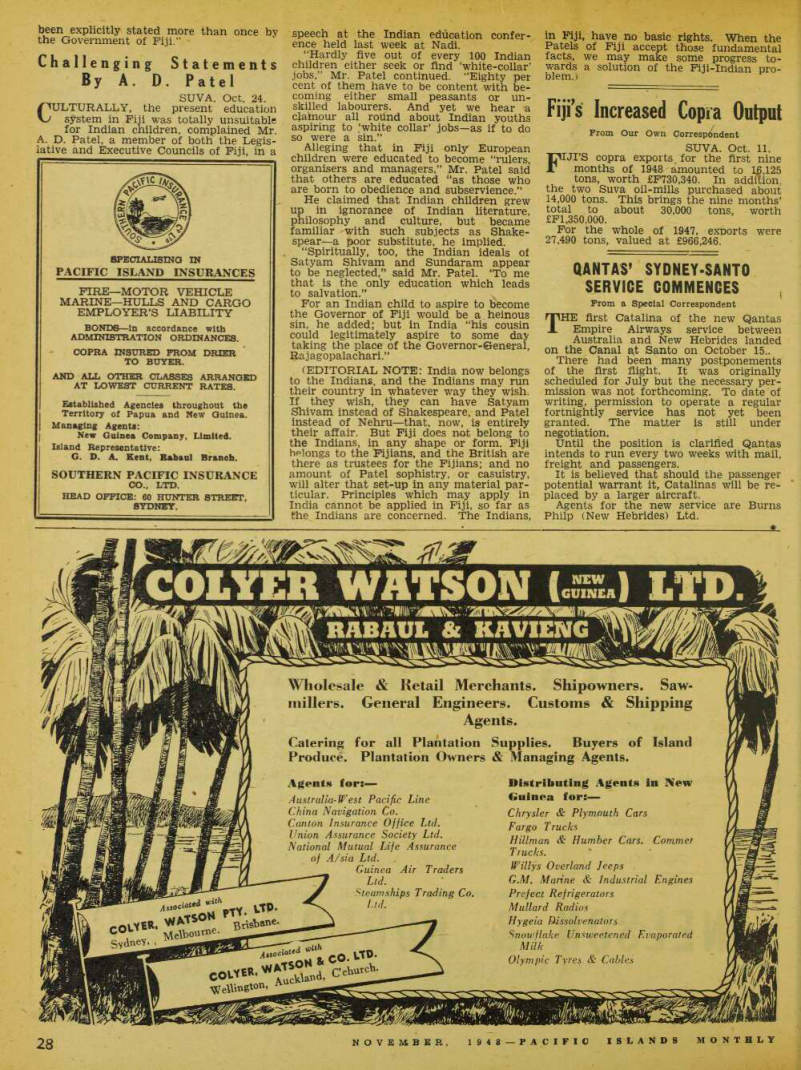
Challenging Statements
By A. D. Patel
Suva. Oct, 24.
CULTURALLY, the present education system in Fiji was totally unsuitable for Indian children, complained Mr.
A. D. Patel, a member of both the Legis lative and Executive Councils of Fiji, in a
speech at the Indian education confer ence held last week at Nadi.
“Hardly five out of every 100 Indian children either seek or find ‘white-collar’ jobs,” Mr. Patel continued. “Eighty per cent of them have to be content with be coming either small peasants or un skilled labourers. And yet we hear a cjahiour all round about Indian youths aspiring to ‘white collar’ jobs—as if to do so were a sin.”
Alleging that in Fiji only European children were educated to become “rulers, organisers and managers,” Mr. Patel said that others are educated “as those who are born to obedience and subservience.”
He claimed that Indian children grew up in ignorance of Indian literature, philosophy and culture, but became familiar with such subjects as Shake spear—a poor substitute, he implied.
“Spiritually, too, the Indian ideals of Satyam Shivam and Sundaram appear to be neglected,” said Mr. Patel. ‘To me that is the only education which leads to salvation.”
For an Indian child to aspire to become the Governor of Fiji would be a heinous sin, he added; but in India “his cousin could legitimately aspire to some day taking the place of the Governor-General, Rajagopalachari.” (EDITORIAL NOTE: India now belongs to the Indians, and the Indians may run their country in whatever way they wish.
If they wish, they can have Satyam Shivam instead of Shakespeare, and Patel instead of Nehru—that, now, is entirely their affair. But Fiji does not belong to the Indians, in any shape or form. Fiji belongs to the Fijians, and the British are there as trustees for the Fijians; and no amount of Patel sophistry, or casuistry, will alter that set-up in any material par ticular. Principles which may apply in India cannot be applied in Fiji, so far as the Indians are concerned. The Indians,
in Fiji, have no basic rights. When the Patels of Fiji accept those fundamental facts, we may make some progress to wards a solution of the Fiji-Indian pro blem.)