South Pacific Commission
pp. 13-79 · Read in the full issue
Headquarters At Noumea :: General and Expert Officials Appointed
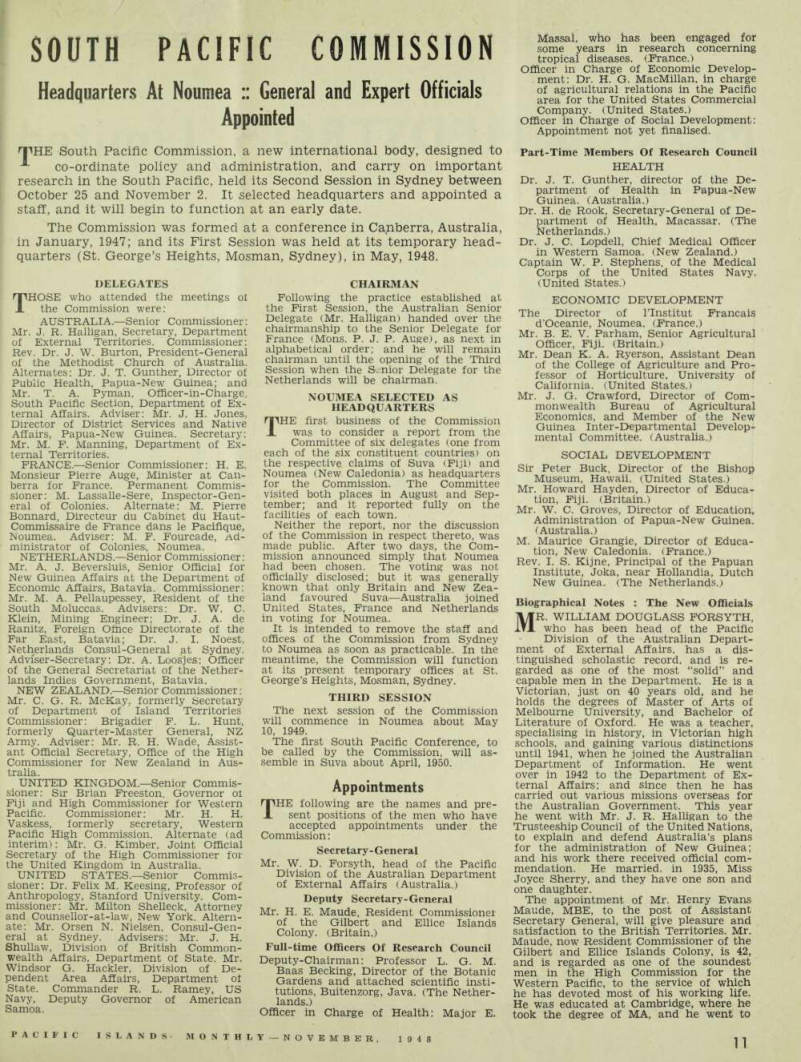
T*HE South Pacific Commission, a new international body, designed to co-ordinate policy and administration, and carry on important research in the South Pacific, held its Second Session in Sydney between October 25 and November 2. It selected headquarters and appointed a staff, and it will begin to function at an early date.
The Commission was formed at a conference in Canberra, Australia, in January, 1947; and its First Session was held at its temporary head quarters (St. George’s Heights, Mosman, Sydney), in May, 1948.
Delegates
THOSE who attended the meetings of the Commission were: AUSTRALIA. —Senior Commissioner: Mr. J, R. Halligan, Secretary, Department of External Territories. Commissioner: Rev. Dr. J. W. Burton, President-General of the Methodist Church of Australia.
Alternates: Dr. J. T. Gunther, Director of Public Health, Papua-New Guinea; and Mr. T. A. Pyman, Officer-in-Charge, South Pacific Section, Department of Ex ternal Affairs. Adviser: Mr. J. H. Jones, Director of District Services and Native Affairs, Papua-New Guinea. Secretary; Mr. M. F. Manning, Department of Ex ternal Territories.
FRANCE—Senior Commissioner: H. E.
Monsieur Pierre Auge, Minister at Can berra for France. Permanent Commis sioner; M. Lassalle-Sere, Inspector-Gen eral of Colonies. Alternate: M. Pierre Bonnard, Directeur du Cabinet du Haut- Commissaire de France dans le Pacifique, Noumea. Adviser: M. F. Fourcade, Ad ministrator of Colonies, Noumea.
NETHERLANDS.—Senior Commissioner: Mr. A. J. Beversluis, Senior Official for New Guinea Affairs at the Department of Economic Affairs, Batavia. Commissioner; Mr. M. A. Pellaupessey, Resident of the South Moluccas. Advisers: Dr. W. C.
Klein, Mining Engineer; Dr. J. A. de Ranitz, Foreign Office Directorate of the Far East, Batavia; Dr, J. I. Noest, Netherlands Consul-General at Sydney.
Adviser-Secretary; Dr. A. Loosjes; Officer of the General Secretariat of the Nether lands Indies Government, Batavia.
NEW ZEALAND.—Senior Commissioner; Mr. C. G. R. McKay, formerly Secretary of Department of Island Territories Commissioner: Brigadier F. L. Hunt, formerly Quarter-Master General, NZ Army. Adviser: Mr. R. H. Wade, Assist ant Official Secretary, Office of the High Commissioner for New Zealand in Aus- UNITED KINGDOM. —Senior Commis sioner: Sir Brian Freeston. Governor ol Fiji and High Commissioner for Western Pacific. Commissioner: Mr, H. H.
Vaskess, formerly secretary, Western Pacific High Commission. Alternate (ad interim): Mr. G. Kimber, Joint Official Secretary of the High Commissioner for the United Kingdom in Australia.
UNITED STATES.—Senior Commis sioner; Dr. Felix M. Keesing, Professor of Anthropology, Stanford University, Com missioner: Mr, Milton Shelleck, Attorney and Counsellor-at-law, New York. Altern ate: Mr. Orsen N. Nielsen, Consul-Gen eral at Sydney. Advisers: Mr. J, H.
Shullaw, Division of British Common wealth Affairs, Department of State. Mr.
Windsor G. Hackler, Division of De pendent Area Affairs, Department of State. Commander R, L. Ramey, US Navy, Deputy Governor of American Samoa.
Chairman
Following the practice established at the First Session, the Australian Senior Delegate (Mr. Halligan) handed over the chairmanship to the Senior Delegate for France (Mons. P. J. P. Auge), as next in alphabetical order; and he will remain chairman until the opening of the Third Session when the Senior Delegate for the Netherlands will be chairman.
Noumea Selected As
Headquarters
THE first business of the Commission was to consider a report from the Committee of six delegates (one from each of the six constituent countries) on the respective claims of Suva (Fiji) and Noumea (New Caledonia) as headquarters for the Commission. The Committee visited both places in August and Sep tember; and it reported fully on the facilities of each town.
Neither the report, nor the discussion of the Commission in respect thereto, was made public. After two days, the Com mission announced simply that Noumea had been chosen. The voting was not officially disclosed; but it was generally known that only Britain and New Zea land favoured Suva —Australia joined United States, France and Netherlands in voting for Noumea.
It is intended to remove the staff and offices of the Commission from Sydney to Noumea as soon as practicable. In the meantime, the Commission will function at its present temporary offices at St.
George’s Heights, Mosman, Sydney.
Third Session
The next session of the Commission will commence in Noumea about May 10, 1949.
The first South Pacific Conference, to be called by the Commission, will as semble in Suva about April, 1950.
Appointments
THE following are the names and pre sent positions of the men who have accepted appointments under the Commission: Secretary- General Mr. W. D. Forsyth, head of the Pacific Division of the Australian Department of External Affairs (Australia.) Deputy Secretary-General Mr. H. E. Maude. Resident Commissioner of the Gilbert and Ellice Islands Colony. (Britain.) Full-time Officers Of Research Council Deputy-Chairman: Professor L. G. M.
Baas Becking, Director of the Botanic Gardens and attached scientific insti tutions, Buitenzorg, Java. (The Nether lands.) Officer in Charge of Health: Major E.
Massai, who has been engaged for* some years in research concerning tropical diseases. (France.) Officer in Charge of Economic Develop ment: Dr. H. G. MacMillan, in charge of agricultural relations in the Pacific area for the United States Commercial Company. (United States.) Officer in Charge of Social Development: Appointment not yet finalised.
Part-Time Members Of Research Council
Health
Dr. J. T. Gunther, director of the De partment of Health in Papua-New Guinea. (Australia.) Dr. H. de Rook, Secretary-General of De partment of Health, Macassar. (The Netherlands.) Dr. J. C. Lopdell, Chief Medical Officer in Western Samoa. (New Zealand.) Captain W. P. Stephens, of the Medical Corps of the United States Navy. (United States.)
Economic Development
The Director of ITnstitut Francais d’Oceanie, Noumea. (France.) Mr. B. E. V. Parham, Senior Agricultural Officer, Fiji. (Britain.) Mr. Dean K. A. Ryerson, Assistant Dean of the College of Agriculture and Pro fessor of Horticulture. University of California. (United States.) Mr. J. G. Crawford, Director of Com monwealth Bureau of Agricultural Economics, and Member of the New Guinea Inter-Departmental Develop mental Committee. (Australia.)
Social Development
Sir Peter Buck, Director of the Bishop Museum, Hawaii. (United States.) Mr. Howard Hayden, Director of Educa tion, Fiji. (Britain.) Mr. W. C. Groves, Director of Education, Administration of Papua-New Guinea. (Australia.) M. Maurice Grangie, Director of Educa tion, New Caledonia. (France.) Rev. I. S. Kijne, Principal of the Papuan Institute, Joka, near Hollandia, Dutch New Guinea. (The Netherlands.) Biographical Notes : The New Officials
Mr. William Douglass Forsyth,
who has been head of the Pacific Division of the Australian Depart ment of External Affairs, has a dis tinguished scholastic record, and is re garded as one of the most “solid” and capable men in the Department. He is a Victorian, just on 40 years old, and he holds the degrees of Master of Arts of Melbourne University, and Bachelor of Literature of Oxford. He was a teacher, specialising in history, in Victorian high schools, and gaining various distinctions until 1941, when he joined the Australian Department of Information. He went over in 1942 to the Department of Ex ternal Affairs; and since then he has carried out various missions overseas for the Australian Government. This year he went with Mr. J. R. Halligan to the Trusteeship Council of the United Nations, to explain and defend Australia’s plans for the administration of New Guinea; and his work there received official com mendation. He married, in 1935, Miss Joyce Sherry, and they have one son and one daughter.
The appointment of Mr. Henry Evans Maude, MBE, to the post of Assistant Secretary General, will give pleasure and satisfaction to the British Territories. Mr.
Maude, now Resident Commissioner of the Gilbert and Ellice Islands Colony, is 42, and is regarded as one of the soundest men in the High Commission for the Western Pacific, to the service of which he has devoted most of his working life.
He was educated at Cambridge, where he took the degree of MA, and he went to
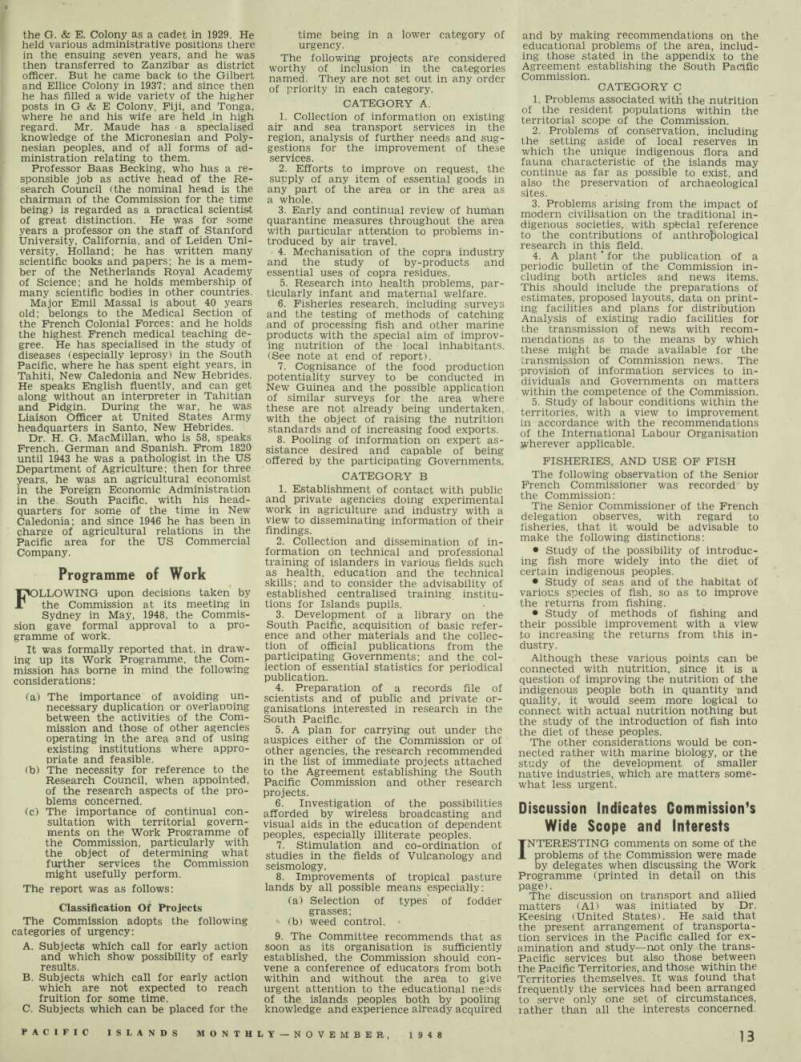
the G. & E. Colony as a cadet in 1929. He held various administrative positions there in the ensuing seven years, and he was then transferred to Zanzibar as district officer. But he came back to the Gilbert and Ellice Colony in 1937: and since then he has filled a wide variety of the higher posts in G & E Colony, Fiji, and Tonga, where he and his wife are held in high regard. Mr. Maude has a specialised knowledge of the Micronesian and Poly nesian peoples, and of all forms of ad ministration relating to them.
Professor Baas Becking, who has a re sponsible job as active head of the Re search Council (the nominal head is the chairman of the Commission for the time being) is regarded as a practical scientist of great distinction. He was for some years a professor on the staff of Stanford University, California, and of Leiden Uni versity, Holland: he has written many scientific books and papers; he is a mem ber of the Netherlands Royal Academy of Science: and he holds membership of many scientific bodies in other countries.
Major Emil Massal is about 40 years old; belongs to the Medical Section of the French Colonial Forces: and he holds the highest French medical teaching de gree. He has specialised in the study of diseases (especially leprosy) in the South Pacific, where he has spent eight years, in Tahiti, New Caledonia and New Hebrides.
He speaks English fluently, and can get along without an interpreter in Tahitian and Pidgin. During the war, he was Liaison Officer at United States Army headquarters in Santo, New Hebrides.
Dr. H. G. MacMillan, who is 58, speaks French, German and Spanish. From 1820 until 1943 he was a pathologist in the US Department of Agriculture: then for three years, he was an agricultural economist in the Foreign Economic Administration in the. South Pacific, with his head quarters for some of the time in New Caledonia; and since 1946 he has been in charge of agricultural relations in the Pacific area for the US Commercial Company.
Programme of Work
IT'OLLOWING upon decisions taken by I 1 the Commission at its meeting in Sydney in May, 1948, the Commis sion gave formal approval to a pro gramme of work.
It was formally reported that, in draw ing up its Work Programme, the Com mission has borne in mind the following considerations: (a) The importance of avoiding un necessary duplication or overlaooing between the activities of the Com mission and those of other agencies operating in the area and of using existing institutions where appro priate and feasible. (b) The necessity for reference to the Research Council, when appointed, of the research aspects of the pro blems concerned. (c) The importance of continual con sultation with territorial govern ments on the Work Programme of the Commission, particularly with the object of determining what further services the Commission might usefully perform.
The report was as follows: Classification Of Projects The Commission adopts the following categories of urgency; A. Subjects which call for early action and which show possibility of early results.
B. Subjects which call for early action which are not expected to reach fruition for some time.
C. Subjects which can be placed for the
time being in a lower category of urgency.
The following projects are considered worthy of inclusion in the categories named. They are not set out in any order of priority in each category.
Category A.
1. Collection of information on existing air and sea transport services in the region, analysis of further needs and sug gestions for the improvement of these services. 2. Efforts to improve on request, the supply of any item of essential goods in any part of the area or in the area as a whole. 3. Early and continual review of human quarantine measures throughout the area with particular attention to problems in troduced by air travel. 4. Mechanisation of the copra industry and the study of by-products and essential uses of copra residues. 5. Research into health problems, par ticularly infant and maternal welfare. 6. Fisheries research, including surveys and the testing of methods of catching and of processing fish and other marine products with the special aim of improv ing nutrition of the local inhabitants. (See note at end of report). 7. Cognisance of the food production potentiality survey to be conducted in New Guinea and the possible application of similar surveys for the area where these are not already being undertaken, with the object of raising the nutrition standards and of increasing food exports. 8. Pooling of information on expert as sistance desired and capable of being offered by the participating Governments.
Category B
1. Establishment of contact with public and private agencies doing experimental work in agriculture and industry with a view to disseminating information of their findings. 2. Collection and dissemination of in formation on technical and professional training of islanders in various fields such as health, education and the technical skills; and to consider the advisability of established centralised training institu tions for Islands pupils. 3. Development of a library on the South Pacific, acquisition of basic refer ence and other materials and the collec tion of official publications from the participating Governments; and the col lection of essential statistics for periodical publication. 4. Preparation of a records file of scientists and of public and private or ganisations interested in research in the South Pacific. 5. A plan for carrying out under the auspices either of the Commission or of other agencies, the research recommended in the list of immediate projects attached to the Agreement establishing the South Pacific Commission and other research projects. 6. Investigation of the possibilities afforded by wireless broadcasting and visual aids in the education of dependent peoples, especially illiterate peoples, 7. Stimulation and co-ordination of studies in the fields of Vulcanology and seismology. 8. Improvements of tropical pasture lands by all possible means especially: (a) Selection of types of fodder grasses: '■ (b) weed control. 9. The Committee recommends that as soon as its organisation is sufficiently established, the Commission should con vene a conference of educators from both within and without the area to give urgent attention to the educational needs of the islands peoples both by pooling knowledge and experience already acquired
and by making recommendations on the educational problems of the area, includ ing those stated in the appendix to the Agreement establishing the South Pacific Commission.
Category C
1. Problems associated with the nutrition of the resident populations within the territorial scope of the Commission. 2. Problems of conservation, including the setting aside of local reserves in which the unique indigenous flora and fauna characteristic of the islands may continue as far as possible to exist, and also the preservation of archaeological sites. 3. Problems arising from the impact of modern civilisation on the traditional in digenous societies, with special reference to the contributions of anthropological research in this field. 4. A plant * for the publication of a periodic bulletin of the Commission in cluding both articles and news items.
This should include the preparations of estimates, proposed layouts, data on print ing facilities and plans for distribution Analysis of existing radio facilities for the transmission of news with recom mendations as to the means by which these might be made available for the transmission of Commission news. The provision of information services to in dividuals and Governments on matters within the competence of the Commission. 5. Study of labour conditions within the territories, with a view to improvement in accordance with the recommendations of the International Labour Organisation .wherever applicable,
Fisheries, And Use Of Fish
The following observation of the Senior French Commissioner was recorded by the Commission: The Senior Commissioner of the French delegation observes, with regard to fisheries, that it would be advisable to make the following distinctions: • Study of the possibility of introduc ing fish more widely into the diet of certain indigenous peoples. • Study of seas and of the habitat of various species of fish, so as to improve the returns from fishing. • Study of methods of fishing and their possible improvement with a view to increasing the returns from this in dustry.
Although these various points can be connected with nutrition, since it is a question of improving the nutrition of the indigenous people both in quantity and quality, it would seem more logical to connect with actual nutrition nothing but the study of the introduction of fish into the diet of these peoples.
The other considerations would be con nected rather with marine biology, or the study of the development of smaller native industries, which are matters some what less urgent.
Discussion Indicates Commission’s
Wide Scope and Interests
INTERESTING comments on some of the problems of the Commission were made by delegates when discussing the Work Programme (printed in detail on this page).
The discussion on transport and allied matters (Al) was initiated by Dr.
Keesing (United States). He said that the present arrangement of transporta tion services in the Pacific called for ex amination and study—not only the trans pacific services but also those between the Pacific Territories, and those within the Territories themselves. It was found that frequently the services had been arranged to serve only one set of circumstances, rather than all the interests concerned.
There was need for training the Islanders in the technical crafts necessary for the running of transportation services. The proper organisation of transportation also brought into the picture such things as meteorology and oceanography, conce n ing which he thought' resolute action by the Council was necessary.
The senior delegate for France em phasised the need for the co-ordination of shipping services, which had been arranged to meet special needs in par ticular groups, without any regard for the needs of adjoining Territories. It was desirable to assemble information in re lation to these matters, so that the pro blems involved could be taken up in a proper way with the interests concerned.
The senior delegate for Britain (Sir Brian Freeston) remarked that this essentially was an administrative problem.
What was really wanted was an analysis of the traffic requirements of particular areas, to be considered in relation to the other needs of the Territories concerned.
Substantial progress could be made in this direction without involving the re search officers.
Dr. Keesing (United States) concurred with this view, and it was agreed that the Secretariat be asked to enquire into this subject.
Surpluses and Shortages ON the subject of better distribution of essential supplies in the Pacific —the need for transferring a surplus from one area to another area that might be short of supplies—the delegate for France directed attention to the obstacles created by a multiplicity of tariff schedules and suggested that the collection of such schedules should be undertaken, so that they might be available for use in an emergency, and also to enable the Com mission to make a study of all the pro blems involved.
Delegate for New Zealand (Mr. McKay) and delegate for Britain (Sir Brian Freeston) said that the plan outlined in the work programme (A 2) should operate only in an emergency and only if the Secretary-General should be asked to act in respect of any particular item.
Prevention Of Disease ON the subject of quarantine measures, Dr. Gunther (Australian delegate) said it was urgent that steps be taken to co-ordinate and standardise the rules and regulations by which the Adminis trations sought to control infectious diseases within the tropics. As an ex ample of urgency, he referred to the pre valence of malaria in the Western Ter ritories, and the need for seeing that air craft did not carry certain types of mosquitoes from diseased to disease-free Territories. He suggested the establish ment of an epidemiological bureau for the assistance and guidance of quarantine officers.
The New Zealand delegate suggested the addition of words to A 3 to permit the distribution of epidemiological informa
tion. The United States delegate said that the Caribbean Commission (West Indies) had approved of legislation to give effect to such a plan. The suggestion was approved of.
Copra Industry ON the subject of the further mechanisa tion and development of the copra industry (A 4), Dr. Gunther (Aus tralia) said that this was something that should await the attention of the Research Council. The Australian Production Con trol Board had in New Guinea under taken the task of collecting a large amount of information in relation to the copra industry, and this would be avail able to the Commission and Council.
The New Zealand d-legate (Mr. McKay) said that the management of the New Zealand Reparation Estates in Western Samoa had introduced many of the most modern methods of treating coconuts and copra; and all technical information in relation to that would be at the dis posal of the Commission.
The French delegation emphasised the importance of the mechanisation of the copra industry.
Control Of Pests DR KEESING (United States delegate) said that American scientists were taking a keen interest in the cam paign against insect pests in their Ter ritories north of the Equator; and they were particularly interested m preventing the spread of such pests through in dustrial activities. He emphasised the
importance of preventing the spread of certain pests to the southwards—he re ferred particularly to the Rhino beetle and the giant or African snail, which had been released by the Japanese during the war in Micronesia. They had scientists now in Africa seeking some control for the African snail. United States scientists would be happy to co-operate with the Commission.
Infant and Mother Welfare SPEAKING in relation to infant and maternal welfare <AS), Dr. Gunther (Australia) said that this was a
tremendous problem—as important to the sociologist as to the medical man.
The causes of infant and maternal death were many, and demanded early study.
They were confident in Papua-New Guinea that they could make substantial progress in this field, but much research was needed. They recommended the establish ment of a wide and detailed programme of research, which might extend over several years.
The New Zealand delegate (Mr. McKay) said that in Western Samoa they had made remarkable progress in this field without any help from sociologists,
nutntiomßt B and anthropologists—but they had had very substantial help from local committees of native peoples, who had been sympathetically instructed and directed.
Dr. Gunther pointed out that there was a considerable difference between Poly nesian and Melanesian communities in this regard—Polynesians could be more easily instructed than the more primitive people of the West.
British delegate (Sir Brian Preeston) said the two viewpoints were not irrecon cilable. A good deal could be done in a practical way, in the field of admin istration, while a broad plan of research was in operation.
Fish As A Food IN relation to the development of fish ing industries, Dr. Gunther (Australia) said that considerable research was being undertaken in Papua-New Guinea, and that information would be available to the Council. They were concerned in New Guinea with the absence of first-class proteins and it was believed that the in troduction of a more generous fish diet would play a big part in raising the standard of the people’s health.
The New Zealand delegate (Mr. McKay) urged that facilities be sought for trans ferring fish from one area to another, so that native communities generally might have a diet more satisfactorily balanced.
He said that the Pacific was remarkable for the way in which fish might be found in abundance in one place and be totally absent in another place not far away, where conditions seemed similar. Research should be directed to the important tasks of preserving fish and arranging for their transportation from good areas to areas where they were scarce.
The Dutch delegation urged co-opera tion with the expert officials of the Indo- Pacific Fisheries Council. Dr. Keesing (United States) was in fullest sympathy with this suggestion and urged co-opera cion not only with the Dutch but with all organisations interested in fishery ex ploitation Most of the items in the B category were agreed to without discussion. Dr.
Kersing (United States) remarked that the absence of discussion did not indicate lack of interest—on the contrary, the lack of discussion indicated almost complete unanimity in relation to these matters.
Pacific Science Congress
A Committee appointed to inquire con cerning the Pacific Science Congress, to be held in New Zealand in February, 1949, reported: The Committee recommends that the Secretary-General make arrangements for the permanent officers of the Commission as far as is feasible, to attend the Con gress as observers, for the purpose of con tact and consultation with leading scholars relative to the research work of the Commission; such part-time members of the Research Council, as are present in their other capacities, might also be asked to act as observers.
First Conference At Suva in
April, 1950
A COMMITTEE of the Commission sub mitted a report on arrangements for the first South Pacific Conference, to be held under the auspices of the Commission. The following were the re commendations adopted;— The following are the 15 territories from which delegates should be sent to the South Pacific Conference: Papua.
New Guinea (Australian Trust Ter ritory) .
(Continued on Page 77)
Nauru.
La Nouvelle-Caledonie et Depend ances.
Etablissements Francais de L’Oceanie.
Dutch New Guinea.
Western Samoa.
Tokelau Islands.
Cook Islands, including Niue.
Fiji.
British Solomon Islands Protectorate.
Gilbert Islands.
Ellice Islands.
American Samoa.
New Hebrides (Condominium).
The Committee records its hope that the Government of Tonga would see its way clear to send delegates to the Con ference, upon invitation from the Com mission.
For the first meeting of the Conference the total number of delegates will be limited to 30, and of alternates and ad visers to 34, and shall be allotted to the territories listed above, according to the quotas set out in the appended schedule.
The first meeting of the South Pacific Conference will take place at Suva (the Senior Commissioners for France and the United Kingdom abstained from voting on this issue) in April, 1950, on the as sumption that it will be possible to arrange a meeting of the Commission, say, two weeks later, also in Suva.
On the financial issues, (a) there will be admitted as a charge against the funds of the Commission the costs of transport between their territories and the place of meeting, of the delegates proper, but not of alternates and advisers; (b) in principle the Commission will bear the cost of subsistance of delegates, but the Commission will not be respon sible for alternates and advisers in this regard, and it is assumed that such costs will be borne by the respective appointing authorities; (c) the Secretary-General will consult with the host Government in regard to details of the scaie of sub sistence, and will submit at a later session of the Commission proposals for approval.
The Rules of Procedure for the South Pacific Conference and the Agenda for its first meeting will be considered at the Third Session of the Commission, and Senior Commissioners, after consultation with their Governments, will inform the Secretary-General before the Third Session of any Rules of Procedure which they wish to propose, and items which they suggested lor inclusion in the Agenda of the Conference.
Members of the Commission and of the Research Council will be invited to attend the Conference as observers.
South Pacific Conference
Representation By Territories
Number of Number of Alternates and Territory Delegates Advisers Papua 2 4 New Guinea (Australian Trust Territory 2 4 Nauru 1 2 La Nouvelle-Caledonie et Dependances .. 2 2 Etablissements Prancais de L’Oceanie 2 2 Dutch New Guinea .. 2 2 Western Samoa .. 2 2 Tokelau Islands .. .. 1 Cook Islands including Niue 2 2
Fiji
'British Solomon 2 2 Islands Protectorate 2 2 Gilbert Islands .. .. 2 2 Ellice Islands 2 2 American Samoa 2 2 New Hebrides (Condominium) 2 2 Tonga (if attending) 2 2 Total 30 34