A 1941 Interview
p. 78 · Read in the full issue
With Mr.
Banno Of Tonga
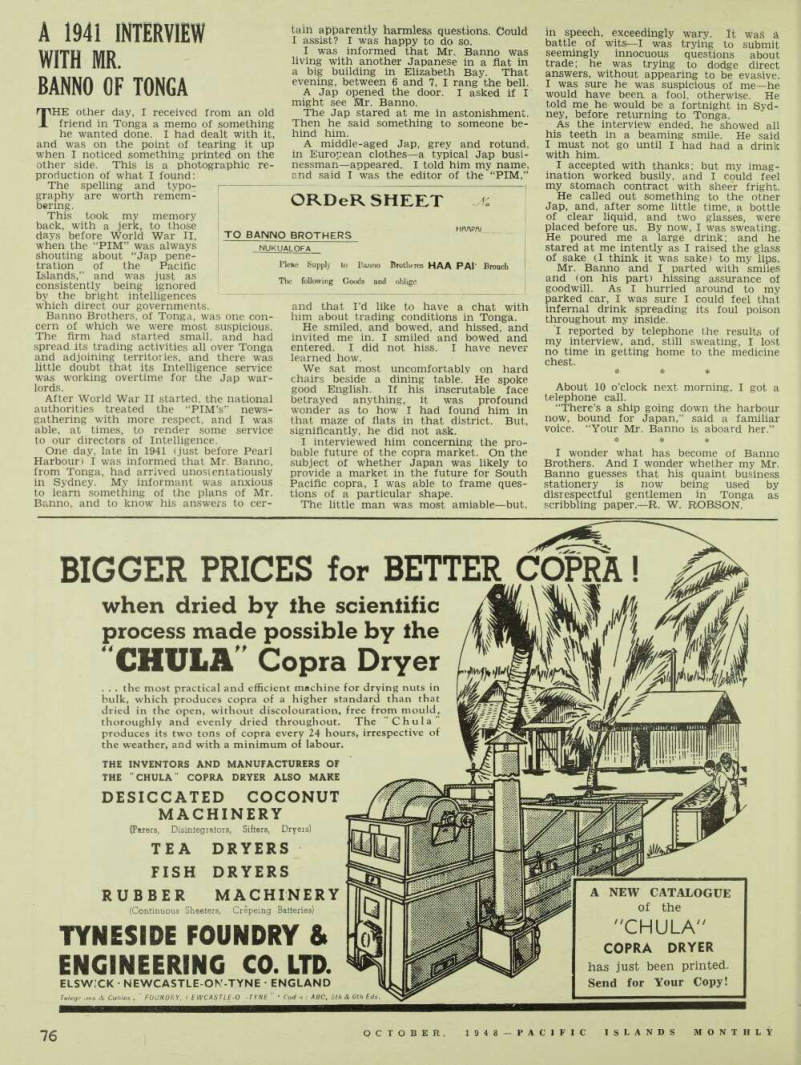
THE other day, I received from an old friend in Tonga a memo of something he wanted done. I had dealt with it, and was on the point of tearing it up when I noticed something printed on the other side. This is a photographic re production of what I found:
The spelling and typo graphy are worth remem bering.
This took my memory back, with a jerk, to those days before World War 11, when the “PIM” was always shouting about “Jap pene tration of the Pacific Islands,” and was just as consistently being ignored by the bright intelligences which direct our governments.
Banno Brothers, of Tonga, was one con cern of which we were most suspicious.
The firm had started small, and had spread its trading activities all over Tonga and adjoining territories, and there was little doubt that its Intelligence service was working overtime for the Jap war lords.
After World War II started, the national authorities treated the “PlM’s” news gathering with more respect, and I was able, at times, to render some service to our directors of Intelligence.
One day, late in 1941 (just before Pearl Harbour) I was informed that Mr. Banno, from Tonga, had arrived unostentatiously in Sydney. My informant was anxious to learn something of the plans of Mr.
Banno, and to know his answers to cer
tain apparently harmless questions. Could I assist? I was happy to do so.
I was informed that Mr. Banno was living with another Japanese in a flat in a big building in Elizabeth Bay. That evening, between 6 and 7, I rang the bell.
A Jap opened the door. I asked if I might see Hr. Banno.
The Jap stared at me in astonishment.
Then he said something to someone be hind him.
A middle-aged Jap, grey and rotund, in European clothes —a typical Jap busi nessman —appeared. I told him my name, and said I was the editor of the “PIM,”
and that I’d like to have a chat with him about trading conditions in Tonga.
He smiled, and bowed, and hissed, and invited me in. I smiled and bowed and entered, I did not hiss. I have never learned how.
We sat most uncomfortably on hard chairs beside a dining table. He spoke good English. If his inscrutable face betrayed anything, it was profound wonder as to how I had found him in that maze of flats in that district. But, significantly, he did not ask.
I interviewed him concerning the pro bable future of the copra market. On the subject of whether Japan was likely to provide a market in the future for South Pacific copra, I was able to frame ques tions of a particular shape.
The little man was most amiable —but,
m speech, exceedingly wary. It was a battle of wits—l was trying to submit seemingly innocuous questions about trade; he was trying to dodge direct answers, without appearing to be evasive.
I was sure he was suspicious of me—he would have been a fool, otherwise. He told me he would be a fortnight in Syd ney, before returning to Tonga.
As the interview ended, he showed all his teeth in a beaming smile. He said I must not go until I had had a drink with him.
I accepted with thanks: but my imag ination worked busily, and I could feel my stomach contract with sheer fright.
He called out something to the other Jap, and, after some little time, a bottle of clear liquid, and two glasses, were placed before us. By now, I was sweating.
He poured me a large drink; and he stared at me intently as I raised the glass of sake (I think it was sake) to my lips.
Mr. Banno and I parted with smiles and (on his part) hissing assurance of goodwill. As I hurried around to my parked car, I was sure I could feel that infernal drink spreading its foul poison throughout my inside.
I reported by telephone the results of my interview, and, still sweating, I lost no time in getting home to the medicine chest. * * * About 10 o’clock next morning, I got a telephone call.
“There’s a ship going down the harbour now, bound for Japan,’’ said a familiar voice. “Your Mr. Banno is aboard her.” * * * I wonder what has become of Banno Brothers. And I wonder whether my Mr.
Banno guesses that his quaint business stationery is now being used by disrespectful gentlemen in Tonga as scribbling paper.—R. W. ROBSON.