The plane gives us Norfolk, super
pp. 48-49 · Read in the full issue
holiday isle . . .
By R. W. Robson
THE year 1948, and aviation, has given the travel-conscious world a new Norfolk. The darK-green, park-like island, that you see standing placid and beautiful amid turbulent blue waters, as you descend from the skies, is not the grim and forbidding place which sea voyagers encountered for over one hun dred years.
To-day, you alight on the island’s wide table-top, among lovely pinetrees and lush meadows. You get an impression of perpetual summer. But yesterday, as you approached Norfolk across the ocean, you saw only very high and ugly cliffs, with huge waves breaking at their feet.
You probably were sea-sick as your ship came to a hazardous anchorage in Sydney Bay. And you got a disrpal wintry impression as you were ferried ashore through tortured seas, to leap dangerously onto the battered old pier at Kingston, surrounded by gaunt hills and a mile of grey ruins.
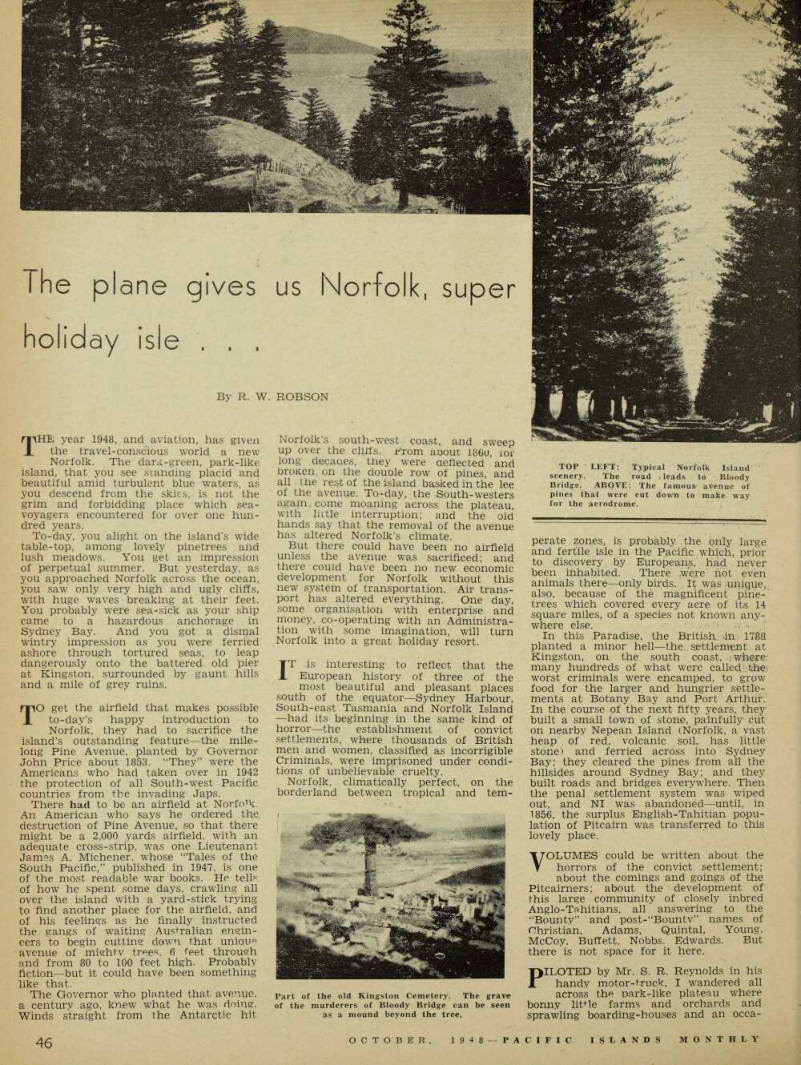
TO get the airfield that makes possible to-day’s happy introduction to Norfolk, they had to sacrifice the island’s outstanding feature—the mile long Pine Avenue, planted by Governor John Price about 1853. “They” were the Americans who had taken over in 1942 the protection of all South-west Pacific countries from the invading Japs.
There had to be an airfield at An American who says he ordered the, destruction of Pine Avenue, so that there might be a 2,000 yards airfield, with an adequate cross-strip, was one Lieutenant James A. Michener. whose “Tales of the South Pacific,” published in 1947, is one of the most readable war books. He tells, of how he spent some days, crawling all over the island with a yard-stick trying to find another place for the airfield, and of his feelings as he finally instructed the gangs of waiting Australian engin eers to begin cutting down that unique avenue of miehtv trees, 6 feet through and from 80 to 100 feet high. Probably fiction —but it could have been something like that.
The Governor who planted that avenue, a century ago, knew what he was doinsr.
Winds straight from the Antarctic hit
Norfolk’s south-west coast, and sweep up over the cliffs. Prom aoout IB6u, for long decaaes, they were deflected and broxen on the double row of pines, and all the rest of the island basked in the lee of the avenue. To-day, the South-westers again come moaning across, the plateau, with little interruption; and the old hands say that the removal of the avenue has altered Norfolk’s climate.
But there could have been no airfield unless the avenue was sacrificed; and there could have been no new economic development for Norfolk without this new system of transportation. Air trans port has altered everything. One day, some organisation with enterprise and money, co-operating with an Administra tion with some imagination, will turn Norfolk into a great holiday resort.
IT is interesting to reflect that the European history of three of the most beautiful and pleasant places south of the equator—Sydney Harbour, South-east Tasmania and Norfolk Island —had its beginning in the same kind of horror—the establishment of convict settlements, where thousands of British men and women, classified as incorrigible Criminals, were imprisoned under condi tions of unbelievable cruelty.
Norfolk, climatically perfect, on the borderland between tropical and tem-
perate zones, is probably the only large and fertile isle in the Pacific which, prior to discovery by Europeans, had never been inhabited. There were not even animals there—only birds. was ainjque, also, because of the magnificent pine-’ trees which covered every acre of its 14 square miles, of a species not known any where else.
In this Paradise, the British an 1788 planted a minor hell —the settlement at Kingston, on the south coast, - where; many hundreds of what were called the; worst criminals were encamped, to grow food for the larger and hungrier settle ments at Botany Bay and Port Arthur.
In the course of the next fifty years, they built a small town of stone, painfully cut on nearby Nepean Island (Norfolk, a vast heap of red, volcanic soil, has little stone) and ferried across into Sydney Bay; they cleared the pines from all the hillsides around Sydney Bay; and they built roads and bridges everywhere. Then the penal settlement system was wiped out, and NI was abandoned—until, in 1856, the surplus English-Tahitian popu lation of Pitcairn was transferred to this lovely place.
VOLUMES could be written about the horrors of the convict settlement; about the comings and goings of the Pitcairners: about the development of this large community of closely inbred Anglo-Tahitians, all answering to the “Bounty” and post-“Bountv” names of Ohristian, Adams, Quintal, Young, McCoy, Buffett, Nobbs. Edwards. But there is not space for it here.
PILOTED by Mr. S. R. Reynolds in his handy motor-truck. I wandered all across the nark-like plateau where bonny little farms and orchards and sprawling boarding-houses and an occa
Part of the old Kingston Cemetery. The grave of the murderers of Bloody Bridge can be seen as a mound beyond the tree.
TOP LEFT: Typical Norfolk Island scenery. The road leads to Bloody Bridge. ABOVE: The famous avenue of pines that were cut down to make way for the aerodrome.
sional store lay hidden among the pines and the masses of semi-tropical flora; and then I descended the steep hill into tree-less Sydney Bay, which seems to be a trap for every southerly wind. And, before I recognised my reaction to the grim, bleak place, I was shivering. This was Kingston, the original convict settle ment.
The settlement extends thinly for a mile along the low, flat shore—the only low, flat shore on Norfolk. It starts in the west, at the ancient stone pier, built with the blood and sweat and tears of two generations of wretched men, dead and forgotten these hundred years. It ends at a large mound, under a pine-tree, at the eastern side of the cemetery—and in this mound are the remains of a dozen convicts. They murdered their warders, and concealed the bodies among the stones, of a bridge they were building —you can see “Bloody Bridge” to-day.
They were seized, marched to the end of the cemetery, made to dig a huge hole; and then they were thoroughly and systematically executed, and buried in that hole. The pathetic mound, un marked, is just outside the cemetery’s official fence.
A large proportion of the old grey stone buildings are in ruins. But enough remain intact to supply Administration offices and provide the staff with quaint residences, erected in the fashion of George 111.
It is a melancholy, gloomy place, this Kingston. I am not imaginative; yet I swear that as I walked there, alone, after dusk, I could hear the sighing and occasional pitiful moan of those tor tured men who dragged out their lives here. Norfolk is a wonderfully pleasant trooical isle, cooled bv constant sea breezes and most lavishly endowed by Nature, free in an astonishing degree from pests end diseases. But he who knows only Kingston would never Nor folk know—for Kingston is a miserable, bleak and depressing hole.
THREE small sawmills are operating on the pine-frrees, which are scattered all over the island, and grow thickly in parts, especially in the north-west.
No one worries much about replacing the pines destroyed. The cones fall freely, and young pines seem, to spring up very quickly. * Sir Charles Rosenthal, while Administrator, tried to enforce a policy of planting a new pine for every one cut down—they called him “the pas sionate pine planter”—but that excellent plan has been forgotten. Mr. Wilson, the present Administrator, has been try ing to interest the islanders in the plant ing of hardwoods; but he, also, has not had much success.
Although the island still is very rich in pine-trees, which give it beauty and great distinction, one gets the impression that there are many fewer pines growing now than there were 50 years ago.
These pines, the invariable fatness and healthiness of the English cattle and horses, the absence of insect and plant pests, and of every kind of dead timber -911 these are features which make the Norfolk Island landscape unique.
NORFOLK may be surrounded by end less leagues of unfriendly sea; but there is compensation in the restless blue waters which make the island one of the hate-themes of mariners. There are two great schnanper-banks there, one north and one south of the island, and if vou can persuade the Islanders to co operate—they are marvellous boatmen —you will catch the world’s biggest schnapper—which also are among the world’s most edible fish.
There are good fish of all kinds in the seas around Norfolk, but the schnapper
that may be caught there are exceptional.
The line fisherman knows nothing better in the sea than big, fighting schnapper; and at Norfolk he will get that kind of schnapper, plus a lot of other pleasant things.
A Bout 1910, A
A medical man re sident in NX in troduced. for his garden, a pretty ornamental shrub. It was the deadly lan tana—known to all central and northern NSW coast dwellers as a No. 1 curse.
The NI lantana seems similar to the NSW plant, and it certainly behaves in the same way. It has crept steadily across a lot of NI land. The Adminis tration introduced a bug, with a view to destroying the plant, but the bug died out before it got really established. It was reintroduced about six months ago. and now seems to be do ing well. It feeds on lantana foliage and ultimately destroys the bush. If the bug is successful. NI can make a fortune out of selling healthy specimens to New South Wales.
QUEER fragments of the island’s tragic history are found in the ancient cemetery, in Kingston. The western end is of recent use, and seems to be full of headstones bearing only the name 0 of Christian, Quintal, McCoy, Evans.
Nobbs, and Buffett. But the western end is a small forest of weathered headstones more than 100 years old. Here are the inscriptions from two or three—there are scores like this: “William Tandy, private soldier in HM 58th Regiment, after long years of faith full servitude to Major Arnev, was acci dentally drouned in Emily Bay, Decem ber 31, 1815, aged 28.’’
“1842—James Saye who was to get 100 lashes for mutiny, died at 46 lashes.
Stop, stranger, stop and meditate On this man’s sad and awful fate; On earth no more he breathes again.
He lived in hope but died in pain.’’
“Sacred to the memory of Thos. Sauls bury Wright, native of Frodringham, Yorkshire, who died Feb. 17, 1843, aged 105. He survived 20 lashes when aged 95.’’
“Walter Burke, executed for mutiny, Sept. 22, 1834.”
THE most interesting Pitcairner on Norfolk Island was also the oldest— Captain Fletcher Quintal, aged 80, veteran of Boer War and World War I. a great grandson of the original Quintal pn d a grandson of the original Nobbs.
He was born on Norfolk in 1868.
He told me that, when the Pitcairners came in 1856, there were still a few ticket-of-leave men and some officers there, as caretakers. In his boyhood, Norfolk was thickly covered with pines,
and Phillip Island (now a bare pile of red clay) also was well wooded. There were even trees on Nepean Island, . , p JSfn f which ultimately turned Is ‘ a desert, were there when Us f ed Norfolk as pets; lt f w ? s an arr \f tbm f' they dld ndt u; et lo ° probab l y ’ Norfolk was saved because there were many wild cats’ on the island then. Inhere were also oaks growing on Norfolk 60 or 70 years ago— but they all gradually disappeared,
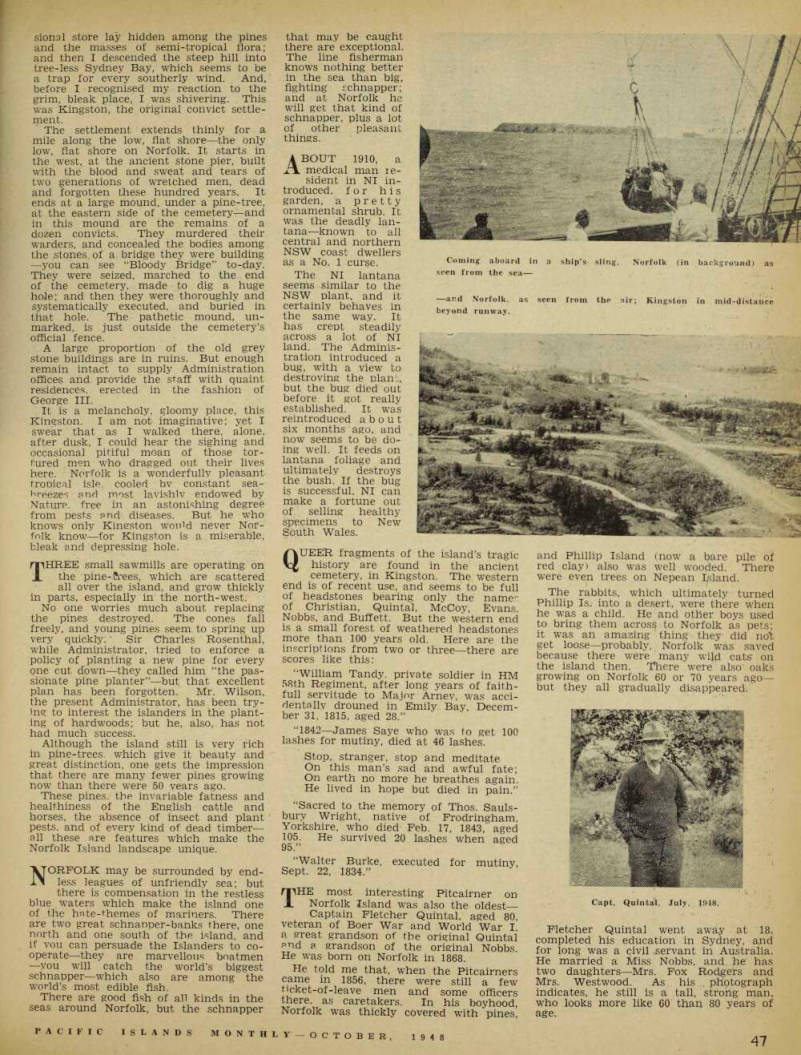
Fletcher Quintal went away at 18, completed his education in Sydney, and for long was a civil servant in Australia, He married a Miss Nobbs, and he has two daughters—Mrs, Fox Rodgers and Mrs. Westwood. As his . phptograph indicates, he still is a tall, strong man, who looks more like 60 than 80 years of age.
Coming aboard in a ship’s sling. Norfolk (in background) as seen from the sea— —and Norfolk, as seen from the air; Kingston in mid-distance beyond runway.
Capt. Quintal, July, 1948.