Bought By Australia-
p. 31 · Read in the full issue
Christmas Is.
Phosphate
NZ Interests
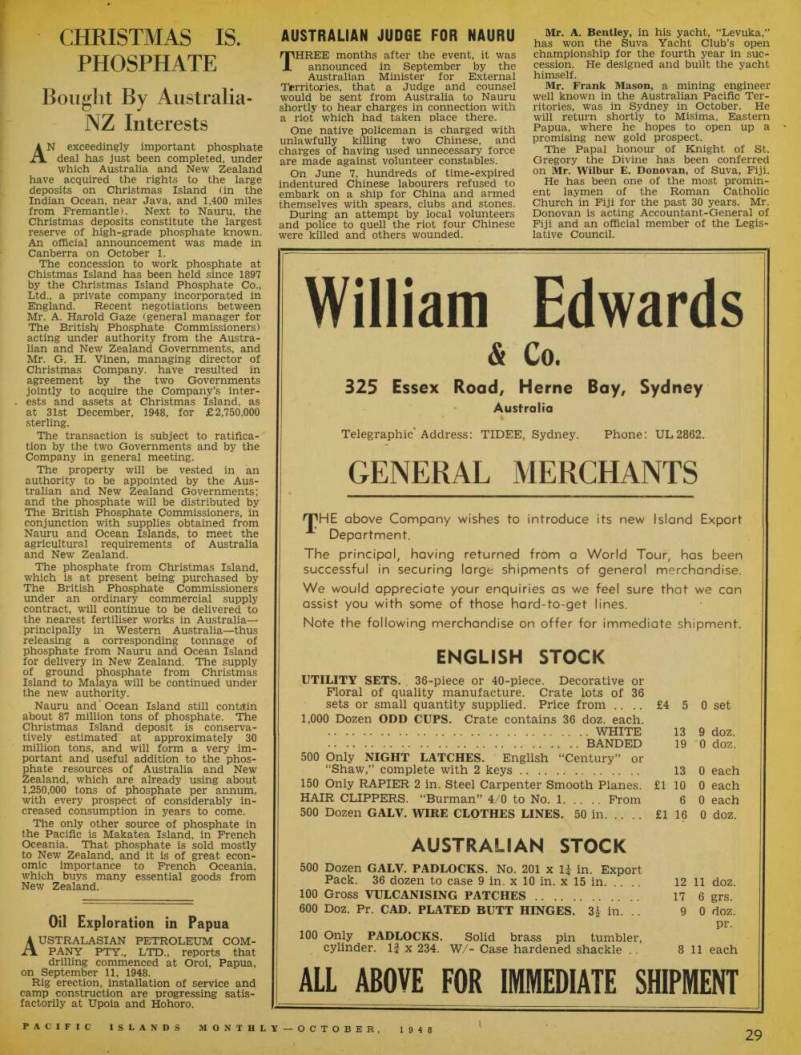
AN exceedingly important phosphate deal has just been completed, under which Australia and New Zealand have acquired the rights to the large deposits on Christmas Island (in the Indian Ocean, near Java, and 1,400 miles from Fremantle). Next to Nauru, the Christmas deposits constitute the largest reserve of high-grade phosphate known.
An official announcement was made in Canberra on October 1.
The concession to work phosphate at Chistmas Island has been held since 1897 by the Christmas Island Phosphate Co., Ltd., a private company incorporated in England. Recent negotiations between Mr. A. Harold Gaze (general manager for The British] Phosphate Commissioners) acting under authority from the Austra lian and New Zealand Governments, and Mr. G. H. Vinen, managing director of Christmas Company, have resulted in agreement by the two Governments jointly to acquire the Company’s inter ests and assets at Christmas Island, as at 31st December, 1948, for £2,750,000 sterling.
The transaction is subject to ratifica tion by the two Governments and by the Company in general meeting.
The property will be vested in an authority to be appointed by the Aus tralian and New Zealand Governments; and the phosphate will be distributed by The British Phosphate Commissioners, in conjunction with supplies obtained from Nauru and Ocean Islands, to meet the agricultural requirements of Australia and New Zealand.
The phosphate from Christmas Island, which is at present being purchased by The British Phosphate Commissioners under an ordinary commercial supply contract, will continue to be delivered to the nearest fertiliser works in Australia— principally in Western Australia —thus releasing a corresponding tonnage of phosphate from Nauru and Ocean Island for delivery in New Zealand. The supply of ground phosphate from Christmas Island to Malaya will be continued under the new authority.
Nauru and ’ Ocean Island still contain about 87 million tons of phosphate. The Christmas Island deposit is conserva tively estimated at approximately 30 million tons, and will form a very im portant and useful addition to the phos phate resources of Australia and New Zealand, which are already using about 1,250,000 tons of phosphate per annum, with every prospect of considerably in creased consumption in years to come.
The only other source of phosphate in the Pacific is Makatea Island, in French Oceania. That phosphate is sold mostly to New Zealand, and it is of great econ omic importance to French Oceania, which buys many essential goods from New Zealand.