Accidental Death of H
pp. 20-22 · Read in the full issue
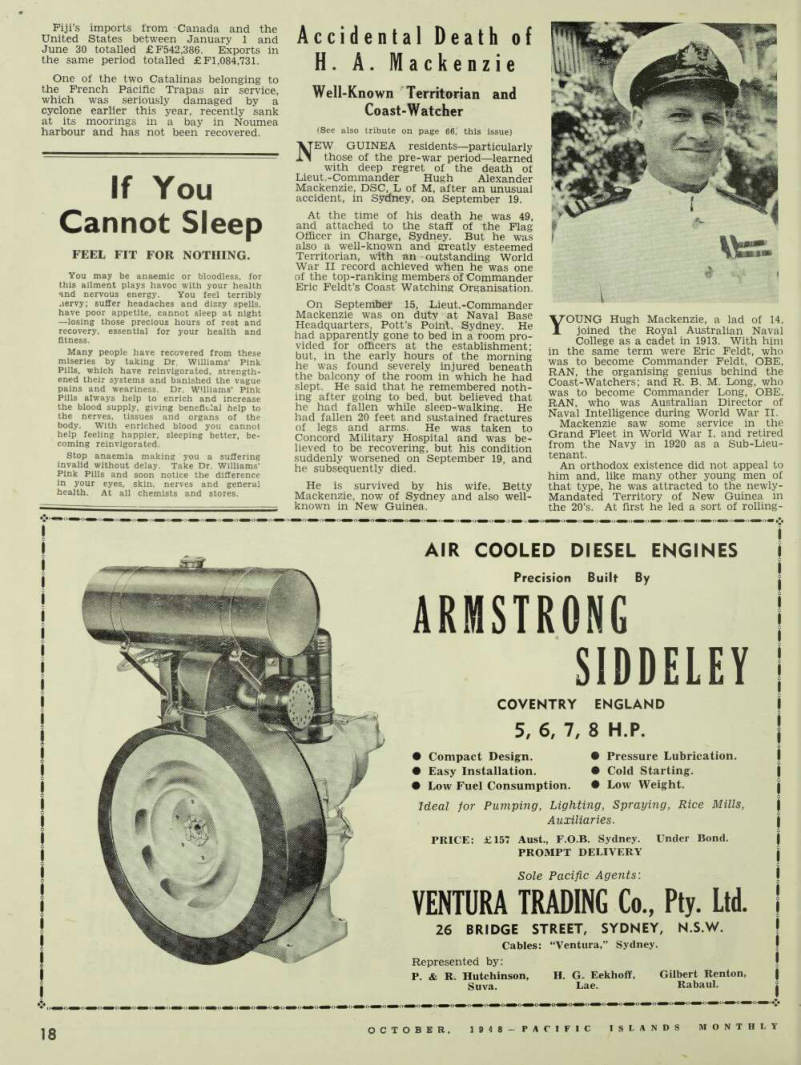

H. A. Mackenzie Well-Known Territorian and Coast-Watcher
(See also tribute on page 66, this issue)
NEW GUINEA residents—particularly
those of the pre-war period—learned with deep regret of the death of Lieut.-Commander Hugh Alexander Mackenzie, DSC, L of M, after an unusual accident, in Sydney, on September 19.
At the time of his death he was 49, and attached to the staff of the Flag Officer in Charge, Sydney. But he was also a well-known and greatly esteemed Territorian, with an outstanding World War II record achieved when he was one of the top-ranking members of Commander Eric Feldt’s Coast Watching Organisation.
On September 15, Lieut.-Commander Mackenzie was on duty at Naval Base Headquarters, Pott’s Point. Sydney. He had apparently gone to bed in a room pro vided for officers at the establishment; but, in the early hours of the morning he was found severely injured beneath the balcony of the room in which he had slept. He said that he remembered noth ing after going to bed. but believed that he had fallen while sleep-walking. He had fallen 20 feet and sustained fractures of legs and arms. He was taken to Concord Military Hospital and was be lieved to be recovering, but his condition suddenly worsened on September 19, and he subsequently died.
He is survived by his wife, Betty Mackenzie, now of Sydney and also well known in New Guinea.
YOUNG Hugh Mackenzie, a lad of 14, joined the Royal Australian Naval College as a cadet in 1913. With him in the same term were Eric Feldt, who was to become Commander Feldt, OBE, RAN, the organising genius behind the Coast-Watchers; and R. B. M. Long, who was to become Commander Long, OBE, RAN, who was Australian Director of Naval Intelligence during World War 11.
Mackenzie saw some service in the Grand Fleet in World War I. and retired from the Navy in 1920 as a Sub-Lieu tenant.
An orthodox existence did not appeal to him and, like many other young men of that type, he was attracted to the newly- Mandated Territory of New Guinea in the 20’s. At first he led a sort of rolling
stone existence—mostly in island schooners and in trading—then he settled down as a planter at Megigi, in the Talasea District of New Britain. He had a likeable personality and was held in high esteem by fellow Territorians. He later proved himself an able leader; a man other men would follow.
He was at Megigi when the Second World War began. In November, 1940, he was appointed assistant to Commander Feldt, head of the Coast Watchers, who then had his headquarters at Port Moresby. Feldt, in his book. “The Coast Watchers,” describes him as . . . “Conscientious and thorough in an unsystematic sort of way, and, occasionally, he would do something quite illogical.
He had none of the qualities of salesmanship or showmanship, whatsoever. In appearance he was of medium height, fair and sturdily built, looking, then, much younger than his 40 years.” ~«.,, , . . , Mackenzie s first task in his new job mon t v tlon when two Gerif H? n i OrS T-P n ? 6W i r^ and) ln . e " cernber, 1940, He was later appointed Naval Intelligence Officer, Rabaul, and he was there when the Japs landed in January, 1942. the subsequent evacuation he helped to save the lives of many who otherwise, out of sheer mexperience, would have perished in the New Britain push, When the retreat began from Rabaul, he collected his small Naval party and drove them to the end of the Toma Road; from there it was a matter of taking to the jungle. Realising that they would have to fend for themselves he gave orders that the teleradio should be destroyed so that the party of 10 would be, as far as possible, unencumbered. He gave them their choice—they could remam with him, under his leadership, or, unprepared for what lay ahead, rush off
with the troops still streaming by. To a man they elected to stay under his guid ance and, with his example, they re mained, in the midst of chaos, calmly preparing for the hardships of the journey, While they were preparing food-packs they were joined by a military party which included Lieutenant P. Figgis, Mil itary Intelligence Officer of Rabaul Force.
Th ey travelled together, following the native pads, up mountain slopes, through dripping jungles. Ahead of them mex-eri enced troops blundered on, some to fall out by the roadside to perish; some into the hands of the Japanese, to be massacred at Tol. m atviwxjtt T jV/fEANWHILE, J. K. McCarthy was organising an escape route along . the north coast of the island, roundm £ up the desperate, despondent troops .with the help of worthy assistants, bullying and cajoling them, by stages to Talasea. When McCarthy learned that some troops had escaped by the southern ro ute he despatched a* timber-man, Frank Holland, to the South Coast, to contact them. Holland walked day and night across New Britain’s central mountains reac h these men. When Mackenzie received McCarthy’s message, he sent his party back with the indomitable Holland b U t decided to stay himself to assist those troops who were too far away to take part j n McCarthy’s evacuation plans.
Figgis remained with Mackenzie.
McCarthy finally commandeered the small Burns Philp ship “Lakatoi,” which was hiding in Witu fiom the Japs, and got his troops, and those' who had come back with Holland, safely away to Aus tralia. a signal was sent to Port Moresby stating that more troops (Mackenzie’s Party) were on New Britain’s south coast, near Palmaimal, and Lieutenant Ivan Champion, in the “Laurabada,” sneaked across from the Trobiands and took them
off— ls 3 evacuees who safely reached Aus tralia in due course.
AFTER leave and a short period in headquarters in Townsville, Mackenzie was sent to Noumea as Deputy Super vising Intelligence Officer (SOPAC) Forces,
and he later moved on to Vila and !BSI where, on Guadalcanal, he established a radio station just seven days after the uS Marines had landed.
This station was to pick up warnings of Jap movements from Coast-Watchers further north (particularly from Paul Mason and W. J. Read, in Bougainville ) and pass them on to the forces on the spot. The radio post was first established in a captured Jap dug-out, a mere hole in the ground, at the edge of the air field. Here Mackenzie and his assistants spent their time in rain, mud and acute misery; but they had the satisfaction of knowing that the post rapidly became the pivot on which the Solomons campaign swung—the field headquarters to which, at one time, 11 Coast-Watchers in the Solomons were sending reports.
Due to speedy dispersal of messages, which this arrangement allowed, the US forces were warned of impending Jap at tacks hours before the Jap’s Rabaul based planes could reach Guadalcanal.
During this time, Mackenzie was in strumental in rescuing F. A. Rhoades and L. Schroeder, who were at dangerous coast-watching posts on North-west Guadalcanal and whose position, due to the landing in the vicinity of Jap rein forcements, was becoming untenable.
Mackenzie sent a launch to their aid and took off, as well, 13 missionaries and one shot-down American airman. For this independent action he earned the dis pleasure of General Vandegrift, of the US Corps of Marines, whole sole purpose was to hold the perimeter established by his Marines near Henderson Field and who, for some reason of his own. appeared to consider Rhoades and Schroeder “expend able.”
During the heavy bombardments that preceded the Jap attempt to recapture
Guadalcanal in October, 1942, Mackenzie and his staff had many narrow escapes from death; and some did not escape.
But during that time of activity Mackenzie’ was organising fresh coast watching posts, particularly on Vella La Vella, Choiseul and in the Russell Group.
Ater the failure of the Japanese to re capture Guadalcanal and after he had been in the thick of things for many months, Mackenzie visited Vila and Noumea, where he met Admiral Halsey, who expressed his admiration of the job being done by the Coast-Watchers.
Mackenzie was, about the same time, pro moted to acting Lieut.-Commander; and when Feldt became ill in March. 1943, Mackenzie appeared to be his logical suc cessor as Supervising Intelligence Officer.
Mackenzie arrived in Sydney on leave in May, 1943, but during it he developed blackwater fever and for many weeks had to fight for his life. In the meantime, Lieut.-Commander J. C. McManus was appointed SIO.
For his work in the Solomons. Mackenzie was awarded the US Legion of Merit.
Mr. J. P. Barron, who has been appointed Executive Engineer to the Fiji Public Works Department, recently arrived in the Colony. * * * Recent news of Dr. and Mrs. A. G.
Rutter, who left the BSI early in the year, is that they are living in Middlesex, England, while Dr. Rutter takes a post graduate course at Hammersmith Hos pital. Dr. Rutter went to the BSI as medical superintendent for the Methodist Mission in the 1930’s and in 1944 he be came chief medical officer of the BSI ad ministration.