Minor Official Revolt Reported
p. 12 · Read in the full issue
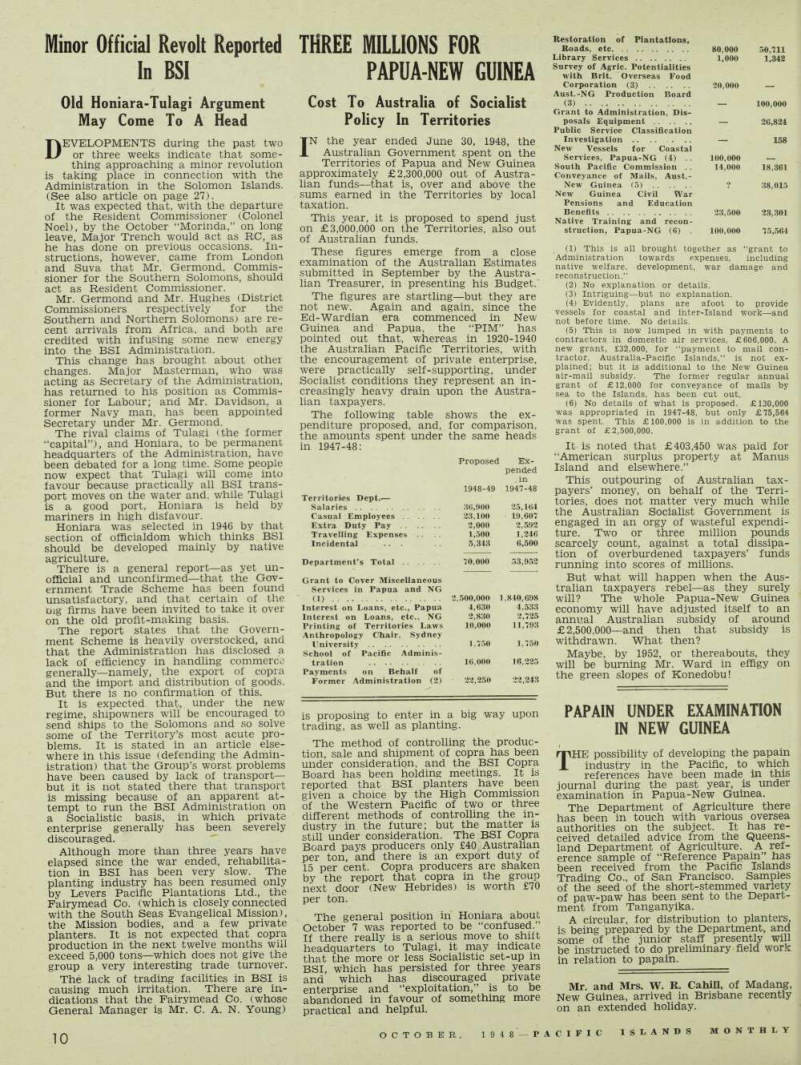
In Bsi
Old Honiara-Tulagi Argument May Come To A Head
Developments during the past two or three weeks indicate that some thing approaching a minor revolution is taking place in connection with the Administration in the Solomon Islands. (See also article on page 27).
It was expected that, with the departure of the Resident Commissioner (Colonel Noel), by the October “Morinda,” on long leave, Major Trench would act as RC, as he has done on previous occasions. In structions, however, came from London and Suva that Mr. Germond, Commis sioner for the Southern Solomons, should act as Resident Commissioner.
Mr. Germond and Mr. Hughes (District Commissioners respectively for the Southern and Northern Solomons) are re cent arrivals from Africa, and both are credited with infusing some new energy into the BSI Administration.
This change has brought about other changes. Major Masterman, who was acting as Secretary of the Administration, has returned to his position as Commis sioner for Labour; and Mr. Davidson, a former Navy man, has been appointed Secretary under Mr. Germond.
The rival claims of Tulagi (the former “capital”), and Honiara, to be permanent headquarters of the Administration, have been debated for a long time. Some people now expect that Tulagi will come into favour because practically all BSI trans port moves on the water and. while Tulagi is a good port, Honiara is held by mariners in high disfavour.
Honiara was selected in 1946 by that section of officialdom which thinks BSI should be developed mainly by native agriculture.
There is a general report—as yet un official and unconfirmed —that the Gov ernment Trade Scheme has been found unsatisfactory, and that certain of the Dig firms have been invited to take it over on the old profit-making basis.
The report states that the Govern ment Scheme is heavily overstocked, and that the Administration has disclosed a lack of efficiency in handling commerce generally—namely, the export of copra and the import and distribution of goods.
But there is no confirmation of this.
It is expected that, under the new regime, shipowners will be encouraged to send ships to the Solomons and so solve some of the Territory’s most acute pro blems. It is stated in an article else where in this issue (defending the Admin istration) that the Group’s worst problems have been caused by lack of transport— but it is not stated there that transport is missing because of an apparent at tempt to run the BSI Administration on a Socialistic basis, in which private enterprise generally has been severely discouraged.
Although more than three years have elapsed since the war ended, rehabilita tion in BSI has been very slow. The planting industry has been resumed only by Levers Pacific Plantations Ltd., the Fairymead Co. (which is closely connected with the South Seas Evangelical Mission), the Mission bodies, and a few private planters. It is not expected that copra production in the next twelve months will exceed 5,000 tons—which does not give the group a very interesting trade turnover.
The lack of trading facilities in BSI is causing much irritation. There are in dications that the Fairymead Co, (whose General Manager is Mr. C. A. N. Young)
is proposing to enter in a big way upon trading, as well as planting.
The method of controlling the produc tion, sale and shipment of copra has been under consideration, and the BSI Copra Board has been holding meetings. It is reported that BSI planters have been given a choice by the High Commission of the Western Pacific of two or three different methods of controlling the in dustry in the future; but the matter is still under consideration. The BSI Copra Board pays producers only £4O Australian per ton, and there is an export duty of 15 per cent. Copra producers are shaken by the report that copra in the group next door (New Hebrides) is worth £7O per ton.
The general position in Honiara about October 7 was reported to be “confused.”
If there really is a serious move to shift headquarters to Tulagi, it may indicate that the more or less Socialistic set-up in BSI, which has persisted for three years and which has discouraged private enterprise and “exploitation,” is to be abandoned in favour of something more practical and helpful.