In The South Pacific
pp. 7-8 · Read in the full issue
No 'Little India' Will Be Tolerated In The South Pacific
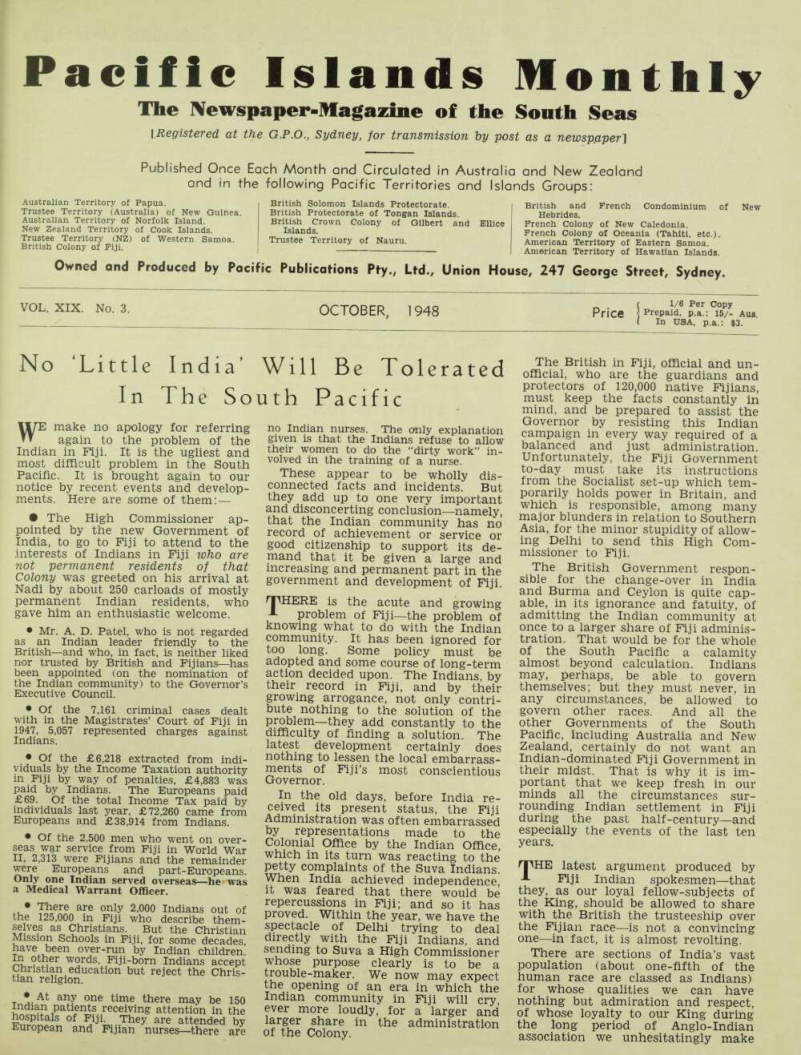
WE make no apology for referring again to the problem of the Indian in Fiji. It is the ugliest and most difficult problem in the South Pacific. It is brought again to our notice by recent events and develop ments. Here are some of them:— • The High Commissioner ap pointed by the new Government of India, to go to Fiji to attend to the .interests of Indians in Fiji who are not permanent residents of that Colony was greeted on his arrival at Nadi by about 250 carloads of mostly permanent Indian residents, who gave him an enthusiastic welcome. • Mr. A. D. Patel, who is not regarded as an Indian leader friendly to the British—and who, in fact, is neither liked nor trusted by British and Fijians—has been appointed (on the nomination of the Indian community) to the Governor’s Executive Council. • Of the 7,161 criminal cases dealt with in the Magistrates’ Court of Fiji in 1947, 5,057 represented charges against Indians. • Of the £6,218 extracted from indi viduals by the Income Taxation authority in Fiji by way of penalties, £4,883 was paid by Indians. The Europeans paid £69. Of the total Income Tax paid by individuals last year, £72,260 came from Europeans and £38,914 from Indians. • Of the 2,500 men who went on over seas war service from Fiji in World War 11, 2,313 were Fijians and the remainder were Europeans and part-Europeans.
Only one Indian served overseas—he was a Medical Warrant Officer. • There are only 2,000 Indians out of the 125,000 in Fiji who describe them selves as Christians. But the Christian Mission Schools in Fiji, for some decades, have been over-run by Indian children, in (Hher words, Fiji-born Indians accept Christian education but reject the Chris tian religion. • At any one time there may be 150 Indian patients receiving attention in the hospitals of Fiji. They are attended by European and Fijian nurses—there are
no Indian nurses. The only explanation given is that the Indians refuse to allow their women to do the “dirty work” in volved in the training of a nurse.
These appear to be wholly dis connected facts and incidents. But they add up to one very important and disconcerting conclusion—namely, that the Indian community has no record of achievement or service or good citizenship to support its de mand that it be given a large and increasing and permanent part in the government and development of Fiji. fpiHERE is the acute and growing A problem of Fiji—the problem of knowing what to do with the Indian community. It has been ignored for too long. Some policy must be adopted and some course of long-term action decided upon. The Indians, by their record in Fiji, and by their growing arrogance, not only contri bute nothing to the solution of the problem—they add constantly to the difficulty of finding a solution. The latest development certainly does nothing to lessen the local embarrass ments of Fiji’s most conscientious Governor.
In the old days, before India re ceived its present status, the Fiji Administration was often embarrassed by representations made to the Colonial Office by the Indian Office, which in its turn was reacting to the petty complaints of the Suva Indians.
When India achieved independence, it was feared that there would be repercussions in Fiji; and so it has proved. Within the year, we have the spectacle of Delhi trying to deal directly with the Fiji Indians, and sending to Suva a High Commissioner whose purpose clearly is to be a trouble-maker. We now may expect the opening of an era in which the Indian community in Fiji will cry, ever more loudly, for a larger and larger share in the administration of the Colony.
The British in Fiji, official and un official, who are the guardians and protectors of 120,000 native Fijians, must keep the facts constantly in mind, and be prepared to assist the Governor by resisting this Indian campaign in every way required of a balanced and just administration.
Unfortunately, the Fiji Government to-day must take its instructions from the Socialist set-up which tem porarily holds power in Britain, and which is responsible, among many major blunders in relation to Southern Asia, for the minor stupidity of allow ing Delhi to send this High Com missioner to Fiji.
The British Government respon sible for the change-over in India and Burma and Ceylon is quite cap able, in its ignorance and fatuity, of admitting the Indian community at once to a larger share of Fiji adminis tration. That would be for the whole of the South Pacific a calamity almost beyond calculation. Indians may, perhaps, be able to govern themselves; but they must never, in any circumstances, be allowed to govern other races. And all the other Governments of the South Pacific, including Australia and New Zealand, certainly do not want an Indian-dominated Fiji Government in their midst. That is why it is im portant that we keep fresh in our minds all the circumstances sur rounding Indian settlement in Fiji during the past half-century—and especially the events of the last ten years.
T'HE latest argument produced by A Fiji Indian spokesmen—that they, as our loyal fellow-subjects of the King, should be allowed to share with the British the trusteeship over the Fijian race—is not a convincing one—in fact, it is almost revolting.
There are sections of India’s vast population (about one-fifth of the human race are classed as Indians) for whose qualities we can have nothing but admiration and respect, of whose loyalty to our King during the long period of Anglo-Indian association we unhesitatingly make
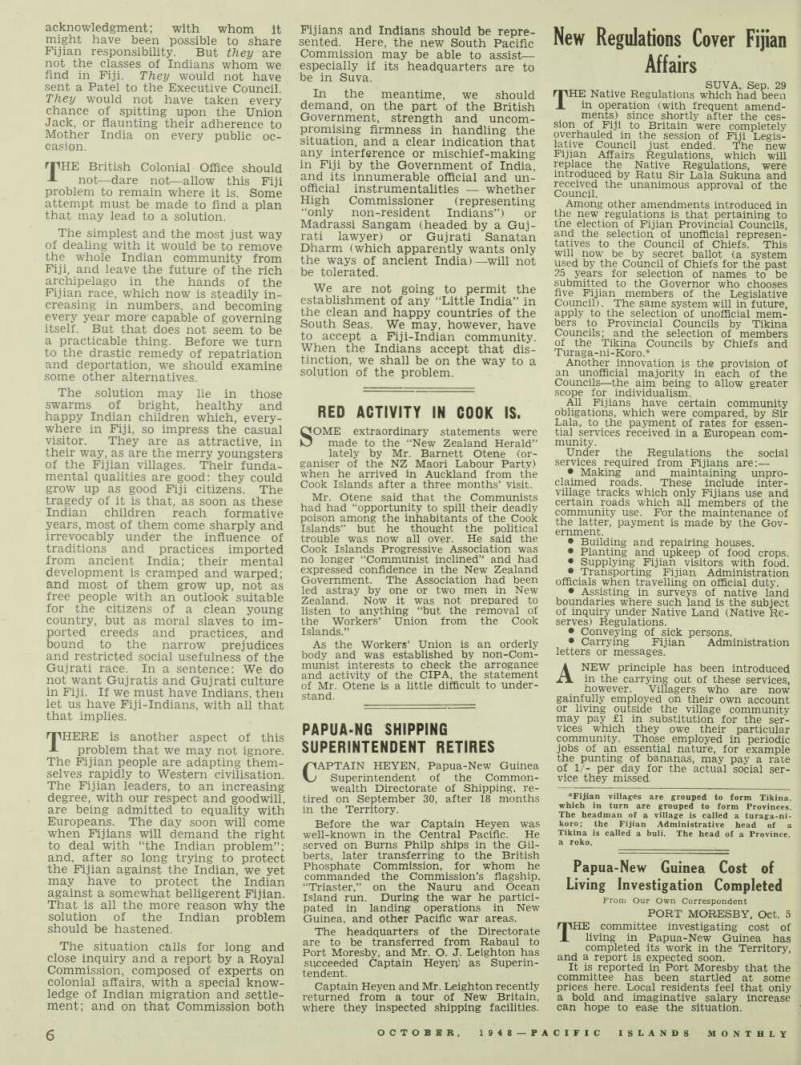
acknowledgment; with whom it might have been possible to share Fijian responsibility. But they are not the classes of Indians whom we find in Fiji. They would not have sent a Patel to the Executive Council.
They would not have taken every chance of spitting upon the Union Jack, or flaunting their adherence to Mother India on every public oc casion.
British Colonial Office should A not—dare not—allow this Fiji problem to remain where it is. Some attempt must be made to find a plan that may lead to a solution.
The simplest and the most just way of dealing with it would be to remove the whole Indian community from Fiji, and leave the future of the rich archipelago in the hands of the Fijian race, which now is steadily in creasing in numbers, and becoming every year more capable of governing itself. But that does not seem to be a practicable thing. Before we turn to the drastic remedy of repatriation and deportation, we should examine some other alternatives.
The solution may lie in those swarms of bright, healthy and happy Indian children which, every where in Fiji, so impress the casual visitor. They are as attractive, in their way, as are the merry youngsters of the Fijian villages. Their funda mental qualities are good: they could grow up as good Fiji citizens. The tragedy of it is that, as soon as these Indian children reach formative years, most of them come sharply and irrevocably under the influence of traditions and practices imported from ancient India; their mental development is cramped and warped; and most of them grow up, not as free people with an outlook suitable for the citizens of a clean young country, but as moral slaves to im ported creeds and practices, and bound to the narrow prejudices and restricted social usefulness of the Gujrati race. In a sentence: We do not want Gujratis and Gujrati culture in Fiji. If we must have Indians, then let us have Fiji-Indians, with all that that implies.
THERE is another aspect of this problem that we may not ignore.
The Fijian people are adapting them selves rapidly to Western civilisation.
The Fijian leaders, to an increasing degree, with our respect and goodwill, are being admitted to equality with Europeans. The day soon will come when Fijians will demand the right to deal with “the Indian problem”; and, after so long trying to protect the Fijian against the Indian, we yet may have to protect the Indian against a somewhat belligerent Fijian.
That is all the more reason why the solution of the Indian problem should be hastened.
The situation calls for long and close inquiry and a report by a Royal Commission, composed of experts on colonial affairs, with a special know ledge of Indian migration and settle ment; and on that Commission both
Fijians and Indians should be repre sented. Here, the new South Pacific Commission may be able to assist— especially if its headquarters are to be in Suva.
In the meantime, we should demand, on the part of the British Government, strength and uncom promising firmness in handling the situation, and a clear indication that any interference or mischief-making in Fiji by the Government of India, and its innumerable official and un official instrumentalities whether High Commissioner (representing “only non-resident Indians”) or Madrassi Sangam (headed by a Guj rati lawyer) or Gujrati Sanatan Dharm (which apparently wants only the ways of ancient India)—will not be tolerated.
We are not going to permit the establishment of any “Little India” in the clean and happy countries of the South Seas. We may, however, have to accept a Fiji-Indian community.
When the Indians accept that dis tinction, we shall be on the way to a solution of the problem.